


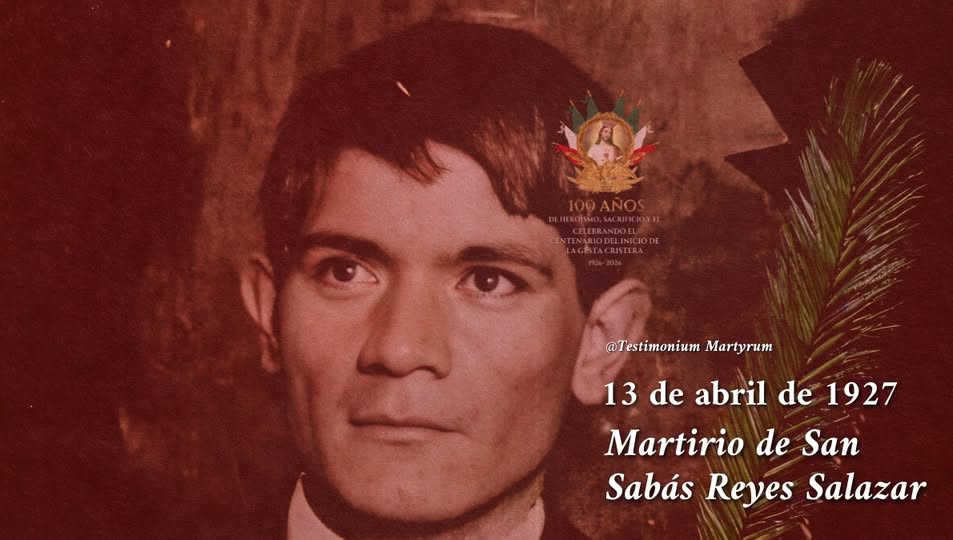
The bishop of Cuernavaca and president of the Mexican Episcopal Conference, Ramón Castro Castro, has launched a new season of catechesis entitled “Witnesses of the Kingdom”. The series, broadcast through his official channels and those of the CEM itself, is set in the context of the centenary of the institution of the feast of Christ the King by Pope Pius XI and seeks to offer the faithful a profound reflection on the Christian meaning of martyrdom and perseverance in the faith.
The initiative is not a mere exercise in historical memory. As the prelate himself has emphasized from the first installment, the Church “does not celebrate its martyrs to feed nostalgia or to wave banners,” but because in them it contemplates “made flesh in Mexican life, the only truth that sustains our faith: that death does not have the last word and that life in Christ is stronger than any threat.”
The first catechesis begins with a decisive historical fact. Exactly one century ago, on December 11, 1925, Pius XI published the encyclical Quas Primas, by which he instituted the solemnity of Christ the King. Only seven months later, one of the most violent religious persecutions of the twentieth century would break out in Mexico. In that land “soaked for four centuries by the presence of Our Lady of Guadalupe,” the cry “¡Viva Cristo Rey y Santa María de Guadalupe!” became the rallying cry of resistance for a people who refused to accept the imposition of a State that sought to erase public faith.
From this framework, Castro pauses on the etymology and theological meaning of the word “martyr.” “The word martyr does not mean what many believe. It does not mean hero, it does not mean soldier, it does not mean fanatic. It simply means witness.” In the Greek of the New Testament, mártir designates one who has seen something and can therefore give testimony in a trial. The Christian is, by definition, a witness to the risen Christ. Jesus’ last words before the Ascension, recorded by Luke, make this clear: “You will receive the power of the Holy Spirit… and you will be my witnesses in Jerusalem, in all Judea, in Samaria, and to the ends of the earth” (Acts 1:8). “They will be my martyrs,” could be translated: “they will be those who have seen and therefore cannot remain silent.”
The first Christian martyr, the deacon Stephen, stoned around the year 35, sums up in his final words the three traits that will mark the entire martyrial tradition: trust in the Lord (“Lord Jesus, receive my spirit”), forgiveness of the executioners (“Lord, do not hold this sin against them”), and a peaceful death (“when he had said this, he fell asleep in the Lord”). Since then, every generation of Christians has known this same pattern. Tertullian, around the year 197, summarized it in the phrase that has echoed for two millennia: “Semen est sanguis christianorum”—the blood of Christians is seed.
The second catechesis develops the founding paradox of the Church’s history: “where a martyr fell, many Christians sprang up.” The Church grows precisely where its witnesses are “harvested.” And it does not forget them. From the second century onward, the names of the martyrs were recorded in the martyrologies. St. Ignatius of Antioch, on his way to martyrdom around the year 110, wrote to the Christians of Rome: “I am the wheat of God; let me be ground by the teeth of the beasts to become pure bread of Christ.”
The first universal calendar is attributed to St. Jerome; the best-known Roman Martyrology was compiled by Cardinal Cesare Baronio in 1584, and the most recent major edition was promulgated by St. John Paul II in 2004. “Behind every name in the martyrology lies a concrete life,” the bishop recalls. “A name written there is a name the Church will never forget.” That is why relics of martyrs are preserved in every altar of every Catholic parish in the world: the Mass is celebrated upon them. “The entire Church is built upon its witnesses.”
St. Thomas Aquinas, in the thirteenth century, offered the classic definition: martyrdom is actus maximi perfectionis caritatis, the most perfect act of charity, because in it the Christian offers to God the greatest good he possesses: his own life. And he offers it while forgiving the executioner. Here Castro introduces a distinction he considers essential: “The Christian martyr is absolutely distinct from the terrorist, the fanatic, the kamikaze. The Christian martyr gives his life; he does not take another’s; he forgives, he does not hate; he dies so that others may live. The terrorist seeks the destruction of the adversary. The distinction is absolute.” As Pope Benedict XVI expressed it, “the martyr is not a fanatic, but a man transformed by the love of God.”
The third catechesis descends from doctrine to the concrete flesh of a Mexican saint. St. Sabás Reyes Salazar (1883-1927), vicar of Tototlán, Jalisco, is presented as a “martyr of perseverance.” Born in Cocula, Jalisco, he cultivated a deep devotion to the Most Holy Trinity. When the persecution reached his town, he could have fled, but he refused to “leave his people without the sacraments.” He was tied to a column for three days without water or food; his palms were burned—the very hands that had been anointed to consecrate—and he was finally shot on April 12, 1927. He did not say what they demanded. He persevered to his last breath.
Castro insists that Sabás’s strength “was not hardness of character, but grace.” Final perseverance, remaining faithful to the very last moment, “is not an achievement of the will; it is a gift God grants to those who abandon themselves into his hands.” In him the promise of Jesus is fulfilled: “Whoever acknowledges me before others, I also will acknowledge before my Father.” The Church, in declaring him a saint, merely recognized one whom Christ had already recognized.
The prelate updates the testimony of this Jalisco priest with a direct reference to recent magisterium: “Pope Leo XIV, in Magnifica Humanitas, asks us to remain faithful to the truth in a persevering way in an age of fragile fidelities and short-term commitments, where everything seems provisional and irrevocable.” St. Sabás, he affirms, “cries out to us that true love is not an impulse that lasts as long as enthusiasm lasts; it is a decision that holds firm when it costs.” The decisive question is not whether one begins well, but whether one remains: “in prayer when it grows cold, in marriage when it weighs heavy, in the word given when no one is watching. Because the crown is not promised to the one who starts with strength, but to the one who perseveres to the end.”
The series “Witnesses of the Kingdom” does not end with the commemoration of a glorious past. It is “an act of grateful memory and at the same time a proposal for today’s disciple.” In an ecclesial and social context marked by the fragility of commitments, the temptation to silence, and the erosion of convictions, the bishop of Cuernavaca proposes recovering the figure of the martyr not as a distant hero, but as the ordinary witness who, having encountered Christ, cannot remain silent.
The first three installments, available on the CEM’s YouTube channels and social media, outline a clear itinerary: from the original meaning of martyrdom as testimony, to the ecclesial memory that safeguards it, and finally to the concrete incarnation of that fidelity in a twentieth-century Mexican priest. The horizon is the same as that of Jesus’ priestly prayer: “I pray for them… that they may be one, as we are one” (Jn 17).
At the conclusion of the third catechesis, Ramón Castro Castro invokes the intercession of St. Sabás Reyes Salazar and closes with the cry that united the Mexican martyrs nearly a century ago and that continues to resound in the conscience of the Church in Mexico: “¡Viva Cristo Rey y Santa María de Guadalupe!”.
The catecheses can be consulted at the following links:
First installment: https://www.youtube.com/watch?v=DL3nwG8FKd4
Second installment: https://www.youtube.com/watch?v=No6Yeida5Lg
Third installment: https://www.youtube.com/watch?v=nxwKkQF6JaM