


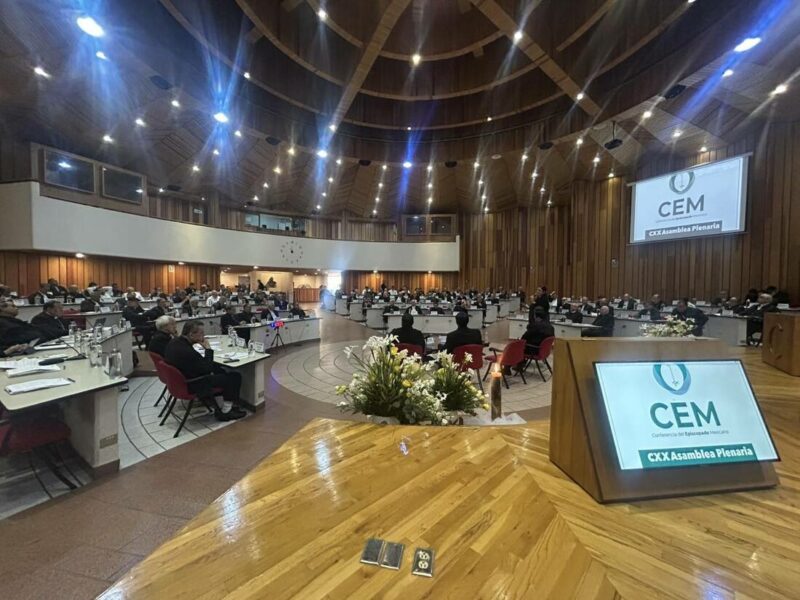
Upon concluding its 120th Plenary Assembly, held from April 13 to 17, 2026, the Mexican Episcopal Conference (CEM) addressed a message to the People of God in which, once again, it presents itself as the Church of the Risen One. The bishops invite us to “receive the peace of the Risen One, which renews our hearts and impels us to walk in hope”. In a hopeful and paschal tone, they renew their commitment to dialogue with the new realities of the country, strengthen a synodal vocational culture, and contribute to the construction of peace and fraternity. They explicitly recognize that “the vocation that God has sown in every heart” is not the exclusive patrimony of the consecrated, but a universal call that reaches laypeople, youth, and every baptized person to transform society from love and the common good.
In the midst of a context marked by “contexts of war, hardened hearts, and threatened peoples”, the shepherds insist that “to remain silent in the face of insecurity is to betray the Gospel” and warn that “normalizing violence corrupts hope”. They reiterate, as in previous messages, their concern for the violence that tears the social fabric and call upon the entire society to work for reconciliation and peace. In the Paschal [season], it is no small gesture to remember that peace is not built “with weapons or empty speeches” and to appeal to the commandment of love as the path to heal wounds.
However, precisely because of the gravity of our situation, this message leaves a taste of insufficiency. Once again, the Episcopate states a problem that society already knows all too well—the insecurity, the violence, the corruption of the social fabric—without specifying the concrete spiritual consequences faced by a people immersed in this crisis.
It is a real risk: That the episcopal messages become predictable repetitions, a press pastoral that denounces without delving deeper, that alerts without demanding. Mexico is not facing a mere “social problem”; it faces a deep wound that sinks to touch vital organs, has destroyed lives, families, and entire communities. The consequences are not only material, but also spiritual. The normalization of death, the idolatry of power and money, the indifference to others’ suffering, corrode hope and, above all, close the heart to redemptive grace.
In the face of this reality, greater forcefulness is required. It is not enough to state concerns; it is necessary to assume that Mexico’s situation demands equally grave reparations for the damages caused to the social body. The Church, which in its tradition has promoted “medicinal” sanctions for fraternal correction and the salvation of souls, has clear precedents of prophetic firmness. In their time, the bishops of Cuernavaca Luis Reynoso and Sergio Méndez Arceo applied the penalty of excommunication to torturers and kidnappers, recognizing that certain behaviors gravely break ecclesial communion and demand a clear response from pastoral authority.
It is not about turning the Church into a political actor, but about exercising its prophetic mission, warning clearly those who do evil—criminals, hitmen, corrupt politicians, nepotistic and authoritarian political parties—that their behaviors have very serious spiritual consequences. Such actions already prevent them, as long as they persist without repentance, from the benefits of salvation and redemption. Excommunication is not a vindictive punishment, but a bitter but necessary medicine to awaken hardened consciences.
We recognize the sincere concern of the bishops. Their voice is important for millions of Mexicans who suffer violence, but precisely because of that accompaniment, it is necessary to express firmly what we have upon us, building peace is denouncing and sanctioning, consoling and repairing. The Church of the Risen One cannot settle for repeating diagnoses; it must announce clearly that evil has a name, a face, and eternal consequences. Only then will its message not be mere pious hope, but leaven that truly transforms the Mexican reality toward true reconciliation. We already know what we suffer; we need to heal, no matter how bitter the medicine.