


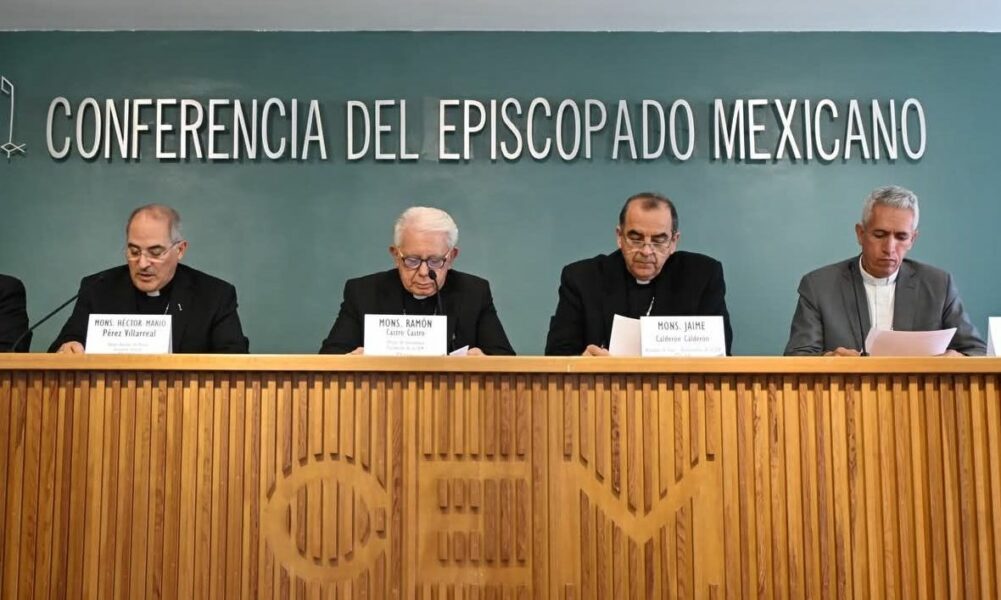
Upon concluding their CXX Plenary Assembly, the bishops of the Mexican Episcopal Conference (CEM) delivered to the People of God a message of paschal hope without evading the harshness of the national reality. In the document titled Message to the People of God, the prelates denounce the “slow erosion of institutions in our homeland”, the “gradual collapse of the world order” and, above all, the “insecurity situation” that continues to mark the daily life of millions of Mexicans.
The text, presented at a press conference by the president of the CEM, Ramón Castro Castro, bishop of Cuernavaca, and the general secretary, Héctor M. Pérez Villarreal, auxiliary bishop of Mexico, was accompanied by a dialogue with journalists. There, the bishops insisted on a phrase that summarizes their stance: “We must not hide the pain that hurts us, but neither should we stop living the fraternity and hospitality that characterize us”.
The message arrives during Easter time when the Church celebrates the victory of life over death, but the bishops recognize that, in Mexico, that victory is still lived amid tears. “To remain silent in the face of insecurity is to betray the Gospel”, they affirm with conviction. They recall the “events of last February” —without detailing them— as an expression of a violence that “not only destroys lives, it corrupts hope”. A country that “normalizes death loses life”, they emphasize.
This denunciation is not new in the Mexican episcopate, but it gains greater force by linking it to the global context. While the bishops were in session, Pope Leo XIV was beginning his apostolic journey to Africa as a “pilgrim of peace”. From Algiers, the Pontiff cried out: “Let us multiply the oases of peace, denounce and eliminate the causes of despair, fight against those who profit from others’ misfortune!”. Words that, according to the bishops, “resound with particular force in our Mexican reality”.
At the press conference, the prelates delved deeper into the drama of forced disappearances, an “open wound” that the Church accompanies closely. “It is not about numbers, but about pastoral experience”, they explained. They have been with the searching mothers and grieving families. “We are in favor of a truth that brings justice and dignified care for the families”, they reiterated. To the mothers of the disappeared, they sent a direct message: “We are here to continue accompanying them in this pain that they will carry to the end”. They invited looking to the Virgin Mary as a model of strength.
The bishops rejected any attempt to politicize their word. Their mission, they clarified, is not partisan, but it does have “an irrenounceable social dimension”: to announce the Gospel, denounce what attacks human dignity, and accompany people in their concrete reality. “Christian faith cannot be spiritualistic”, they insisted. Regarding the relationship with the federal government, they pointed out that there is a “cordial and open” dialogue, mainly through the Secretariat of the Interior, focused on issues of peace and care for victims, although they have not held direct meetings with the Presidency.
Another axis of the message is the Cristero memory, whose centenary is celebrated this year. Far from turning it into a banner of confrontation, the bishops present it as a “testimony of faith” of thousands who gave their lives for religious freedom “with courage and fidelity”. “It is not a memory of confrontation, it is remembered with gratitude, not to divide, but to learn and build”, they affirm.
The text also highlights the value of each person and the relevance of vocation. It is not only about priestly ministry or consecrated life, but about the personal call that God addresses to each baptized to participate in society “from their state of life and their charisms”. Youth, in particular, seek “to give meaning to their life from faith” and need “listening and accompaniment with concrete language”.
In a hopeful tone, the bishops see in the upcoming FIFA World Cup a providential opportunity. “It invites participants and attendees to make this event a sign of the human vocation to communion among peoples and an opportunity to show that it is possible to live fraternity in diversity”, they write. At the press conference, when questioned about the contradiction between internal violence and an event of that magnitude, they responded that Mexico can show “the solidarity face of the people” without denying the suffering.
The message closes by invoking Saint Mary of Guadalupe, “Queen of Peace”, so that she intercedes and helps Mexicans to “look at each other as brothers and to build bridges with a reconciled future, that springs from justice and mercy”.
The bishops sign the document with their blessing and closeness. It is headed by Ramón Castro Castro as president and Héctor M. Pérez Villarreal as general secretary.
With this message, the denunciation of violence and institutional erosion is, at the same time, the insistence on accompanying the victims and calling on organized civil society to “continue working for peace and reconciliation in the country, and build together a history whose fruits future generations will enjoy”.