


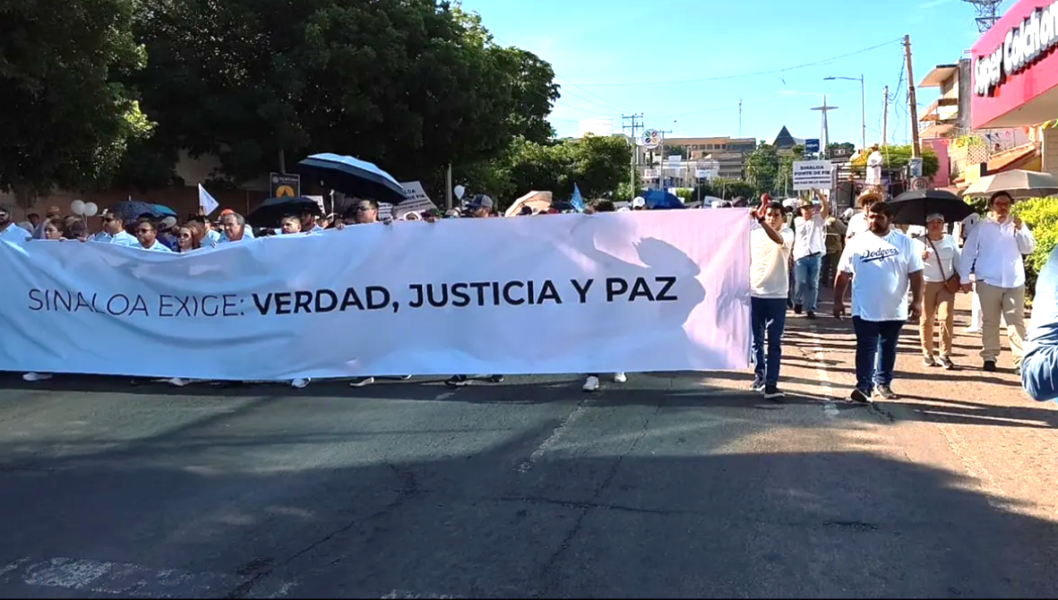
The peace march in Culiacán brought together tens of thousands of citizens and featured the active participation of the Catholic Church and Bishop José Jesús Herrera Quiñones, who presided over the celebration of the Eucharist and delivered a message against violence. The procession started at the La Lomita church and concluded at the Cathedral Basilica of Our Lady of the Rosary, in the city center
On Sunday, September 13, 2026, Culiacán became the stage for one of the most significant mobilizations in recent years: the peace march, which brought together tens of thousands of citizens on a route from the La Lomita church to the Cathedral Basilica of Our Lady of the Rosary. What distinguished this march was the call from the Diocese of Culiacán, led by Bishop José de Jesús Herrera Quiñónez. The Catholic Church, through circulars and pastoral messages, directly urged the faithful to join, suspended the morning Sunday Masses, and turned the mobilization into an act of faith and citizenship.
In Circular No. 16/2026, addressed to priests, deacons, consecrated persons, and laypeople, Bishop Herrera Quiñónez asked attendees to dress in white and participate in the march “Culiacán, Stand Up”. The decision to suspend Sunday Masses was considered unprecedented and revealed the diocese’s intention to place peace as a pastoral and social priority, inviting the community to walk together in an act that transcended the religious to become a civic demand. In this sense, the Church did not merely accompany the event; it was a protagonist in both the call and the leadership of the event.
The day began with a Mass at an improvised altar at La Lomita. There, Bishop Herrera Quiñónez delivered a message that set the tone for the mobilization: “We want to live in peace, we want safe streets, we want peaceful families.” His words, filled with pastoral strength, were also a political demand. He insisted that pain should not turn into hatred, but rather into a reason for fraternity and solidarity, and called for institutions that protect life and restore trust in society, requiring strong and responsible institutions that uphold respect and dignity for individuals while avoiding any form of corruption. The message resonated among attendees as a call for reconciliation, but also as a denunciation of the authorities’ inability to guarantee security and justice, and to criminal groups: “Stop!… It is still possible to change course,” the bishop stated.
The march route began at La Lomita, descended along Álvaro Obregón Avenue, and crossed the main streets of downtown Culiacán until reaching the Cathedral. Along the way, participants carried banners with slogans such as “We don’t want fear, we want peace” and “Sinaloa, stand up”, while white balloons were released as a symbol of hope. The white attire of the attendees reinforced the solemn and hopeful character of the mobilization. The journey from a place of devotion to the civic heart of the city reflected the intention to unite faith and citizenship in a single outcry.
Participation was massive. It is estimated that between 30,000 and 50,000 people responded to the call, a figure that reflects the social exhaustion in the face of violence that has left more than 3,000 dead and nearly 2,900 missing in the last two years, resulting from the internal conflict within the Sinaloa Cartel. The march brought together families, business owners, search collectives, and civil organizations in a cross-cutting expression of unity. The presence of Coparmex Sinaloa and the Inter-Chamber Council reinforced the civic nature of the mobilization, but it was the Church that provided moral legitimacy and the capacity to mobilize.
The demands were direct. Security, justice, and institutional strengthening were called for. Search collectives, made up mainly of mothers looking for their missing children, raised their voices with slogans such as “When one mother cries, we all cry”, highlighting the human pain behind the numbers. The interim governor Graciela Domínguez Nava and the municipal government were criticized for their lack of effective responses to the crisis. The march became a forum for denunciation and a space for political pressure, capable of placing the peace agenda at the center of public debate.
Bishop Herrera Quiñónez insisted that peace cannot be reduced to the absence of violence, but must be built with justice and fraternity. His message transcended the religious and became a social and political discourse, addressing both believers and non-believers. It encapsulated the demand of a people who refuse to live in fear. By taking on a leading role, the Church reinforced the legitimacy of the movement and gave it a moral character that goes beyond the immediate context.
Local and national media highlighted the magnitude of the mobilization and the role of the diocese in the call. The march was not only an act of protest, but also an exercise in political and social pressure. The route from La Lomita to the Cathedral symbolized a collective transition toward hope, amid a context marked by violence when, that same weekend, 10 people were killed in the clash between the two main factions of organized crime, whose most violent phase began on September 9, 2024.
The peace march in Culiacán was an event that demonstrated the capacity of Sinaloan society to organize and demand conditions of security and dignity. The official call from the Diocese of Culiacán, led by Bishop Herrera Quiñónez, turned the mobilization into an act of faith, reconciliation, and political demand. The massive participation, the forceful demands, and the pastoral message consolidated the march as a milestone in the struggle for peace in Sinaloa. Beyond the immediate context, what became clear is that society is not willing to resign itself to fear, and that peace, understood as justice and fraternity, is an inalienable demand.