


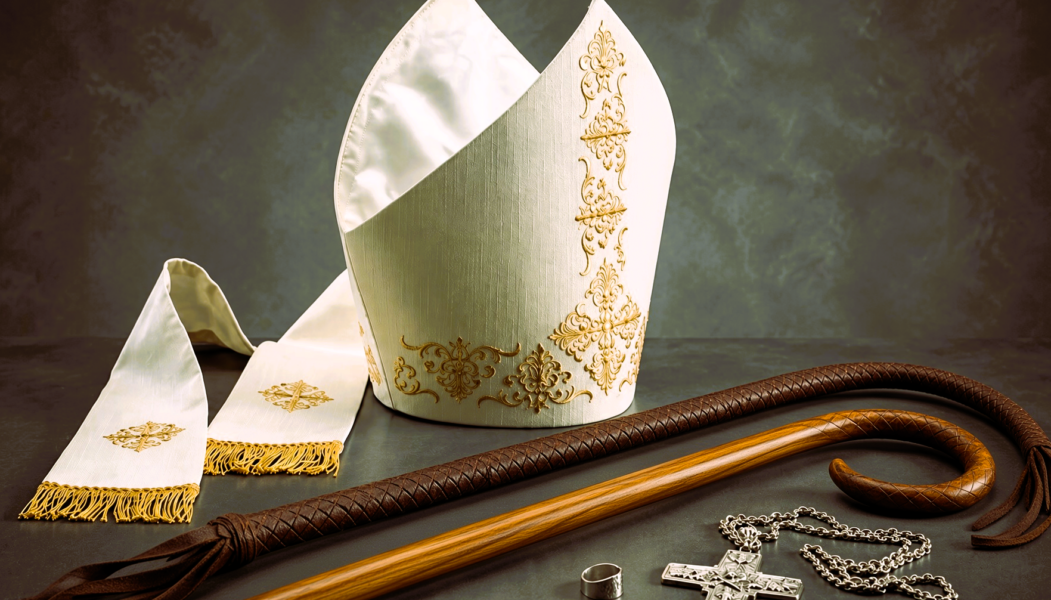
A few days ago, I received this interesting article: “When the crozier becomes a whip” (published on June 16, 2025 on ataquealpoder.es). It is a harsh, sarcastic, and necessary critique of what the author considers a “widespread and structural practice” in the Church: the silent, methodical, and piously justified mistreatment of priests by their bishops. It is presented under the guise of “canonical discernment,” “pastoral accompaniment,” or “integral care for the presbyter,” but it produces deeply destructive consequences.
The denunciation targets the Archbishop of Oviedo, who sent a message to Father “Lito,” Manuel García Velasco. During an illness, the archbishop fraternally encouraged the presbyter in his suffering; however, between the lines, he invited him to retire, leave his home, and withdraw from ministry. The author presents it as an example of “digital pastoral care” that replaces face-to-face conversation with a mobile message that pushes the priest toward ecclesial irrelevance.
The author of this account warns that priests who think, speak, question, or have social and theological sensitivity are labeled as “troublesome.” In contrast, those who are obedient without judgment, submissive, and who repeat the official narrative are considered “exemplary pastors.” Vocation or charism is not valued, only obedience, ideally tinged with fear.
The article does not reveal what happened to Father Lito, but the singular opinion denounces the enormous gap between the discourse of mercy and synodality and the actual practice of power in particular dioceses and archdioceses, using concrete examples and deliberately provocative language to highlight what it considers a betrayal of the original meaning of the episcopal ministry. In short, the metaphor of the crozier turned into a whip.
The full article can be read below as it was published on ataquealpoder.es
In the Church, where fraternal love, forgiveness, mercy, and pastoral accompaniment are preached, there is a very widespread practice, though carefully disguised as “canonical discernment”: the silent, methodical, and piously justified mistreatment of priests by their bishops. In many cases, it is a subtle but devastating violence, exercised from above with white gloves and episcopal smiles, yet with deeply destructive consequences.
Special mention should be made of those bishops who come from religious orders, supposedly trained in community life, shared obedience, and listening to the Spirit. How curious that, once vested with the mitre and crozier, they seem to forget all that. The charism disappears, humility fades, and the only thing that remains is authority… well understood as a tool of control.
These bishops, trained in the liturgy of conventual silence, arrive in the diocese like someone landing in a 19th-century African colony: they do not understand the language, they do not know the culture, but they have orders to carry out and structures to impose. They surround themselves with loyal courtiers, issue decrees in sweetened and merciful language, and deploy all their capacity for “accompaniment” with a lapidary phrase: “after deep pastoral discernment, it has been deemed appropriate to dispense with his services.”
This is how many priests are “accompanied” today: with forced transfers, unsigned letters, cold calls, premature retirements, or simply with absolute administrative silence.
The case of Rafael Palomino is already paradigmatic. A committed priest, with a solid pastoral trajectory, independent thought, and a critical sensibility, he became inconvenient for doing what should be normal: thinking out loud, questioning the obvious, expressing in conscience what many keep silent out of fear. His bishop’s response? Not dialogue, but sudden removal. Of course, with a merciful tone, impeccable form, and institutional piety. Not a stain, not a sound, not a word too many. Only a clear conclusion: better out than in.
But the irony peaks with the episode of the “priest Lito,” Manuel García Velasco, to whom his archbishop, Jesús Sanz Montes, sent a WhatsApp message during his illness to convey his “fraternal encouragement.” And yes, it was fraternal: because the same message included, between the lines, the invitation to retire, leave his home, and withdraw from ministry. What a detail! It cannot be denied that digital pastoral care is on the rise. In the absence of face-to-face conversation, a mobile message is enough to “accompany” a priest on his way to ecclesial irrelevance. All with affection, of course. Because in this Church, abandonment is also managed with emojis.
All of this, of course, is done invoking the name of Christ, ecclesial communion, and “integral care for the presbyter.” What fine sarcasm: the care consists of leaving him without a parish, without a community, without a space, and, if lucky, with a modest pension. But always maintaining the paternalistic tone that envelops everything. Because in the Church, even contempt comes wrapped in liturgical cellophane.
Priests who think, who speak, who question, who have social or theological sensitivity, are seen as “troublesome.” In contrast, those who are obedient without judgment, submissive without soul, those who repeat the official narrative in a monotone voice, those are indeed “exemplary pastors.” There is no need for vocation; it is enough to have obedience and, if possible, a little fear.
The problem is not anecdotal; it is structural. It is not that there is a clueless or authoritarian bishop: it is that there is a system that protects power and leaves people unprotected. Dioceses become small fiefdoms where the bishop acts like a medieval lord, surrounded by a court of vicars, delegates, and secretaries who shield his figure and prevent any criticism. And if any priest, naively, expects dialogue, he will only find closed windows, scripted phrases, and decisions already made.
Meanwhile, the faithful watch the spectacle with bewilderment. They wonder why priests they admired disappear, why living parishes are closed, why voices that gave hope are silenced. And the answer never comes, because in this Church much is said about synodality, but little is practiced. Listening is preached, but silence is enforced. Fraternity is proclaimed, but punishment is applied.
The Church that punishes its own priests with a white glove is digging its own grave. Not because of external persecution, nor secularization, nor ideological conspiracies. But because it has turned the crozier, a symbol of guidance and care, into a sophisticated whip with which to mark territory and crush dissent.
And as a theological-pastoral conclusion, it is worth remembering that the episcopal crozier, a symbol of the shepherd who guides, was designed to protect the sheep, not to strike them. But in certain offices, its function has been reinterpreted: it is no longer a tool of shepherding, but an institutional rod of correction. If a sheep strays, it is not sought: it is sanctioned. If it speaks, it is silenced. If it falls ill, it is thanked via WhatsApp. And if it dies, a brief note is dedicated on the diocesan website. What a beautiful ministry, striking in the name of the Good Shepherd! Ironies of the Spirit.