


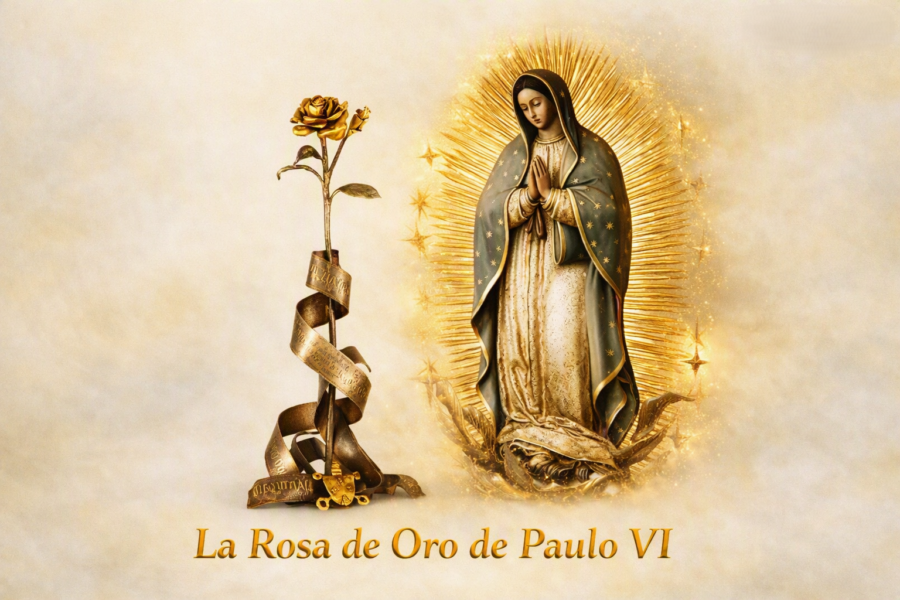
The fiftieth anniversary of the dedication of the Basilica of Guadalupe, this October 12, and the opening of the Guadalupan Jubilee Year, have been fitting occasions to recall events of singular deference to the Mother of God and to the people of Mexico. One of these was when, on the afternoon of May 31, 1966, the Basilica of Guadalupe received an award for the faith of the Mexicans and a living expression of a Pope’s love; the chronicles of that day describe the Church’s celebration of a singular gift in the pontificate of Paul VI to Mexico: the golden rose, a gift granted to Saint Mary of Guadalupe, of which sixty years will have passed in 2026.
On March 25, 1966, Paul VI arranged for the rose to be delivered to the Tepeyac Shrine. He blessed it on Laetare Sunday in the Sistine Chapel, a piece crafted by the Italian sculptor Giuseppe Pirrone (1898-1978). The Pope acknowledged that the gift was a sign of “Our affection and predilection for Mexico.” Entrusted to the dean of the College of Cardinals, Carlo Confalonieri (1893-1986), secretary to Pope Pius XI, it was brought to the Basilica in his capacity as Papal Legate with the personal greeting of the Roman Pontiff to the entire Mexican nation.
Paul VI gave Confalonieri two commissions. Through this gift, to convey the Pope’s invaluable love for Mexico, a well-deserved recognition of the faith of the Mexicans, a prize for their tenderness and devotion to the Mother of Heaven. He would say of the Mexican people that “in hours of trial and sorrow, the names of Christ the King and of Mary of Guadalupe have tempered the Catholic fiber of a people that has not retreated before the heroisms imposed by fidelity to the Gospel.”
Secondly, the Holy Father assured his prayer, a pledge of peace and concord for Mexico and the American continent. He therefore prayed for the faith and assistance of the Virgin for the “beloved cardinal archbishop of Guadalajara, for the venerated archbishop of Mexico, and for the entire zealous Episcopate” while sending his blessing. Pope Montini had granted a similar recognition to only two notable shrines of Christendom by bestowing upon them a golden rose, the Basilica of the Nativity in Bethlehem in 1964 and that of Fátima, Portugal, in 1965.
The gift arrived in Mexico at the end of May 1966. On the 31st, the feast of the Visitation, an incredible manifestation of faith and devotion took place, bringing together the entire Mexican Episcopate around the tilma of Juan Diego to give an exceptional welcome to the papal Legate. Nearly seventy thousand faithful witnessed the presentation of the first golden rose after the aggiornamento Council, Vatican II.
Hours earlier, Cardinal Confalonieri had various encounters that served as a prelude to the celebration that afternoon of May 31. He stayed at the Conciliar Seminary of Mexico, directed by the rector, Father Abelardo Alvarado Alcántara (1933-2021), later auxiliary bishop of Mexico (1985) and who would never hold the title of a diocese, and the vice-rector, Father José Álvarez Barrón. During the morning, the corridors of the magnificent building of Casa Tlalpan witnessed the procession of prelates who met with the papal Legate. Cardinal José Garibi Rivera, archbishop of Guadalajara, held a half-hour conversation and, afterward, the visitor met with the seminarians.
The lodging was propitious for the blessing of the recently completed southern wing of the Seminary. Confalonieri delivered a brief address to the students in which he reiterated Paul VI’s love for Mexico, “hope of Ibero-America.” The chronicles of the time reveal the particular gesture the dean of the College of Cardinals had toward a seminarian, Manuel Castelló, who suffered a fracture that obliged him to use crutches. Seeing him in such a condition, the papal Legate expressed his wish for a speedy recovery by presenting him with a medal of Saint Christopher, patron of travelers.
Carlo Confalonieri received popular greetings aboard the vehicle that took him through the Mexico City of the 1960s. The second stage of that morning was at the seat of the apostolic delegation, the residence of the representative of the Holy See, Luigi Raimondi. Before diplomats, Cardinal Garibi Rivera and Miguel Darío Miranda, archbishop of Mexico, bishops, businessmen, and journalists, the magnificent golden rose of Paul VI was presented for the first time. Confalonieri expressed it thus: “The pontifical gift is here, before your eyes, with the grace of art, the suggestiveness of the symbol, with the beauty of the homage rendered to our common Mother who has brought to these regions the smile of heaven. It is by her intercession before the throne of God that I cordially invoke upon your worthy persons, upon the countries you here so highly represent, and upon your activity before this noble and beloved Mexican nation, the most select blessings of God.”
Immediately afterward, not only the sense of sight was delighted by the beauty of the craftsmanship; Cardinal Confalonieri placed among the petals a tiny capsule of rose fragrance which, according to those witnesses, immediately filled the place in the seat of the apostolic delegation. The meeting concluded with a luncheon offered by Archbishop Raimondi and, after a rest at the seat of the Conciliar Seminary of Mexico, the cardinal dean went to the Basilica to deliver the gift and message of the pilgrim Pope.
The reception at the Basilica was apotheotic. Archbishop Miguel Darío Miranda and Abbot Guillermo Schulenburg Prado received the Roman Prelate while the Guadalupan Hymn resounded in the Old Basilica. Journalistic accounts describe the cheers for Confalonieri, shouts and acclamations to Christ the King and the Virgin of Guadalupe, seasoned with condemnations and death to communism. The prayerful encounter between the Legate and the sacred tilma was prolonged before he proceeded to the eucharistic sacrifice, which he presided over and which was concelebrated by thirteen bishops. Guillermo Schulenburg received the Bull, recorded on parchment, whose letters arranged the delivery of the rose by the will of the Roman Pontiff.
The most transcendent moment was the presentation of the Rose to the archbishop of Mexico who, on his knees, accepted the gift. After holding it for a few minutes, he placed it in the hands of the abbot, who raised the trophy to the delight of the People of God gathered on such a solemn occasion. Miguel Darío Miranda, addressing the faithful, acknowledged the emotion of receiving the exquisite golden tribute. He would say: “In these moments, the profound and most noble motives that have guided the Sovereign Pontiff to grant us this honor fill our souls with joy… The Holy Father chose the Basilica of Guadalupe to bestow the golden rose with the purpose of touching directly the heart of the Mexicans, and therefore it is all of Mexico that thanks His Holiness for such a special distinction.”
Thus began the sacrifice of the Eucharist, a special occasion made in the language of the people and not in a foreign tongue thanks to the great prophetic intuition of the Second Vatican Council and of Paul VI. The homily of Cardinal Confalonieri did not hesitate to define this event as one “of the most pleasing and solemn” of his life and reiterated why Paul VI had shown special deference to the Mexican nation: “It is the Pope who has thought of you. Pope Paul VI, who after having moved the world by traveling with admirable boldness of apostolic charity and, in a brief space of time, as a pilgrim of religion, charity, and peace to the Holy Land, to India, and to the UN, has turned his eyes toward your homeland and comes today, an intentional pilgrim—that is, with his thought, with his affection, with his desire, with his prayer, with his blessing—in your midst, to pay honor to your little Virgin, heavenly patroness of Mexico and of Ibero-America, and precisely when the whole Church celebrates the liturgical feast of the queenship of Mary.”
The importance of the tribute was no small matter. The times of openness moved Paul VI to place them under the maternal care of Saint Mary of Guadalupe, as was made evident in what was affirmed to be the eloquent homily of Cardinal Confalonieri: “Indeed, it is not without particular significance that the first golden rose blessed by the Pope after the historic event of the Second Vatican Ecumenical Council… has been destined for this shrine, prince of the American continent.”
The golden close of the celebration was provided by the Pope himself when he sent his greeting recorded on magnetic tape and heard in the Guadalupan precinct. The prose of Paul VI was sprinkled with allegories and poetic lines that linked biblical events with the Guadalupan event and quotations from the Fathers of the Church. And the commission of the successor of Peter to all of Mexico was the colophon of the discourse of the spiritual pilgrim to our land: “Venerate her, love her always. May she bless you and obtain for Mexico the graces that we implore from Heaven through her intercession with Our Apostolic Blessing.”
The successors of Pope Paul VI would have similar gestures toward the Guadalupana, but perhaps less apotheotic than that of 1966. The last of them was in November 2013 when Pope Francis gave a golden rose to the dark Virgin on the occasion of the continental Marian vigil. Like his predecessor, he followed the footsteps to link in time the presentation of the golden rose of Pope Montini, a tribute and recognition of the faith of the Mexicans for their love of Saint Mary of Guadalupe. That occasion is also linked in our days with the fiftieth anniversary of the dedication of the new Basilica of Guadalupe in 1976 and the opening of the Jubilee Year with indulgences granted by Pope Leo XIV in this 2026-2027.
Events of faith and devotion, more than half a century ago, as the chroniclers who witnessed what was defined as the most important celebration in all Ibero-America said. May 31, 1966, as a journalist from El Excélsior wrote, was the day that “the Mexicans did not want to end.”
And for perpetual memory, the inscription at the foot of the Rose: “Paul VI, Supreme Pontiff. To the Sacred House of the Blessed Virgin Mary of Guadalupe. Given on March 25, 1966.”