


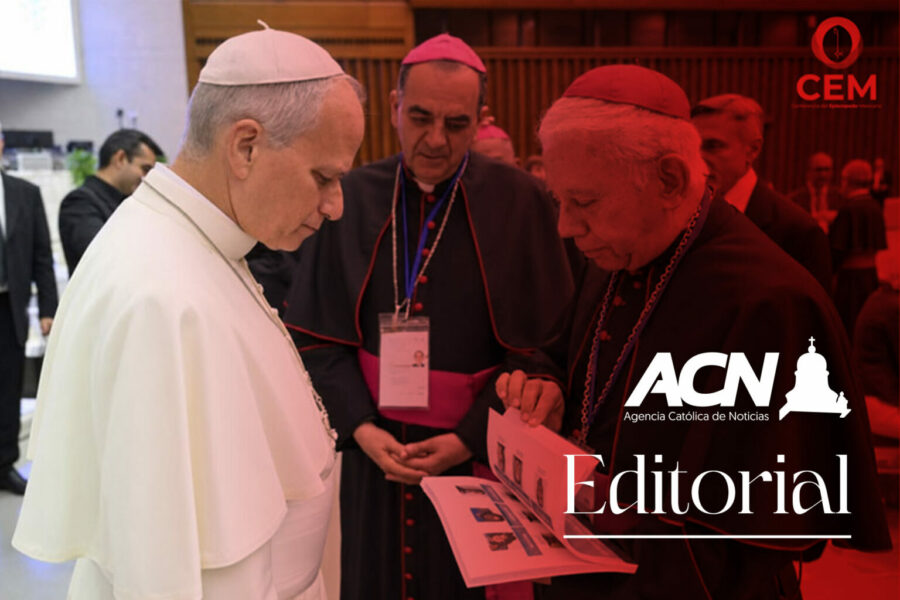
In the framework of the meeting “Ten Years after Amoris laetitia: Proclaiming the Gospel with Families Today”, Ramón Castro Castro, president of the Mexican Episcopal Conference and bishop of Cuernavaca, presented to Pope Leo XIV the volume The Faces and Names of Forced Disappearance in Mexico, together with the archbishop of León, Jaime Calderón Calderón, vice-president of the CEM, who was invited as the president’s companion and as a guest of the Pope. The document, dated September 2026 and prepared by the National Dialogue for Peace, comprises 208 pages (Spanish and English) with faces, names, dates and places of disappearance.
The book does not claim to contain the stories of the more than 132,000 persons who are disappeared and unaccounted for according to official figures. As its own introduction acknowledges, “we would have liked to gather… the stories of the more than 132,000 persons… To speak of their favorite food, the streets they walked, the embraces they used to give.” Instead, it gathers concrete records: Elías Macías Galván (Guadalajara, 5 May 2019), Héctor Hugo Camaño Alvarado (Tlajomulco, 5 May 2013), Carlos René Rojas Domínguez (Mérida, 4 November 2019), and dozens more—women, young people and children—along with minimal yet precise accounts: the guitar of Marco that no one has played again, Alma’s half-written diary, the four birthdays Rocío has missed, the five and a half years Miguel has not greeted his mother. The motto that closes the volume is “Present. Until we find them”.
The explicit intention is that whoever receives it—the Pope, the United Nations, institutions—not only be moved, but moved to action in the face of the forensic crisis, impunity and the dismantling of bodies that prevent a reliable register. This gesture is also a precedent that Leo himself will take into account regarding a possible visit that could take place in 2027 or toward 2031, marking 500 years since the apparitions of the Virgin of Guadalupe.
The purpose of the presentation is to break the mere statistic. Forced disappearance and disappearance committed by private individuals have turned thousands of persons into figures in a register that does not answer what happened to them. The document states that “if it were a single episode, this story would have ended. Yet the faces… are part of a past stubbornly determined to remain in a present that seems to stretch on without end.” The Church has taken up this cause not as one more item on its social agenda, but as evidence of the unthinkable to which the concept and value of life can be reduced—a life reduced to data, a family suspended in a limbo without place or time, a people for whom it becomes difficult to imagine a livable future. The expressed commitment is “not to look away” and “to organize hope from justice, co-responsibility and truth.”
This ecclesial reading coincides with what international human-rights bodies have repeatedly pointed out. The United Nations Committee on Enforced Disappearances activated, for the first time with regard to Mexico, the procedure under Article 34 of the International Convention, in view of indications that disappearances are practiced systematically or on a widespread basis and could constitute crimes against humanity. Amnesty International and the Inter-American Commission on Human Rights have documented the scale: more than 130,000 persons unaccounted for, tens of thousands of unidentified bodies, impunity close to 99 % in many contexts, and growing risks for the searchers themselves. The crisis exceeds internal institutional capacities and requires international cooperation, effective search and forensic identification. The book that reached the Pope’s hands is, in that sense, a bridge—concrete memory of the families that the National Dialogue for Peace gathered between August and September 2026, around the International Day of the Victims of Enforced Disappearances, so that “no voice is lost in silence.”
The presentation does not resolve where they are, but the document admits the impossibility of imagining a shared future “without first addressing the demand for justice and truth” and places at the center of ecclesial reflection on family and life—within the framework of the meeting on Amoris laetitia—the reality of those who are missing and of those who never stop searching for them. Each photograph, each name and each suspended date reminds us that behind the figure there is a person, a family and a story that the State and society cannot continue to treat as mere administrative data. Until we find them, the commitment the Church has made visible before the Pope is not to look away, which is why it is the book that holds the faces of the disappeared.
The book can be downloaded here: