Carlos Aguiar Retes, Primate Archbishop of Mexico, has ordered that his official communiqué on the reform of the Basilica in the manner of the Roman basilicas, dated July 12, 2026, be read mandatorily at the end of all Eucharistic celebrations in parishes, rectories, and chapels of the Archdiocese of Mexico this Sunday, July 19.
The text seeks to legitimize a “stage of updating and improvement of administrative, operational, and pastoral processes” at the Insigne and National Basilica of Guadalupe, accepts the “resignation” of Canon Efraín Hernández Díaz as rector and episcopal vicar of Pastoral Zone I, appoints Canon Daniel Víctor Villalobos Ortiz in his place, and announces the creation of an archdiocesan commission to prepare for the 500th anniversary of the Guadalupan event.
The document invokes as reference the reforms promoted by the late Pope Francis in the basilicas of Santa Maria Maggiore and St. Peter, speaks of distinguishing the pastoral mission from administrative operations, of strengthening co-responsibility, of greater institutional clarity, and of placing the entire life of the shrine at the service of the proclamation of Jesus Christ and the veneration of the Virgin. It thanks those who contributed experiences and concerns, and closes with a call to communion, to avoid “interpretations that may sow division,” and to trust in the words of the Morenita: “Am I not here, I who am your Mother?”
Read in its real context, the communiqué is not an act of transparency or genuine renewal. It is an exercise in narrative control that seeks to close on a false note an open crisis of opacity, accusations of mismanagement, and contradictory decisions by the archbishop himself. Whoever reads it without qualification becomes, in conscience, an instrument of that operation.
From August–September 2025, the Guadalupan chapter formally alerted the cardinal to a critical situation. The already widely known facts led to a canonical investigation and an audit, the results of which remain unknown. The findings of those reviews have never been made public in a complete and verifiable manner. In May 2026, contrary to the expectations raised by the initial removal and without disclosing the conclusions, Aguiar unilaterally reinstated Hernández Díaz, stating that there were no elements preventing his return. The decision caused bewilderment, indignation, and additional tensions within the chapter. The rector continued to have significant absences, including his absence from the July 9, 2026 event with President Claudia Sheinbaum, until, on July 12, the cardinal accepted a new “resignation” and appointed Villalobos Ortiz.
The July 2026 communiqué presents all of this as an orderly process of “routine reviews,” attentive listening, and ecclesial discernment culminating in a renewal inspired by the Roman basilicas. It completely omits the sequence of suspension, audit, unilateral reinstatement, and new departure. It speaks of “opportunities to strengthen” without saying what was found, what was corrected, or what remains pending. That omission is the core of the whitewashing.
Appointing Daniel Víctor Villalobos Ortiz, a canon of the chapter itself and until now vicar for the clergy, may be read as a gesture of rapprochement with those who denounced the situation, but it does not resolve the underlying problem as long as the results of the Deloitte audit and the canonical investigation remain unpublished. Without knowing what irregularities were substantiated or dismissed, what amounts were involved, what contracts or practices were reviewed, and what corrective measures were implemented, the change of personnel is cosmetic. The trust of the faithful and of the millions of pilgrims who deposit offerings is not restored by an appointment; it is restored by truth and accountability.
The communiqué insists on distinguishing the pastoral mission from administrative operations and on consolidating a “more efficient and orderly” institution in accordance with civil and ecclesial norms. That distinction is necessary, but dangerous if it translates into greater concentration of financial management in the central structure of the archdiocese. The Basilica of Guadalupe is not just any parish: it is the most visited Marian shrine in the world, receiving substantial resources from the offerings of ordinary people. Concentrating its administration without clear mechanisms of transparency, independent oversight, and public information to the faithful and the chapter does not produce efficiency; it produces opacity and eliminates accountability. The experience of recent years demonstrates precisely that the lack of effective control and the non-publication of results generates recurring crises.
One example of such opacity is the handling of foreign-currency resources that has drawn so much attention in the Basilica’s management. It is known that, throughout the year, thousands of faithful from dioceses in the United States come to Tepeyac, leaving significant resources in hard currency, dollars.
Reliable sources provided this medium, Infovaticana, with important indications of how dollar revenues enter the coffers of Tepeyac, allowing a comparison of monthly dollar revenues recorded in the institution’s accounts during 2024, 2025, and the first four months of 2026. The data, arithmetically verified in full, make it possible to reconstruct with precision the evolution of those resources.
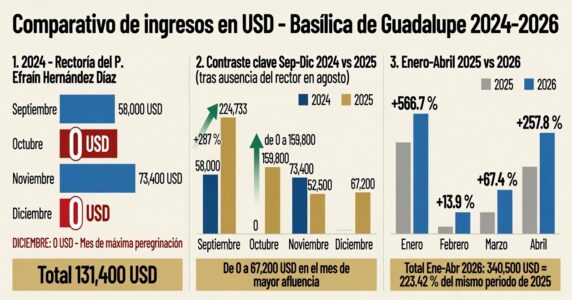
According to the information, in 2024, under the rectorship of Father Efraín Hernández Díaz, dollar revenues were limited to four months and totaled only 131,400 dollars. September recorded 58,000 dollars, October showed zero, November reached 73,400 dollars, and December, the month of greatest pilgrim influx due to the December 12 feast, again reported zero dollars. That null record in the month of maximum pilgrimage is one of the most striking data points in the document.
From August 2025, the absence of the then-rector was noted. That same month again shows zero dollars. However, from September onward, revenues undergo a significant change when compared with the same months of the previous year. September rises from 58,000 to 224,733 dollars; October jumps from zero to 159,800 dollars. November falls from 73,400 to 52,500 dollars. December, by contrast, rises from zero to 67,200 dollars. The contrast in the month of greatest influx is especially telling: from recording no revenue at all in 2024 to accounting for 67,200 dollars in 2025.
The first four months of 2025, still under the rectorship of Father Hernández Díaz, offer another precise point of comparison with the same period in 2026. January rises from 15,000 to 100,000 dollars. February increases from 53,100 to 60,500 dollars; March advances from 63,900 to 107,000 dollars; and April grows from 20,400 to 73,000 dollars. The sum of these four months in 2026 reaches 340,500 dollars, far exceeding the total recorded in the months considered in 2024.
The information does not interpret the numbers. It merely records them. The temporal sequence, however, is clearly established: zeros in months of high and maximum pilgrimage during the rectorship of Father Efraín Hernández Díaz, reappearance and growth of revenues from the time of his absence, and a sustained increase in the first months of 2026. The figures allow the reader to form an informed judgment about the difference in the recording of institutional resources between the two periods.
This brings us back to the central point now being shamelessly imposed. The Church’s doctrine on scandal, truthfulness, and obedience does not require the uncritical dissemination of incomplete or misleading narratives. The Catechism and the moral tradition recall that scandal is a grave fault when it leads others into error or weakens the faith through behaviors or silences that contradict the Gospel. The absence of information, the opacities, and a communiqué that presents as “pastoral renewal” what is the administrative closure of a crisis of alleged misappropriation accusations—without providing the elements of judgment that would allow the faithful to discern—is not an act of communion; it is an instrument of control.
Priests, deacons, and leaders of communities have no obligation of conscience to read a text that, by omitting what is essential, becomes a vehicle for an image-laundering campaign by the archbishop. Whoever does so uncritically, knowing the context, could become complicit in the scandal that has damaged the credibility of the shrine. Ecclesial obedience is not blind and does not extend to the propagation of partial versions that protect authority at the expense of truth and of the Church itself.
Since Aguiar assumed the primatial archdiocese in February 2018, the Basilica has been under his responsibility as custodian. The purported reforms and updates now solemnly announced have not prevented the 2025–2026 crisis from erupting, the audits from remaining opaque, or the archbishop’s own decisions from generating more confusion than clarity. Presenting the preparation for the 500th anniversary (2031) as the horizon that justifies silence about the recent past is using a sacred event to cover the deficiencies of a pontificate already considered the worst in centuries.
True preparation for the fifth centenary of the Guadalupan event does not consist of mandatory communiqués that avoid “divisive interpretations,” but of truth, justice, and radical transparency in the management of a patrimony that belongs to the People of God. Publishing the results of the audits, establishing external and permanent controls over resources, ensuring that administration is not concentrated opaquely, and asking forgiveness for the damage caused to trust would be authentic signs of renewal. Until that happens, the July 12 communiqué will remain what it is: an attempt to whitewash an authority that, after eight years, has still not demonstrated that it has fundamentally resolved the problems it itself has managed.
The Church needs more than a narrative of cosmetic neatness. It deserves the truth. And the truth, according to the Lord himself, admits no half-measures or calculated silences: “Let your word be ‘Yes, yes’; ‘No, no.’ Anything more than this comes from the evil one” (Mt 5:37).