


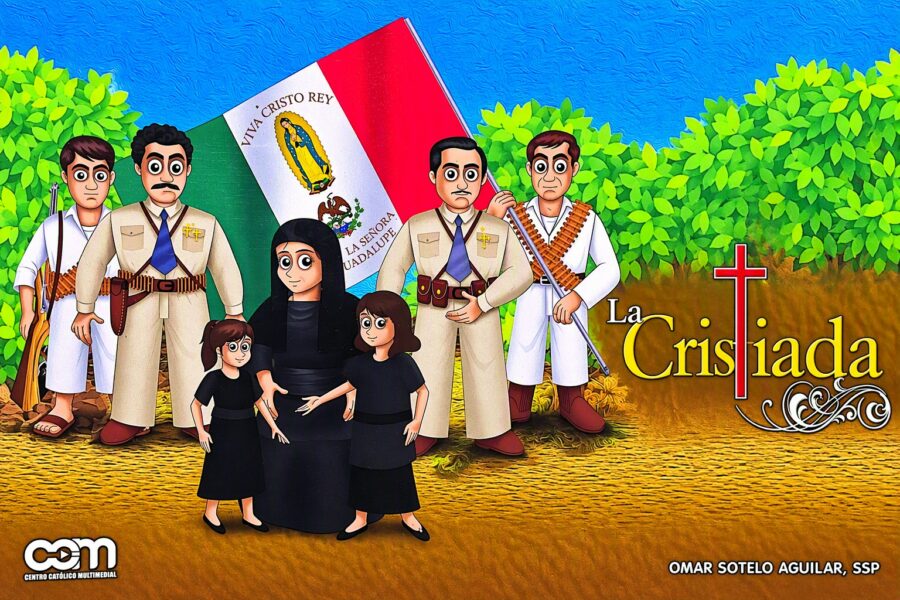
In the framework of the commemoration of the one hundred years since the beginning of the Cristero War, the Centro Católico Multimedial presents Cristiada, a comic book by Father Omar Sotelo Aguilar, SSP, director of the organization. The work does not merely recount a difficult episode in history—the religious persecution under the government of Plutarco Elías Calles and the popular uprising that responded with the cry “¡Viva Cristo Rey!”—but is also intended as catechetical material accessible to both children and adults. Its purpose is to recover the strengthening of identity and make it close to new generations through the visual language of comics and multimedia resources that allow interaction with the scenes.
Father Sotelo Aguilar, a priest of the Society of Saint Paul and a journalist with a long career, has stated in an interview that the Cristiada represents “a painful moment of our faith in Mexico,” from which “the strengthening of the Christian identity of an entire people” can be recovered. We need, he adds, “to strengthen our Christian identity, our faith in Christ the King and in our Most Holy Mother, the Virgin of Guadalupe.” That is precisely the contribution this material seeks to make. In a context in which the episode has frequently been silenced or relegated in official memory, the comic format allows the events, the suspension of worship, the resistance of peasants, women, and young people, the role of the National League for the Defense of Religious Freedom, and the sacrifice of those whom the Church recognizes as martyrs to be brought closer, making it appealing to both young and old.
One of the aspects the author himself highlights is the almost “artisanal” character of the work. Cristiada is not the result of artificial intelligence or other automated digital tools. It is an original production in which the story was created from the panels to the last detail, in full color and with careful visual craftsmanship. The artwork was done by Ricardo Vázquez, a collaborator of the Centro Católico Multimedial, underscoring the dedicated work on each page. This choice reflects the conviction that, although creating comics and animated proposals is laborious and not always economical, it constitutes an effective vehicle for transmitting faith and memory to new generations.
The comic narrates the confrontation between the Calles government and the Catholic militias that rose up to defend religious freedom against laws that sought to limit the power of the Church. Its accessible tone aims to strengthen Christian identity and to recall that faith is a reality for which a people were willing to give their lives. In addition to its value as a historical account, the work is conceived as a catechetical instrument, designed so that families and communities can dialogue about a chapter that profoundly marked the life of the Church in Mexico.
Cristiada does not remain solely in physical format. It incorporates various QR codes that direct the reader to audiovisual material, allowing interaction with scenes from the comic and enriching the reading with complementary content.
Cristiada is also presented as a complement to Milagro en el Tepeyac, the first comic book by the Centro Católico Multimedial, based on the Nican Mopohua. That work recounts the apparitions of the Virgin of Guadalupe through the eyes of two children, Rosita and Juancho, who on December 12 accompany their parents on the pilgrimage to the Basilica and meet Juan Diego, who tells them the miracle. It is also hybrid and includes QR codes that allow viewers to see scenes such as the Virgin’s dialogue with Juan Diego or the conversation with Uncle Bernardino.
From the Centro Católico Multimedial, where multimedia production is undertaken with limited resources but with hope, it is recognized that the work is arduous and that it is only just beginning. Beyond their historical value, both comics are offered as instruments for intergenerational dialogue and family catechesis.
Father Omar Sotelo Aguilar invites readers to acquire Cristiada and Milagro en el Tepeyac through the website of the Centro Católico Multimedial. Both represent a concrete effort to make available to families materials that combine historical rigor, visual appeal, artisanal production, and digital resources in the service of memory and catechesis. Acquiring these works is, in that sense, a simple gesture of shared memory and faith.
The full interview can be viewed here: