


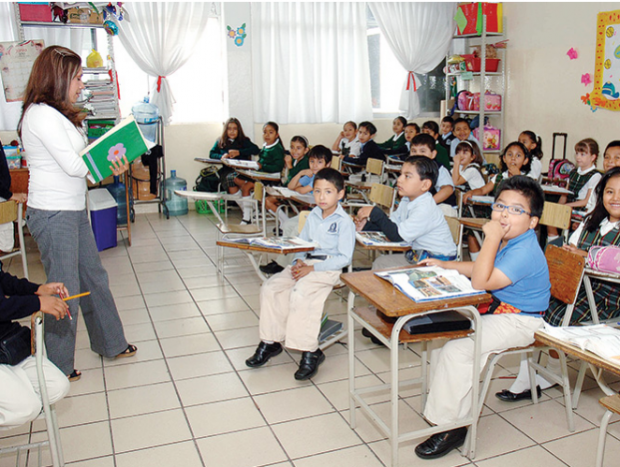
In a message disseminated on the occasion of Teacher’s Day, the Mexican Episcopal Conference has reiterated the fundamental value of teachers in building a solidarity, free, educated, and peaceful country.
The document, dated May 14, 2026, in Mexico City and signed by Bishop Ramón Castro Castro, president of the Conference, along with Auxiliary Bishop Héctor M. Pérez Villarreal and the Archbishop Emeritus of León and person in charge of the Educational and Cultural Pastoral Dimension, Alfonso Cortés Contreras, highlights the irreplaceable work of those who day by day shape Mexico’s future from the classrooms.
The date of May 15, on which this national commemoration has been celebrated for more than a century, has a precise historical origin. President Venustiano Carranza approved the initiative and issued the corresponding decree. Some sources specify that the document was signed on November 23, 1917, published in the Official Gazette of the Federation on December 3, 1917.
The decree is brief and consists of two main articles; the first declares May 15 as Teacher’s Day, with school activities to be suspended on that date; the second establishes that on that day, parents or guardians will send the children to greet their teachers as a sign of gratitude. This provision coincided with the anniversary of the Taking of Querétaro in 1867, an event that consolidated the Mexican Republic. Additionally, on May 15, 1950, Pope Pius XII proclaimed Saint John Baptist de La Salle as the special patron of educators of childhood and youth, granting this commemoration a profound spiritual meaning that underscores the nobility of the teaching vocation.
The text greets with gratitude and closeness the teachers of the entire country. “Your presence in every classroom in our country is an irreplaceable act of commitment and hope,” it states. With patience, dedication, and love, they devote their lives to forming new generations, comparing them to a craftsman who molds his piece or a farmer who tills his land. Their vocation, the message emphasizes, is a mission of hope for the nation.
The Mexican Episcopal Conference quotes the words of Pope Leo XIV in the Jubilee of the Educational World, who recognized that educators contribute to embodying the face of Christ for millions of students. Thanks to their diversity of charisms, methodologies, and experiences, they ensure adequate formation that places at the center the good of the person, both in humanistic knowledge and in scientific knowledge.
The message highlights the teachers’ capacity for adaptation in the face of present challenges. In the midst of a cultural change that fragments the human being, envelops them in uncertainty with abundant information but scarce formation, and introduces them into a global, digital, and vertiginous world, their task remains vital. They do not limit themselves to transmitting knowledge: they touch the hearts of people, awaken their interiority, accompany them in the search for truth, and help them discover their dignity and human vocation.
The Conference also recognizes the difficulties they face. It mentions the excessive bureaucracy and political and teaching contexts that, instead of strengthening their vocation and providing them with what is necessary to fulfill their noble mission, often prioritize interests foreign to the good of Mexican childhood and adolescence or to their own professional performance. In response, it exhorts educators not to lose sight of the fundamental human question: an attentive gaze on each student, a heart open to their needs, and a constant encounter marked by dedication, generosity, and pedagogical boldness.
“Educators are called to a responsibility that goes beyond the employment contract: their witness is worth as much as their lesson,” recalls the papal quote included in the document. The bishops invite parents, directors, authorities, and students to concretize alliances and an educational pact that overcomes misunderstandings and particular interests. This pact, they affirm, must design “new maps of hope” to rebuild the social fabric, form responsible citizens, and promote a culture of peace.
To all the teachers of Mexico, the Episcopate tells them that they are “craftsmen of humanity” and the protagonists who embody and give meaning to society’s educational efforts. “Thank you for sustaining the hope of our people from every classroom, from every community, and from every silent effort to form a more human and fraternal country,” the message concludes. It extends a congratulation with solidarity and closeness, and asks Jesus Christ, Lord and Teacher, for the gift of gratuity and generosity to form future generations. It also invokes the intercession of the Most Holy Mary of Guadalupe.
This recognition takes on special relevance when considering the scale of the educational task in Mexico. According to data from the Interactive Educational Consultation System of the Secretariat of Public Education for the 2024-2025 school cycle, the country has 2 million 61 thousand 23 teachers in basic, upper secondary, and higher education levels. This figure serves a national enrollment of more than 32 million students. Women represent around 64 percent of the teaching staff, confirming that education in Mexico has a marked feminine face, especially in the early levels where their presence exceeds 69 percent.
These statistics not only illustrate the magnitude of the collective effort but also the strategic importance of valuing and supporting those who practice teaching. In a context of accelerated changes and social challenges, the episcopal message invites the entire society to recognize that the teacher’s work transcends the classroom: it is a pillar for rebuilding the social fabric and forging a more just and human Mexico. The teaching vocation, which the Episcopate describes precisely, thus becomes a bridge between the revolutionary past that sought to educate for freedom and the present that demands forming citizens capable of facing a complex world without losing the human dimension.
Carranza’s decree arose at a moment of national reconstruction after the Revolution, when the country sought to consolidate its institutions through education. That decision to suspend classes and promote a gesture of family gratitude reflected the conviction that teachers were essential agents of social transformation. More than a century later, the bishops’ message updates that same recognition but enriches it with a spiritual and humanistic perspective: teachers not only transmit knowledge but mold hearts and build hope amid contemporary fragmentation.
Mexican teachers, with their daily witness, embody that ideal of service that transcends any contract or bureaucratic norm. Their silent dedication in urban and rural communities, in public and private schools, sustains the hope of a country that still dreams of being more equitable and fraternal. The bishops’ call is not only a recognition; it is an urgent invitation to the entire society—parents, authorities, students—to build that educational pact that the document proposes with clarity and urgency.
With their witness and daily dedication, teachers continue to be, as the document states, irreplaceable in building a better future. The call of the Mexican Episcopal Conference resonates as a timely reminder: educating is, above all, a shared work of hope.
https://acnmex.com/de-la-conferencia-del-episcopado-mexicano-mensaje-en-el-dia-del-maestro/