


The most recent report from the Observatory of Catholic Citizenship and Social Analysis lays bare a reality that official discourse insists on concealing: Mexico is undergoing a profound humanitarian crisis, marked by criminal violence, the forced disappearance of people, and the internal displacement of thousands of families. Far from addressing these tragedies with effective policies, the government of the Fourth Transformation exacerbates them through its unhealthy self-referentiality: an obsession with constructing and defending its own narrative of success that ultimately revictimizes those who have already suffered the unspeakable.
Published in recent days, the document compiles alarming data on the magnitude of the emergency. Official figures and independent counts coincide in indicating more than 128,000 missing persons and tens of thousands of unidentified bodies held in state custody. This is compounded by thousands of internally displaced persons who flee their communities in the face of the impossibility of living under the yoke of organized crime. The report warns that these victims not only suffer the initial violence, but also a second institutional victimization: the indifference, minimization, and abandonment that result from a power more concerned with self-celebration than with protecting its people.
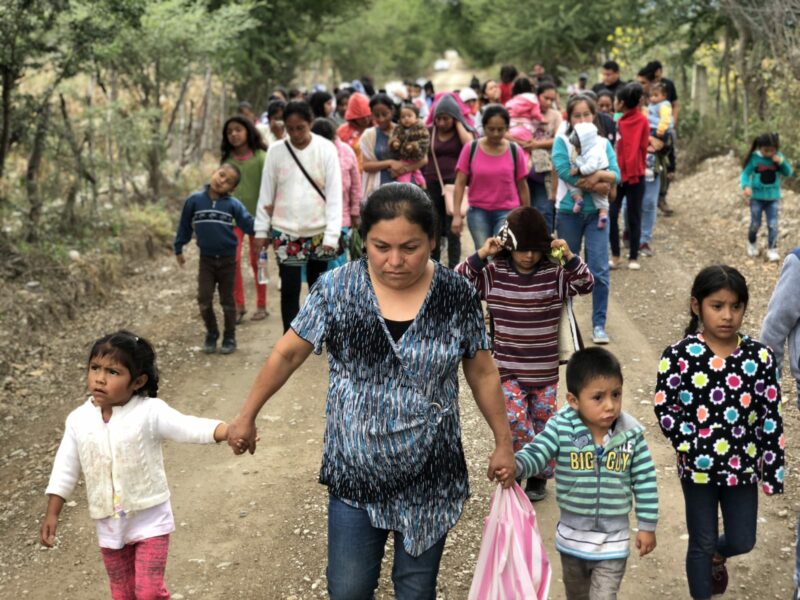
One of the most harrowing cases occurs in the Sierra de Guerrero. Between May 9 and 10 of this year, indigenous communities in the municipalities of Chilapa, such as Tula, Xicotlán, and Acahuetlán, suffered systematic armed attacks by organized crime groups. The perpetrators used high-caliber firearms and explosives launched from drones. More than 800 families—nearly three thousand people— were forced to abandon their homes in a matter of hours. Many sought refuge in churches or makeshift commissariats, where they recount scenes of panic: burned homes, stolen livestock, and death threats.
The testimonies collected are heart-wrenching. Indigenous women carrying their children in their arms, elderly people who left behind decades of work in the land, children who saw their schools and health centers become empty. The state authorities initially recognized only 70 families displaced, a figure that contrasts dramatically with the reports of the communities themselves. This underestimation is not an administrative error: it forms part of the self-referential logic of the regime. Instead of assuming the real dimension of the tragedy and deploying immediate resources, the federal government prioritizes discourses that exalt supposed security achievements and “hugs, not bullets”. The Sierra de Guerrero thus becomes an uncomfortable mirror that the power prefers not to look at.
The Observatory of Catholic Citizenship and Social Analysis argues with data and testimonies that this unhealthy self-referentiality operates at several levels. First, through the manipulation or minimization of statistics: missing persons are turned into “not located” and displaced persons into “voluntary movements”. Second, through the centralization of the narrative: each act of violence is attributed exclusively to organized crime, avoiding any responsibility for structural omissions. Third, with bureaucratic revictimization: families who report crimes face endless procedures, lack of psychological support, and absence of concrete responses. While the official discourse revolves around the defense of the transformative project, as if recognizing the crisis would equivale to admitting an ideological failure.
This dynamic not only perpetuates the pain of the victims, but also erodes the trust in the institutions. In the Sierra de Guerrero, the displaced do not ask for discourses; they demand immediate security, dignified humanitarian assistance, and a state that stop looking at its own navel. The report of the Observatory of Catholic Citizenship and Social Analysis is an urgent call: while the Fourth Transformation revels in its self-referentiality, the humanitarian crisis not only persists, but will deepen. Mexico cannot allow a government that, in the face of blood and displacement, chooses first to care for itself.
The full report can be read here:
Ciudadania Catolica y Analisis Social 55