


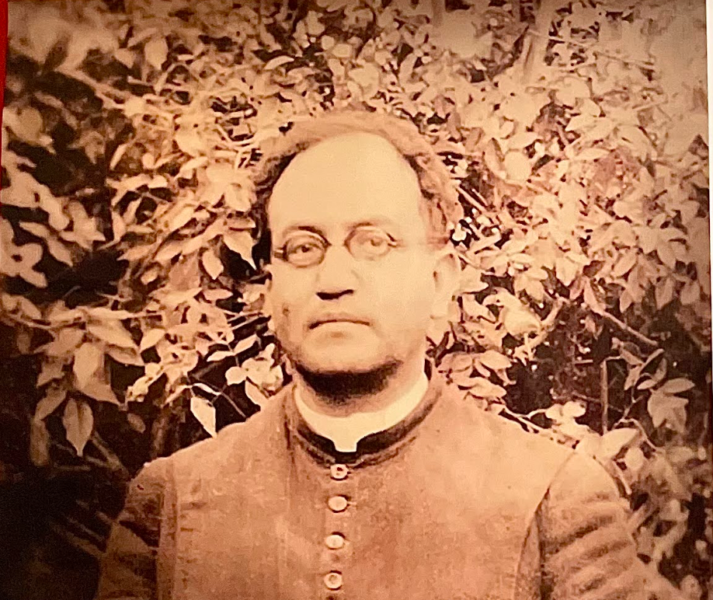
The bishop of Cuernavaca and president of the Mexican Episcopal Conference (CEM), Ramón Castro Castro, has presented a new catechesis in the series “Witnesses of the Kingdom,” focused on the figure of Saint Justino Orona Madrigal, the martyred parish priest who chose to remain with his people until death during the religious persecution of 1928. Under the title “Witnesses of the Kingdom, called to unconditional fidelity. Saint Justino Orona Madrigal, the shepherd who did not flee”, the prelate revives the memory of the Jalisco priest to challenge today’s Catholics about staying with those whom God has entrusted to them.
The reflection begins with the Gospel image of the Good Shepherd: “I am the good shepherd. The good shepherd lays down his life for the sheep; the hired hand, however, when he sees the wolf coming, flees because the sheep do not matter to him.” Some stay and some flee. Today, Castro Castro affirms, we contemplate a priest who stayed.
Justino Orona Madrigal was born on April 14, 1877, in Atoyac, Jalisco, in extreme poverty. His family needed him to work, but God’s call was stronger. At the age of 16 he entered the seminary and was ordained in 1904. During 24 years of ministry he kept nothing for himself. He founded a religious congregation for orphaned and poor girls. He wrote: “Those who follow the path of pain with fidelity can ascend to heaven with certainty.” He knew pain and had found meaning in it.
When the persecution intensified, many begged him to flee. He always responded calmly: “Among my own I live or die.” It was not recklessness, but the very definition of the shepherd. For Justino, his ministry could not be understood without his people. Staying was his way of loving.
In the early hours of July 1, 1928, sheltered with his vicar, Father Atilano Cruz Alvarado, at the Las Cruces ranch near Cuquío, he spent his last night planning how to continue reaching the sick. He thought of others until the eve of his death. When the soldiers arrived, he himself opened the door and, before they could say a word, shouted: “Long live Christ the King!” He was riddled with bullets. His last word was an acclamation to Christ. The shepherd gave his life for his sheep and, like the prophets, did not abandon his people. His staying was already an announcement and a denunciation, forceful in truth and unarmed in manner.
Here, the bishop points out, is the light for today. Pope Leo XIV, in his first encyclical Magnifica Humanitas, asks us to care for human relationships in a time that makes them liquid and disposable. Where is it so easy to block, abandon, pass by? “Among my own I live or die” means, translated to our time, not letting go of those God has entrusted to me: my family, my community, the poor next door. When staying costs, that is already a form of the unarmed peace of the Gospel.
Today’s question is very concrete: Do I know who my own are and am I willing to stay with them, to serve them, to love them to the end? Because fidelity is not a feeling that comes and goes; it is a decision renewed every morning.
The series “Witnesses of the Kingdom,” begun in mid-July 2026, is set within the horizon of the centenary of the institution of the solemnity of Christ the King by Pius XI and updates the call to be witnesses of Christ in times of fragile fidelities. Castro Castro, with his dual responsibility as diocesan pastor and president of the Mexican bishops, offers in this catechesis not only a historical remembrance, but a direct challenge to the daily life of the faithful in a country marked by violence, polarization, and the temptation to abandon the most vulnerable.
The complete catechesis is available at: