


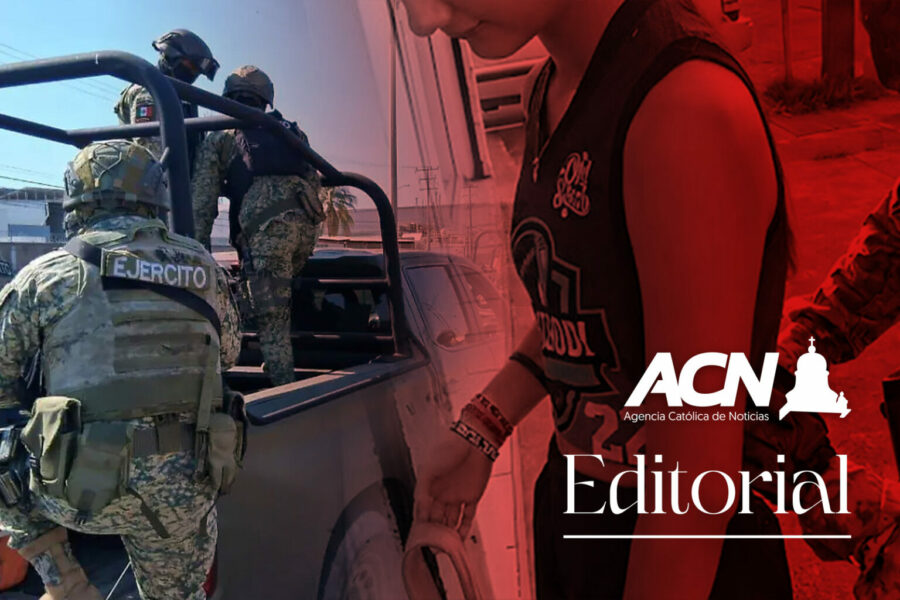
A video is circulating on social media and exposes a scene that should outrage anyone. In Mazatlán, this past weekend of August 22, a member of the army security forces conducts a body search on a 16-year-old adolescent. There are no visible signs of an ongoing crime, no judicial warrant is shown, and no guardian or personnel specialized in child care is present. Only the detention, the touching, and the violation of a girl’s privacy. The image is not an isolated incident or an “operational error.” It is the concrete expression of a logic that has normalized treating minors as if they were adults and that turns mere suspicion into a license to invade bodies that the law and international treaties mandate be protected with special care.
International instruments and the Mexican Constitution itself clearly establish that children and adolescents are not subject to the same security procedures as adults. The best interests of the child is not a rhetorical slogan; it is a guiding criterion that must steer every action by authorities. The Universal Declarations of the Rights of the Child and Article 4 of the Constitution recognize a special status for minors. Any state decision must prioritize their development, their dignity, and the full exercise of their rights. Treating a 16-year-old adolescent with the same search protocols applied to an adult suspected of a serious crime is not only disproportionate; it is a direct violation of that principle.
The safeguarding of minors’ integrity cannot be displaced by generic arguments of “public security.” Parents and guardians are the primary parties responsible for raising and protecting their children. The use of police or military force, security checks, and body searches neither replace nor nullify that parental authority. An act of interference with a minor’s body requires reasonable grounds, proper justification, and execution by trained personnel under specialized supervision. Claiming “security reasons” is not enough to subject an adolescent to a search that arbitrarily undermines her parents’ authority and exposes her to unnecessary vulnerability.
Respect for bodily integrity is even stricter. Physical inspection measures constitute a serious intrusion into personal integrity. International bodies have stressed that such measures are justified only in truly exceptional circumstances. Any form of search without parental consent or without solid, well-founded justification harms privacy, honor, dignity, and the family’s right to protect its members. Adequate protocols also require the use of technologies that avoid physical contact. Preferring manual touching of a minor’s body when non-invasive alternatives exist reveals a mindset that prioritizes the display of force over the protection of those least able to defend themselves.
The rights of minors take precedence. Article 16 of the Constitution, which prohibits interference with a person, family, home, papers, or possessions, acquires even greater relevance when children and adolescents are involved. The Supreme Court of Justice of the Nation has held that, to protect the best interests of the child, police and administrative agencies must provide special attention. Police or the military cannot equate a minor with an adult or subject them to procedures that criminalize them in advance. Their protection comes before that of adults; that is the logic of public order when childhood is taken seriously.
Finally, an environment of safety and affection must be guaranteed. A police pat-down generates tensions and risks, especially in contexts of military presence. Authorities are obliged to consider each minor on an individualized basis. In the Mazatlán case, no parent had certain guarantees that the officer who conducted the search was qualified to prevent abuse, prejudice, or negligent treatment. Nor was there any certainty that the procedure safeguarded the adolescent’s emotional balance. The result is the destruction of the safe and healthy environment that the law requires be preserved.
Mere suspicion is not a definitive element that justifies searches of minors. In Mexico, where violations of children’s rights reach alarming figures—violence, exploitation, disappearances, premature criminalization—suspicion becomes authorization for body searches that turn into a dangerous slope.
The militarization of public security cannot serve as a pretext to abuse force or to carry out inspections that harm the rights of children and youth when there is no proven justification that security is truly at risk. The security of an event, a street, or an area is not built by invading an adolescent’s body. It is built with intelligence, proportionality, respect for legality, and, above all, with the awareness that children are not objects of control but subjects of preferential rights. The degree of civilization of a society is demonstrated by the way it treats its children and young people. And it has clearly been shown that we are very far from that.