


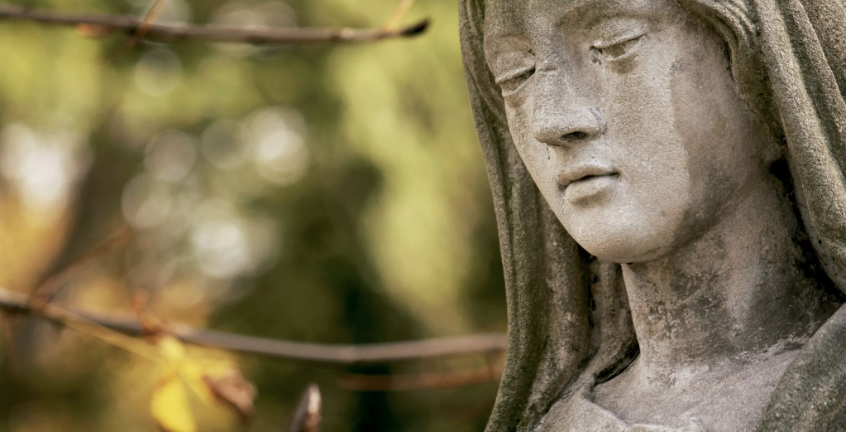
Fr. José Juan Sánchez Jácome / ACN.- The Church’s tradition pauses with recollection and devotion before the seven last words that Jesus Christ uttered before his death. In the same way, it focuses on the few words that the Virgin Mary spoke throughout her life, in which it finds countless teachings.
Mary spoke little in the Gospels, but what she managed to say is full of a depth that continues to illuminate and enamor the lives of the faithful. In addition to her words, Mary’s silence is also extremely eloquent in referring to faith and the mystery of God.
Nothing greater can be said of Mary than calling her the Mother of God, as the saints insist. José María Cabodevilla expresses it with astonishment: “We say Mother of God and we say it calmly, with the same naturalness as we say the mother of Carlos or Carlota. However, that expression demands our stupor, even a certain resistance, a certain scandal. Mother of God. At the limit of language and on the very edge of the absurd, we have had to speak thus: God, who is incapable of making another God, did the most he could do, a Mother of God.”
Within this admiration aroused by the Mother of God, even Martin Luther, in his commentary on the Magnificat (1520-1521), goes so far as to affirm: “Humanity has summarized all its glory in a single phrase: the Mother of God. No one can say anything greater of her, even if they spoke as many languages as there are leaves on the trees.”
Cardinal Francis George, referring to Cardinal Newman who related the mystery of the Incarnation to devotion to Mary, states: “Devotion protects doctrine; without an appropriate devotion, a doctrine diminishes in its influence on Christian life. Specifically, he related the doctrine of the Incarnation of the Eternal Son of God in Jesus of Nazareth to devotion to Mary as the Mother of God. Because Jesus had a human mother, He is truly man; because Jesus is God, Mary is the Mother of God. Devotion to Mary as Mother of God protects our belief in Jesus as true God and true man. Mary’s mission in the history of salvation is to strengthen our faith in the doctrine of the Incarnation.”
The Gospels record seven words of Mary, although the last one is dedicated to her by Jesus: “How will this be, since I am a virgin?” (Lk 1:34); “Behold, I am the handmaid of the Lord. May it be done to me according to your word” (Lk 1:38); “My soul magnifies the Lord…” (Lk 1:46-55); “Son, why have you treated us like this? Your father and I have been looking for you with great anxiety” (Lk 2:48); “They have no wine” (Jn 2:3); “Do whatever he tells you” (Jn 2:5); “Woman, behold your son; son, behold your mother” (Jn 19:26-27).
These words of Mary, infinite in their meaning, were spoken in the context of the angel’s annunciation, in the visit to her cousin Saint Elizabeth, in the temple of Jerusalem, when her son Jesus was lost at 12 years old, and at the wedding at Cana. Before the angel she utters her first word and at Cana she utters her last words.
At Cana in Galilee she intervenes, first speaking to Jesus: “They have no wine”; and then, giving instructions to the servants: “Do whatever he tells you.” We can highlight two aspects in Mary’s life.
First, the Virgin is a mother who takes the initiative and anticipates difficulties. Mary is a mother concerned with what I lack and aware of what I am not. She makes us see that we may have everything, but we lack the essential, whose absence can ruin the great feast of life.
Indeed, Mary is the representative of humanity in distress, of all those who are losing joy and hope. Like a true mother, who is capable of interceding and pleading for her children, Mary hastens the hour of Jesus’ intervention.
If at Cana Mary, out of her mother’s heart, intervened without anyone asking her to, imagine what she will not do for us if we ask her with faith and devotion. Saint Alphonsus Liguori said: “Before God, the prayers of the saints are the prayers of friends, but the prayers of Mary are the prayers of a Mother.”
Mary was there, just as she would also be later at the foot of her son’s cross. Like Mary, a Christian must learn to be there, at the exact moment, at the hour of pain, anguish, and need. Both at Calvary and at Cana, Jesus does not call her “mother,” but “woman,” to constitute her as the new Eve who is at the side of the new Adam in the work of redemption.
Her second intervention at Cana is to tell the servants and to tell us, almost in a tone of spiritual testament: “Do whatever he tells you.” What changes life and restores joy, what assures us of a certain course, is listening to Jesus and being willing to do what he asks of us.
Jesus’ miracle always goes beyond what is asked of him. Jesus not only saves the feast, but by copiously turning water into wine (600 liters of wine), he announces the splendor and joy of the messianic wedding feast to which we are invited.
Mary’s words immediately connect us with Jesus’ words at the Last Supper, which we hear again with devotion and solemnity at the moment of consecration during Holy Mass. Mary said: “Do whatever he tells you.” And Jesus tells us, through the apostles: “Do this in memory of me.” Mary’s words, like Jesus’, have to do with wine, with his blood shed for us, and with the joy and feast that he brings to our life when the Lord nourishes us with his body and blood.
How Jesus would remember his mother’s words at the Last Supper! Jesus surely also remembered his mother’s words at the annunciation: “May it be done to me according to your word,” when in the synagogue of Nazareth he said: “Today this scripture passage is fulfilled in your hearing.”
Through Mary’s intercession, let us ask that we not lack the wine of love, and with the prayer of Fr. José Luis Martín Descalzo, let us pray for families and marriages in crisis:
“Lord, here is our life shattered like a table after a banquet. It has been twelve years since we married, loving each other. You know that very well. She was for me the best thing in this world. I was for her the dream of her life. We swore love and eternal love. That day it would have seemed impossible to me, this coldness of today. But you see: we no longer have wine, love slipped away between our fingers like a handful of sand, and today we are empty, putting up with each other, almost like two who hate each other. And whose fault is it? How to know? The fault of both, surely. Over time we squandered the wine of love and a dark vinegar of egoisms filled our souls. And now we are here and perhaps we still love each other, but we also hate each other, and that day is approaching when neither of us matters to the other, like two strangers.
Could you not return to our home the same as you were on our wedding day? If our wine turned to water, can you not turn the water back to wine and weariness to love? Look, at the door of the soul there are six jars full of emptiness waiting for your word. We ask you for nothing. We only tell you the same as your mother on the day of Cana: Lord, we no longer have wine, we no longer have love. This is your hour! If you willed it, if you helped us, today could begin for us the best wine of our marriage.”