


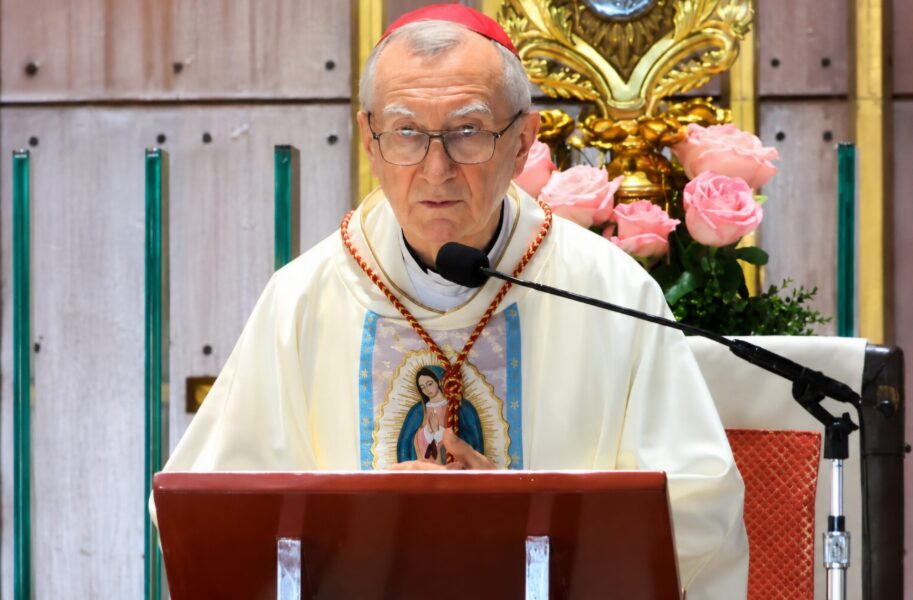
Homily of Cardinal Pietro Parolin, Secretary of State of the Holy See, at the solemn Mass of the Diocese of Torreón, Basilica of Guadalupe, Wednesday, August 5, in memory of the dedication of the Basilica of Saint Mary Major.
Dear brothers, bishops and priests, dear brothers and sisters in Christ, especially dear pilgrims of the Diocese of Torreón, who come here on pilgrimage today, accompanied by your bishop and your priests:
First of all, I would like to thank the Bishop of Torreón for allowing me to preside over this Eucharist. It was his turn, but knowing that I am just passing through, he said it was fine and yielded the place to me. Thank you very much, Your Excellency; may the Lord reward you abundantly for your kindness.
Gathered here today in this sacred place, the spiritual heart of the American continent, we bow with reverence at the feet of Our Lady of Guadalupe, Our Mother. It is an honor and a privilege for me to celebrate this Mass with all of you, and I am especially pleased to do so with the pilgrims of the Diocese of Torreón. And to all, I am glad to convey the special blessing of the Holy Father, Pope Leo XIV, and to express his closeness to all of you and even more so to the entire people of this great land. I give thanks to God for celebrating the Eucharist in this sanctuary, precisely on the day when the Church celebrates the liturgical memorial of the dedication of another great Marian church, the Basilica of Saint Mary Major in Rome.
According to tradition, in the fourth century, a noble and wealthy Roman without children, named John, together with his wife, prayed to the Virgin Mary, asking her for guidance on how to use their fortune to honor her. The Virgin Mary appeared to them in a dream on the night of August 4, 352 AD, instructing them to build a church on the Esquiline Hill and promising that the exact location would be miraculously marked by snow.
That same night, Pope Liberius had an identical vision. The following morning, August 5, amid the sweltering heat of the Roman summer, the summit of the Esquiline Hill was covered with a perfect layer of snow, upon which the Pope traced the foundations of the church, beginning the construction of the original Basilica of Saint Mary Major. The miracle of the snow is commemorated each year with a solemn celebration in the basilica. During the liturgy, a shower of white rose petals falls from the ceiling, evoking the miracle and reminding all present of the closeness of the Mother of God.
This reenactment naturally leads us to the miracle of Guadalupe, in which roses fell from Juan Diego’s tilma, revealing the miraculous image of the Virgin. Of course, the true unity between both stories does not lie in the flowers, but in the presence of the Virgin, who never ceases to show her closeness and concern for her children, always helping them draw ever closer to her divine Son. Do we not see in today’s Gospel a clear example of a mother’s love? This mother pleads before the Lord, not for herself, but for her daughter. She will not rest until she has done everything possible for her. And her faith tells her that only Jesus Christ can grant her what she needs.
The Lord rewards the absolute trust she places in Him, as well as her determination. Her example resonates with special force here in Mexico, where so many mothers continue to search with steadfastness and faith for their missing children. Nothing can stop them from doing everything possible to help their children, and we can all help them with our prayers so that, like the woman in today’s Gospel, their perseverance and faith may be rewarded.
This sanctuary holds deep meaning for many people throughout the Catholic world. It is a place of pilgrimage, reflection, conversion, vision, and prayer. Our times are marked by numerous challenges. The scourge of war, the horror of hunger, and the devastation of violence are all too frequent in a world that has known two millennia of the preaching of the Good News of Jesus Christ.
What can we learn in this place that will help us face the countless challenges ahead? Without a doubt, the first is presence. Our Mother came here and, in fact, reminded Juan Diego with words that have echoed through the centuries: Am I not here, I who am your Mother?
Her presence brought comfort and security to a society that had experienced rapid and unexpected changes. Her apparition showed a way to reconcile cultures and peoples in a truly universal faith, where there is neither Jew nor Greek, neither slave nor free, but all are united as one. Her example challenges us to be present also for the needy, the marginalized, migrants, and foreigners.
She did not appear to the powerful or the influential, but to a simple man. And yet, her message through him has reached the most remote corners of the world. That is the second lesson we can learn here: that although we may be small and weak, by the grace of God we can work wonders.
A faithful witness to the truth of the Gospel can transform hearts and, therefore, transform the world. Despite the many terrible situations that persist in our time, I am constantly impressed and indeed moved by the faithful witness of believers who follow Christ amid difficulties and suffering, whether in refugee camps, field hospitals, ministering in war zones or in areas ravaged by disease. And each one of us, dear brothers and sisters, is called to give that witness in our homes, our families, our workplaces, and, of course, in the public and civic sphere.
The whole of society needs the message of the Gospel, and all of us are, like Saint Juan Diego, bearers of a message we are called to share.
The final aspect of the meaning of this sanctuary on which I would like to dwell is prayer. We come here to contemplate the Virgin Mother of God and to meditate on all that her presence represents. How can we look upon this image and not feel moved to prayer? Dedicating time to the meditation of the Word, to adoration, and striving to deepen our interior life of communion with God are not optional extras for Christians, but the essence of our relationship with God. Nothing can replace this personal relationship with the Lord. Each of us is invited to set aside time to open ourselves to the Lord and truly listen to His voice in prayer.
When the Lord speaks of giving us His peace, a peace that the world cannot give, He speaks of something that is found only in prayer. A true fruit of prayer is that inner peace which comes from on high, where God, through the presence of the Holy Spirit, dwells in the human heart. This is a place where we can pray for peace, first in our own hearts and then in our society.
Too many communities are marked by violence and aggression, and too many families have known the pain of loss because of it. From Tepeyac, from this sacred little house, Mary of Guadalupe, the Mother of the true God for whom one lives, today as yesterday, invites us to a school of prayer where the lesson she teaches us is the pacification of peoples and reconciliation among brothers and sisters.
To this end, for these intentions, then, in conclusion, we implore: Our Lady of Guadalupe, intercede for us. Saint Juan Diego, pray for us. Amen.