


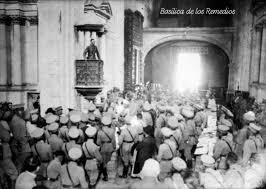
El Semanario de Guadalajara / Armando González Escoto.- The first of August marks one hundred years since the suspension of public worship decreed by the Bishops of Mexico. One hundred years also since the enactment of the Calles Law, which codified the articles on ecclesiastical matters published in the 1917 Constitution. One hundred years since the first armed uprisings that took place from August to December in Zacatecas, Guanajuato, and Jalisco, laying the groundwork for the so-called Cristero War, which was called in January 1927. Between 1927 and 1929, one hundred years will have passed since numerous martyrs who, without having taken up arms, were sacrificed.
Over these one hundred years, all kinds of accounts, testimonies, legends, myths, ideologically driven historiographical research or neutral ones seeking objectivity, successful canonization processes, stalled, altered, or suspended ones, as well as accusations, grudges, revenges, and an enormous confusion that persists to this day have circulated, and the current anniversary may be an opportunity to clarify, if we learn to place truth above sentiment and ideology.
Of course, we already have very concrete data that will need to be developed and explained in due time, for example: the martyrs were not Cristeros, the Cristeros cannot be martyrs; President Plutarco Elías Calles did not suspend public worship; for most of the beatified or canonized martyrs, we do not know what their last words were, the conditions that in those years qualified a war as just never existed in the Mexican case unless arguments are forced, clarify the type of persecution experienced in Mexico, avoiding generalizations or simplifications, and likewise understand that some of the martyrs did not meet the requirements to be canonized unless they had been granted a dispensation.
Broader studies are still pending on the effects of the suspension of public worship on the Christian community, particularly on the clergy, as well as the question of the harm suffered by the civilian population at the hands of both the federal army and the Cristeros, the study of the formative processes that those who were Bishops received at the time, to understand the diversity of their positions, or the specific character of Mexican religious nationalism analyzed as an ideology with all the negative characteristics that processes of ideologization have in any field. The same study would be required to understand why two-thirds of the Mexican states did not take part either in peaceful or armed defense during the religious conflict.
Pending are studies in the field of gratitude we owe to the North American and Spanish dioceses that helped the Church on pilgrimage in Mexico during those years, but also to the countries whose diplomats collaborated intensely in the search for a solution, such as Chile, France, and the United States. Also for the solidarity shown by the Catholic communities of Belgium, Italy, Cuba, and others. Equal recognition to the Mexican legislators who finally abolished the anticlerical laws after an intense process that ran from 1987 to 1992.