


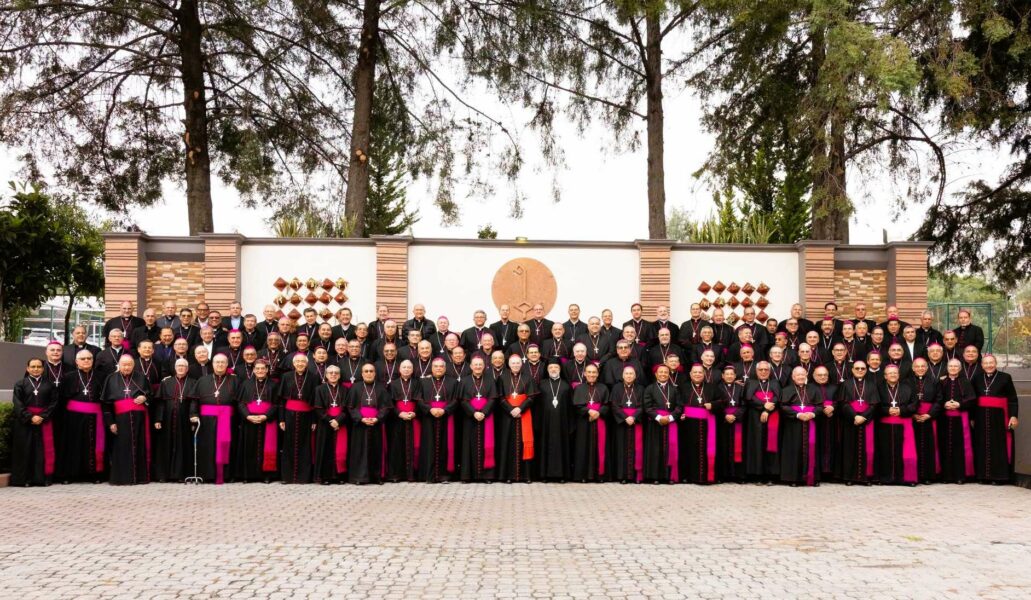
The opening declaration of the Jubilee Year for the centenary of the Cristera Resistance constitutes the main event of the 121st plenary assembly of the Conference of the Mexican Episcopate. Upon concluding their work, the bishops addressed a message to the people of God in which they link the memory of the martyrs of Christ the King with a question that takes on special gravity in light of the national situation: What should be the attitude of believers in the face of violence, corruption, political polarization, and the advance of organized crime?
The episcopal document states that Mexico is going through deeply complicated social and political scenarios marked by violence, division, the presence of organized crime, and widespread corruption. Added to this are political struggles that polarize and confuse society, as well as laws that, from the bishops’ perspective, seek to silence dissenting and critical voices.
In the face of this panorama, the response proposed by the Church is neither withdrawal nor indifference. Nor is it confrontation through violent means. The Episcopate calls on believers to remain steadfast in the faith and to put on the “armor of God,” an image taken from Saint Paul that refers to the spiritual strength needed to endure difficult times. The battle, the bishops emphasize, is not fought with physical weapons, but through trust in God and commitment to justice, truth, and peace.
This exhortation takes on a historical dimension with the announcement of the Jubilee Year granted by Leo XIV, which will be celebrated from November 22, 2026, to November 21, 2027. The commemoration recalls the martyrs of Christ the King, as well as the families and priests who preserved the faith and religious practice during the persecution. It is not presented merely as an evocation of the past, but as a call to examine the responsibility of Catholics in light of present circumstances.
The centenary of the so-called Cristera Resistance places at the center of episcopal reflection the public meaning of faith. The memory of those who defended their religious convictions must translate, according to the message, into a courageous, committed faith capable of constructively engaging in social life. The Jubilee would have no meaning if it were reduced to commemorative ceremonies, expressions of nostalgia, or historical claims disconnected from current problems.
For this reason, the bishops insist that the commemoration must strengthen faith and promote pastoral renewal. This renewal begins, they maintain, by “returning to Jesus,” recovering his words as good news, and rediscovering the passion that transformed the lives of the first disciples. The Church needs to begin anew from Christ in order to communicate the Gospel to a society wounded by fear, injustice, and fragmentation.
The attitude of the believer, therefore, cannot consist of a spirituality isolated from reality. The Christian proclamation has a social dimension that requires commitment to the common good. Hence, the Episcopate proposes to review, renew, and promote the evangelizing processes of communities through a living, experiential, and communal catechetical formation. The goal is not only to transmit religious knowledge, but to form consciences capable of acting responsibly.
The message also contains a concrete commitment to walk alongside the victims of violence and injustice, to accompany families searching for their missing loved ones, and to support those who defend human rights and social causes. The suffering of the victims, the bishops warn, challenges the Christian conscience and demands a Church that is close, supportive, and a builder of peace.
This statement constitutes one of the most significant points of the pronouncement. Steadfastness in faith must not be confused with passivity or evasion. To resist as Christians means to defend the dignity of the person, to proclaim the truth without ambiguity, and to work for a more humane, just, and solidary society. It also means rejecting the temptation to respond to hatred with hatred or to turn religion into an instrument of political confrontation.
The centenary commemoration is also linked to the Intercontinental Guadalupana Novena, conceived as another path of renewal for Christian life. Both initiatives aim to make present the demands of the Gospel and contribute to the building of the Kingdom of God under the sign of Redemption.
The question posed by the Episcopate thus finds a demanding answer. In the face of a wounded Mexico, the attitude of the believer must be steadfast in faith, courageous in defending human dignity, close to the victims, and active in the building of peace. The Jubilee Year of the Cristera Resistance will be an authentically Christian commemoration if the memory of the martyrs does not fuel new divisions, but rather a hope capable of transforming the present.