


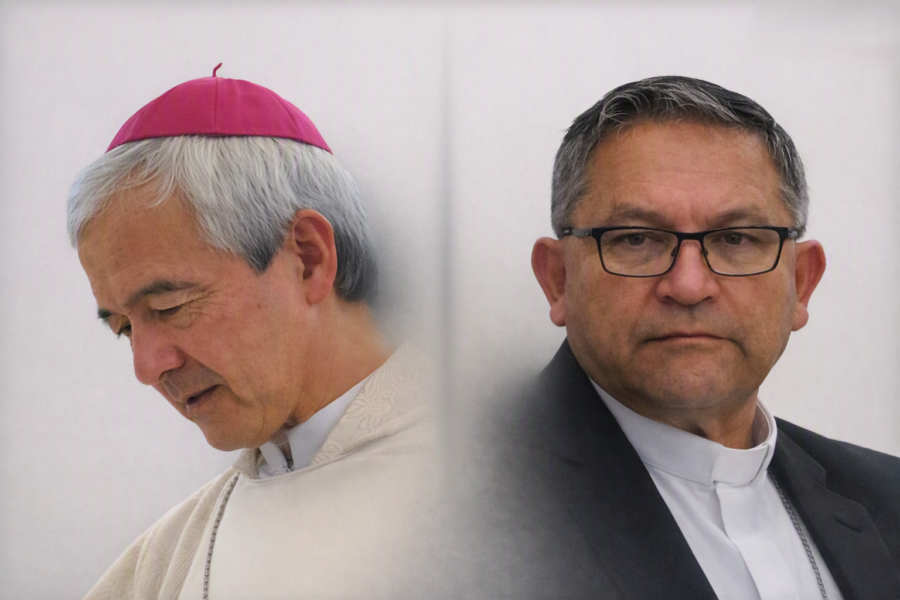
On the morning of this Monday, September 21, 2026, the Mexican Episcopal Conference announced two appointments that are reshaping the episcopal map of central Mexico. Leo XIV accepted the resignation of Víctor Sánchez Espinosa from the pastoral governance of the Archdiocese of Puebla de los Ángeles and appointed as his successor Jorge Carlos Patrón Wong, until now Archbishop of Xalapa, who will be the IX Archbishop of that see. Likewise, the resignation of Fidencio López Plaza from the head of the Diocese of Querétaro was accepted, and Víctor Alejandro Aguilar Ledesma, until now Bishop of Celaya, was named its XI Bishop.
Both resignations close important episcopal chapters. Sánchez Espinosa was born on May 21, 1950 and López Plaza on April 28, 1950; both had already reached the age of 75, the age at which diocesan bishops must submit their resignation to the Pope. The first governed Puebla from his appointment on February 5, 2009, for nearly seventeen years. The second had been in Querétaro since 2020. According to the Archdiocese of Puebla itself, Sánchez Espinosa will remain as Apostolic Administrator until the installation of Patrón Wong, scheduled for Thursday, November 19, 2026.
The new Archbishop of Puebla, Jorge Carlos Patrón Wong, was born on January 3, 1958, in Mérida, Yucatán. He was ordained a priest on January 12, 1988 by Manuel Castro Ruiz for the Yucatecan clergy. He studied Philosophy and Theology at the Conciliar Seminary of Yucatán and, between 1988 and 1993, earned a licentiate in Spiritual Theology and Psychology from the Pontifical Gregorian University in Rome. In 2022, the Marist University of Mérida awarded him an honoris causa doctorate. After a brief service as vicar in Ticul and Tizimín, he established himself as a formator; between 1994 and 2000 he served as prefect of the minor seminary and of the theological stage, coordinator of human formation, and professor of Psychology, Philosophical Anthropology, and Spiritual Direction. He was chaplain to religious sisters, advisor to the university group Omega and to the School for Parents, lecturer and chaplain at Marist institutions, spokesperson for the Archdiocese of Yucatán, and coordinator of its media commission. From 2000 to 2009 he was rector of the Conciliar Major Seminary of Yucatán. During those years he presided over the Organization of Mexican Seminaries (2003-2008) and the Organization of Latin American Seminaries (2004-2009). That formative vocation foreshadowed the role that would later take him to Rome.
Benedict XVI appointed him Coadjutor Bishop of Papantla on October 15, 2009; he received episcopal ordination on December 15 of that year, and on May 2, 2012 he became ordinary of the diocese. Within CELAM he served on the Department of Vocations and Ministries, and within the CEM he chaired the Episcopal Commission for Vocations and Ministries for the 2012-2015 triennium. The decisive turn came on September 21, 2013, when Pope Francis raised him to the dignity of archbishop and appointed him Secretary for Seminaries of the Congregation for the Clergy, a responsibility he exercised until February 2022. For nearly nine years he was one of the Mexicans with the greatest influence on priestly formation on a universal scale. At the same time, Francis made him a member of the Congregation for Catholic Education, a consultor of the Congregation for the Evangelization of Peoples, and a counselor of the Pontifical Commission for Latin America. In 2020 the Government of Mexico awarded him the Ohtli recognition for his work with compatriots abroad.
On December 8, 2021, Francis appointed him V Archbishop of Xalapa. He took possession on February 8, 2022; from the Roman dicastery he moved, in one leap, to the metropolitan see of Veracruz. In Xalapa he did not sever his ties with Rome or with Latin America. In 2022 he was named a member of the Dicastery for Divine Worship and the Discipline of the Sacraments; in 2023, coordinator of the CEBITEPAL of CELAM and episcopal advisor to the Serra Apostolate in Mexico and Central America. In the 2024-2027 triennium he again chaired the CEM Commission for Vocations and Ministries. Already under Leo XIV he was appointed consultor of the Dicastery for Evangelization in June 2025, and again counselor of the Pontifical Commission for Latin America in January 2026. The same pontiff now sends him to Puebla. The itinerary is notable: formator in Yucatán, bishop in Papantla, Vatican secretary for seminaries under Francis, Archbishop of Xalapa, and, four and a half years later, holder of one of the oldest sees in the country, of greater pastoral and spiritual influence and relevance to public powers, in one of the regions of the country with the deepest roots and history of the Church in Mexico.
On January 24, 1519, in one of history’s coincidences, Leo X erected with the bull Sacri apostolatus ministerio the germ of the Diocese of Puebla, the Carolensis diocese, first conceived for Yucatán and recognized as the first episcopal circumscription established for the territory that would become New Spain. The Dominican Julián Garcés was its first bishop. The see was fixed in Tlaxcala and, between the late 1530s and the royal decree of 1543, it was transferred to the city of Puebla de los Ángeles, better endowed with a church and a strategic position. For centuries it retained the title of Tlaxcala. On August 9, 1903, Pius X elevated it to a metropolitan archdiocese. Its episcopal roster includes the blessed Juan de Palafox y Mendoza, Manuel Fernández de Santa Cruz, and, in the twentieth century, Ramón Ibarra y González, who managed the elevation; Octaviano Márquez y Toriz; and Rosendo Huesca Pacheco, whose governance exceeded 31 years. On January 28, 1979, John Paul II inaugurated the III General Conference of the Latin American Episcopate at the Palafoxian Seminary, forever linking the name of Puebla to the history of the Church on the continent.
Today the Angelopolitana Province has as its suffragans Huajuapan de León, Tehuacán, and Tlaxcala. Its own territory covers nearly 21,000 square kilometers. The Annuario Pontificio, with data from the end of 2021, records 5 million 660 thousand baptized Catholics out of a population of 7.18 million, that is, nearly 79 percent. The archdiocese is organized into six pastoral zones and 31 deaneries, with more than 300 parishes—316 according to that same pontifical statistic—and a landscape of churches, shrines, and hermitages exceeding two thousand five hundred buildings. It is an ancient, dense, and complex local Church, baroque in its heritage, contemporary in its demography. It receives an archbishop whose hallmark is not that of a pastor of a single long diocese, but that of a formator of seminarians who knew the Curia from within and later governed a metropolitan see, with relative distance from public power, since Patrón has also been, in a moderate way, critical of the powers in office.
The second move operates on a different scale and geography. The new Bishop of Querétaro, Víctor Alejandro Aguilar Ledesma, was born on April 5, 1965 in San Guillermo, municipality of Valle de Santiago, Guanajuato. He entered the Minor Seminary of Morelia in 1977, studied Philosophy and Theology at the Major Seminary between 1982 and 1989, and was ordained on December 10, 1989 in the cathedral of Morelia by Estanislao Alcaraz Figueroa. Between 1997 and 1999 he obtained in Rome a licentiate in Theology of Marriage and the Family at the John Paul II Institute of the Pontifical Lateran University. That family imprint runs through his ministry: vicar in Salamanca and Pátzcuaro, parochial administrator in El Caracol, head of the diocesan secretariat for evangelization and catechesis, rector of churches, seminary professor, head of Family Ministry of the Archdiocese of Morelia from 2003 to 2010, pastor of the Señor de la Clemencia in Moroleón, and episcopal vicar of a zone.
Francis appointed him Auxiliary Bishop of Morelia on December 1, 2015, with the titular see of Cástulo; he received ordination on February 25, 2016. On June 12, 2021 he was sent to Celaya, of which he took possession on July 12 as its V bishop. Within the CEM he was responsible for the Episcopal Dimension for the Laity in the triennia 2018-2021 and 2021-2024, and for 2024-2027 he chairs the Episcopal Commission for the Family, Youth, Adolescence, the Laity, and Life. The transfer to Querétaro does not take him out of the Bajío; he was born in Guanajuato, formed in Morelia, pastored Celaya, and now assumes a diocese that comprises the entire state of Querétaro and seven municipalities of Guanajuato—Atarjea, Doctor Mora, San José Iturbide, Santa Catarina, Tierra Blanca, Victoria, and Xichú. He is a bishop of the region who remains in the region, in a see of strong urban growth, industrial corridor, and dense popular religiosity.
Querétaro does not have the antiquity of Puebla, but its history is deeply religious and linked to the history of Mexico. Pius IX erected it on January 26, 1863 with the bull Deo optimo maximo, detaching it mainly from the Archdiocese of Mexico, in the same movement that created other dioceses and elevated Morelia and Guadalajara. The bull was executed on February 7, 1864. The first bishop, Bernardo Gárate López de Arizmendi, arrived on January 29, 1865, erected the chapter and seminary, and died the following year. The diocese was born amid the Reform, the French Intervention, and the Siege of Querétaro. Its cathedral passed from the parish of Santiago to the church of San Francisco and, from 1921, to San Felipe Neri. In the list of prelates—ten up to López Plaza—the years of persecution and the Cristero War weigh heavily, as do the episcopate of Francisco Banegas Galván and the reconstruction of the twentieth century. Since November 25, 2006 it has been a suffragan of the Archdiocese of León, in the ecclesiastical province of the Bajío.
The most recent figures from the Annuario Pontificio place the diocese at around 2.66 million Catholics out of a population close to 2.97 million, with about 120 parishes, more than 360 priests, and 15,326 square kilometers. Local spokespersons have spoken of extreme contrasts: urban parishes of tens of thousands of inhabitants and mountain communities of only a few thousand. That demographic and economic vitality, and not only the number of churches, explains the pastoral weight of the see that Aguilar Ledesma receives.
Read together, the new appointments touch two of the most relevant ecclesiastical entities with a projection that surpassed several forecasts. Puebla, a Church of half a millennium and of more than five and a half million baptized, is placed in the hands of an archbishop who formed priests from Yucatán, Papantla, and the Vatican. Querétaro, a diocese of 1863 and engine of the Bajío, is placed in the hands of a Guanajuato bishop, specialist in family and laity, who does not leave the region. A see dating from the beginnings of the evangelization of Mexico and another from the nineteenth century receive on the same day distinct pastors, yet both with institutional expertise and the concrete charge of translating that history into living communities with the influence their predecessors exercised.