


The Observatory of Catholic Citizenship and Social Analysis published its report number 69, Fissures and Decline of the 4T, on August 24, 2026, a diagnosis that maintains that the regime of the Fourth Transformation has entered a decline that appears irreversible, marked by corruption, internal deterioration, and the weakening of institutions. The text starts from an ethical criterion of Benedict XVI in Caritas in veritate: alongside individual good exists the common good, that of the “all of us” formed by persons, families, and intermediate groups, a good that is not sought for itself, but for those who can only achieve it effectively in an ordered social community. Working for it implies caring for the institutions that structure legal, civil, political, and cultural life. From that premise, the observatory asks whether Mexican-style populism of the 4T can survive further acts of corruption and what consequences a movement in near-absolute power that is in full decline has for the country.
The first blow documented in the report is the discrediting of two figures from the inner circle of Andrés Manuel López Obrador. On June 9, the U.S. Department of State confirmed the visa cancellation of Morena senator Adán Augusto López Hernández due to investigations into alleged ties to organized crime. On the night of August 13, Andrés Manuel López Beltrán (“Andy”), the former president’s son, released a letter to Donald Trump in which he denounces that his visa was withdrawn “unjustifiably” and demands the dismissal of Marco Rubio and Christopher Landau, whom he accuses of engaging in “Hitler-style politicking.” He also requests a personal response from the U.S. president. At the morning press conference on August 14, President Claudia Sheinbaum defended López Beltrán and described the cancellations as an act of political interference: “it is not even-handed, it is not for all countries… they are attempts to interfere in Mexican politics.” The Catholic Observatory interprets these revocations as a harbinger of ministerial and judicial persecution by the U.S. Department of Justice, and maintains that Andy’s letter bears the mark of AMLO or, at the very least, his approval: the absurdities would be the work of “father and son in delirious communion.”
On the international level, the report records contrasts that erode Mexico’s regional leadership. At the 40th International Conference for Drug Control (IDEC), held on August 18 and 19 in Buenos Aires, Terry Cole, head of the DEA, praised Omar García Harfuch as “a trusted partner and a good friend of the United States over the past 20 years.” The praise contrasts with previous statements by members of Trump’s cabinet regarding links between Mexican politicians and the cartels. The analysis clarifies that there is no double talk: Harfuch is singled out precisely because that trust was built over two decades. Simultaneously, on August 19, the OAS urgently convened a hemispheric meeting on Daniel Ortega’s announcement to permanently suspend elections in Nicaragua (“There will be no more elections here”). Twenty-six countries supported the call; Mexico abstained and Brazil voted against. Alejandro Encinas called for respect for Nicaraguan sovereignty and for prioritizing dialogue. The Observatory recalls that AMLO is a founder of the Puebla Group, an extension of the São Paulo Forum, of which Ortega is a founding member, and that the abstention shows the international discredit of the government due to the causes it defends.
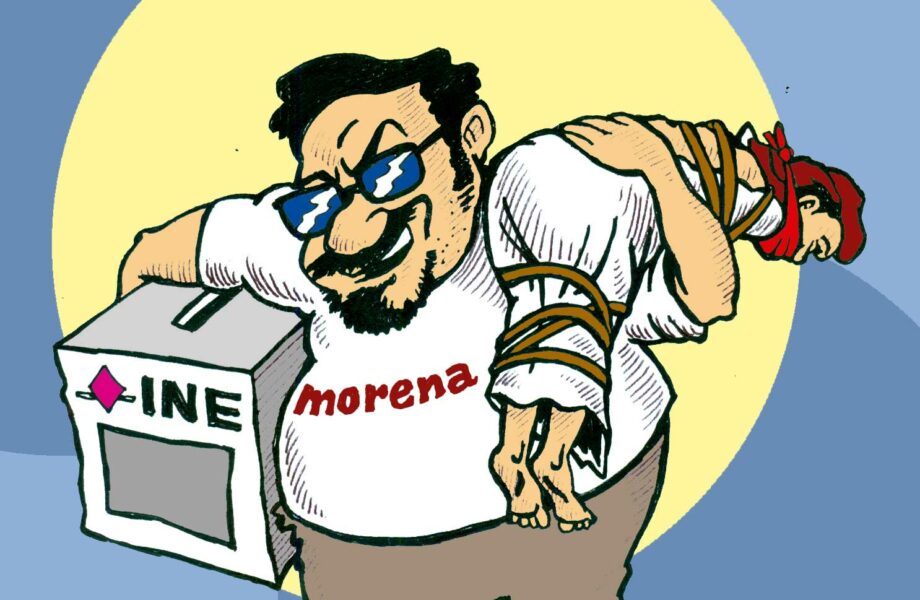
On the eve of the 2026-2027 electoral process, which was to begin on September 10, the report points to disagreements in the leadership of the INE and the TEPJF. On July 31, the INE’s Complaints and Denunciations Commission prohibited the PRI and its leader Alejandro “Alito” Moreno from calling Morena a “narco party” and from using expressions such as “narcogovernment,” “Morena cartel,” or “narcodictatorship.” The Catholic Observatory warns that this prohibition appears to extend to parties, media, and journalists. On August 20, Mónica Soto Fregoso, president of the TEPJF, presented a surprising resignation that, according to the document, was legally unjustified, without the constitutional “serious cause.” She not only left the presidency: she resigned outright from the tribunal, effective August 31. The report recalls that Soto reached that position through maneuvers by then-deputy Sergio Gutiérrez Luna to validate an artificial majority of Morena and its allies that enabled AMLO’s “Plan C,” and that she approved without major questioning the judicial election riddled with irregularities. The Senate approved the resignation in fast track. The vacant position has no certain date for replacement, leaving the Superior Chamber incomplete at the start of the electoral calendar. The observatory asks whether there is a plan to stop a possible opposition victory in 2027 from the TEPJF.
The fourth event is the controversial return of Rubén Rocha Moya to the governorship of Sinaloa on August 21. Journalistic reports indicated that AMLO left Palenque and installed himself in Mexico City to politically operate the defense of his closest circle in the face of possible hesitations by Sheinbaum. That same day, Morena governors issued a statement of “absolute and categorical support” for the president and criticized “the excess, individual decisions, and factional interests.” Ricardo Monreal maintained that Rocha’s return “has not been timely,” that the State did not authorize it nor was it informed, and asked him to request leave again. For the Catholic Observatory, Rocha Moya has operated the financial relationship between the Sinaloa Cartel and Morena, with AMLO’s consent. The report links these events to allegations of irregular campaign financing ahead of 2027: journalistic investigations speak of unreported resources and cash-collection schemes. Although it does not assert a direct causal relationship with the crisis at the INE and the TEPJF, it notes that the origin of the disputes in the INE’s General Council lies in the accusations of “narco party.”
The analysis identifies two structures that creak. The first is dual power: AMLO operates from the capital the defense of his figures and his project, while Sheinbaum faces the institutional and international consequences. The second is Mexico’s leadership in the Latin American left, eroded by its stance at the OAS and the contrast between the praise for Harfuch and the visas withdrawn from Andy and Adán Augusto for alleged ties to organized crime and huachicol operations linked to the CJNG. The document concludes that institutions are weakening: the presidency in the face of caciquism, personalistic decisions imposed on institutions, and the inexplicable amputation of the tribunal that determines the legality of electoral processes. Added to this is international discredit and an Attorney General’s Office whose autonomy, according to the report, does not allow it to see what affects the ruling party. “All that has been expressed are but clear signs of the fissures and internal decline of the 4T,” it states.
The scenario, the Catholic Observatory maintains, is set for a united and vigorous citizen presence that changes the country’s course. The good at stake is not that of a political project, but that of the persons, families, and institutions that can only achieve their good effectively in an ordered social community.
The full analysis can be read here: