


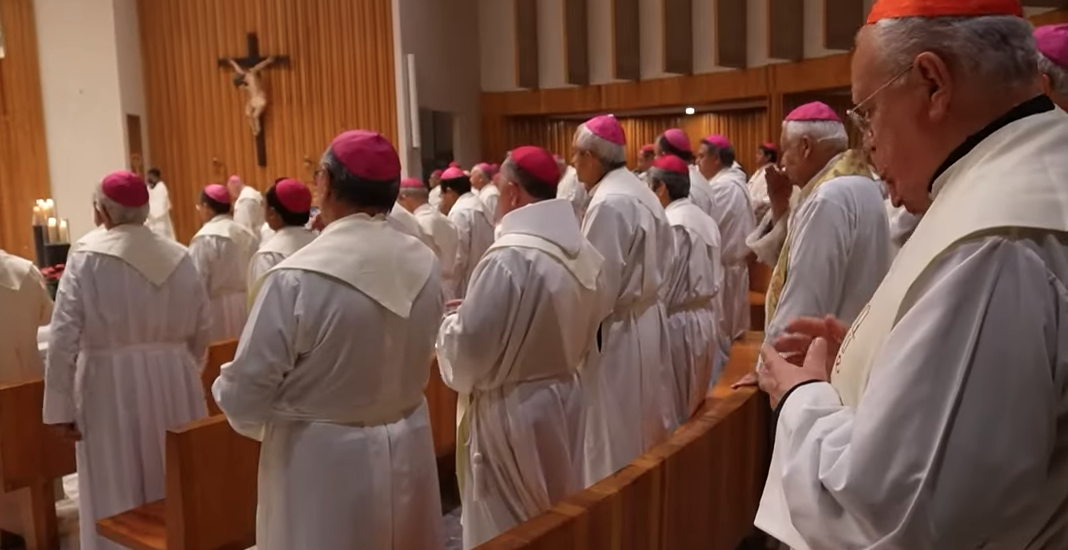
From April 13 to 17, 2026, the 98 bishops and archbishops who lead the dioceses of Mexico will gather at Casa Lago to celebrate the CXX Plenary Assembly of the Mexican Episcopal Conference (CEM). The president of the CEM and bishop of Cuernavaca, Ramón Castro Castro, delivered a message to Mexican Catholics in which he invited them to accompany the meeting with prayer and trust in the Holy Spirit.
“From April 13 to 17, all the bishops of Mexico will be gathered in the 120th Plenary Assembly to reflect and discern together on the challenges and opportunities we face as a Church. In this meeting, we will raise our prayers and thoughts to the Lord, seeking the light of the Holy Spirit to guide our decisions and actions,” affirmed Castro Castro.
The bishop asked the faithful “to accompany us in this process through your fervent prayers” and highlighted that “communion in prayer strengthens our Church and allows us to advance in the mission entrusted to us by our Lord Jesus.” He also invoked the intercession of the Virgin Mary, “Mother of the Church,” and concluded with a greeting of peace: “May the peace and blessing of the Lord be with each one of you, your families, your communities. Courage.”
The tone of the message is serene and spiritual. Castro Castro emphasizes the need for collective discernment and for raising prayers in the face of the “challenges and opportunities” that the Church in Mexico faces. However, this call for unity and communion clashes head-on with the critical view that, from specialized journalism, has been made about the way the assembly develops.
In the podcast Bajo Llave, hosted by Felipe Monroy, María Eugenia Jiménez, Lilian Reyes, and Juan Pablo Reyes, the socio-religious analysts harshly questioned the lack of transparency of the episcopal meeting. “These plenary assemblies are just like under lock and key,” they stated. They described the venue as an “ecclesiastical bunker,” a walled complex accessible only by prior invitation and by bus, surrounded by surveillance and with an annex built specifically so that journalists do not cross paths with the bishops. “A few years ago the press conference was held in the same building where the bishops worked; now they keep them far away, literally they don’t cross paths with them even from afar,” they lamented.
The journalists recalled that, at the end of the last century, there were more combative and communicative bishops who were not afraid of the press or social scrutiny. “Today they live in a bubble, they issue messages and trust that they will reach the people of God on their own,” they criticized. They pointed out that neither President Ramón Castro Castro nor the general secretary, Héctor Mario Pérez Villarreal, nor the treasurer Jorge Alberto Cavazos Arispe usually grant open interviews or broad press conferences. “They are afraid of reporters’ questions,” they summarized.
Beyond the form, the analysts of Bajo Llave questioned the agenda itself. Although they recognize that the assembly will analyze the situation of the country and review pastoral projects, they warned that urgent issues seem to dilute or arrive late. They mentioned forced disappearances—one of Mexico’s most serious scourges—and warned that, although it will probably be encompassed under the generic umbrella of “peace building,” there is no specific episcopal structure to accompany the collectives of searching mothers. “The Catholic Church arrives late to this phenomenon,” they affirmed. They recalled that small churches and clerics have accompanied these families for years with “pick and shovel,” while the hierarchy has barely opened spaces like the recent mass at the Basilica of Guadalupe.
Another gap pointed out was attention to childhood and victims of sexual abuse by clerics. “We don’t see a strong flag against abuses. Childhood seems reduced to transmitting the faith, but no concrete defense is offered to them,” they denounced. They also criticized the lack of effective “listening centers” for the faithful facing everyday problems, unemployment, insecurity, family violence. “There is a lack of organization, a lack of real listening,” they insisted.
The hosts recalled that the bishops have a Global Pastoral Project approved years ago, with six concrete work options, but they doubted that the majority could list them. “Pope Francis told them: ‘make a plan.’ They did it, but it seems they forgot it,” they ironized. They demanded grounding synodality in concrete actions: social pastoral care, attention to migrants, victims of violence, and true coordination with the laity, who are the main pastoral agents in the parishes.
In political matters, the analysts warned that a distancing from the federal government persists. Religious freedom, migration, and insecurity continue to be pending issues for fluid dialogue, they affirmed.
Thus, while Bishop Ramón Castro Castro calls for prayer, communion, and discernment illuminated by the Holy Spirit, specialized religious journalism puts its finger on the sore spot, an assembly that, despite its importance, remains hermetic, distant from the faithful and the media, and with an agenda that, according to its critics, does not respond with the urgency and closeness that Mexico demands from its pastors. The 120th Plenary Assembly starts with a message of encouragement and hope from the episcopal dome; outside the bunker, however, the question persists as to whether that communion will really reach “ground level” to the communities that need it most.
The “Bajo Llave” podcast can be listened to here: