


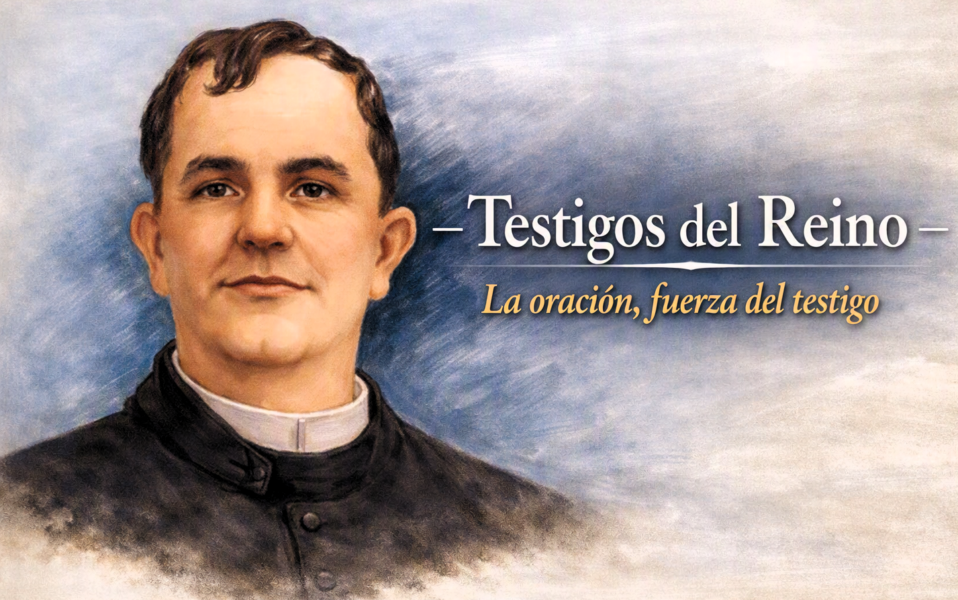
The bishop of Cuernavaca and president of the Mexican Episcopal Conference, Ramón Castro Castro, recently offered a catechesis within the series “Witnesses of the Kingdom” that has left a profound mark on the faithful. Under the title “Prayer, the Strength of the Witness”, the prelate evoked the figure of Saint Miguel de la Mora de la Mora, protomartyr of Colima, to show how prayer becomes the sustenance of Christian fidelity amid persecution and adversity.
The account shared by the bishop is striking: a priest facing the firing squad, taking his rosary from his pocket and beginning to pray. That gesture sums up an entire life and becomes a symbol of spiritual resistance. Saint Miguel was born in 1874 in Tecalitlán, Jalisco, and was ordained a priest in 1906. He served in the cathedral of Colima with simplicity and dedication, especially toward the poor and the sick. Two loves defined his ministry: the Eucharist and the Virgin Mary, whose rosary he always carried with him.
The catechesis recalled that Colima was the first state to enforce the Calles Law, which sought to restrict the Church’s activity. In the face of this, Father Miguel remained steadfast: he preferred to hide and continue serving his community rather than yield to pressure. Finally, he was arrested and executed by firing squad, falling struck down with the crucifix in his hand and prayer on his lips. His death, witnessed by his brother, became a testimony of fidelity and courage.
For Castro Castro, the martyr’s example reveals that prayer is not an escape from reality, but a secret energy that sustains fidelity to the end. In a world marked by noise and distraction, he recalled the words of Pope Leo XIII on the need to guard the interior life. Saint Miguel’s rosary, he said, is a school of interiority and a serene denunciation in the face of injustice. No authority can command over conscience or over the worship of God. Prayer, far from being a passive refuge, becomes a spiritual weapon that allows resistance without violence, with the force of truth and the gentleness of witness.
The catechesis posed an incisive question: where did Saint Miguel draw the strength to remain faithful when it cost him his life? The answer, the bishop noted, lies in prayer. Whoever truly prays, endures. He invited the faithful to take the rosary in their hands, following the martyr’s example. In times of cultural crisis and relativism, prayer presents itself as a path of resistance and affirmation of human dignity. “Saint Miguel de la Mora, pray for us,” he concluded, reaffirming the motto that accompanied so many Mexican martyrs: “Long live Christ the King and Holy Mary of Guadalupe!”.
Beyond the historical evocation, the catechesis is part of a broader pastoral context: the need to strengthen the interior life of believers in the face of external pressures. The figure of the martyr becomes a mirror of the present, where faith is challenged by ideologies, political systems, or cultural dynamics that seek to relegate the religious to the private sphere. The bishop insisted that prayer is also a denunciation: an act that reveals the primacy of conscience over any power. In this sense, the testimony of Saint Miguel challenges Mexican society, reminding us that fidelity to transcendent values may demand sacrifices, but it never loses its relevance.
Ramón Castro Castro’s catechesis was not limited to a historical remembrance. It was a call to rediscover prayer as a transformative force, capable of sustaining fidelity amid adversity. The example of Saint Miguel de la Mora, martyr of the Rosary, becomes a beacon for today’s believers: a reminder that true resistance is not waged with weapons, but with perseverance in faith and prayer. In the bishop’s words, prayer is the simple and radical response that allows us to remain faithful when everything seems lost. And in that fidelity lies the strength of the witness.
The full catechesis can be viewed here: