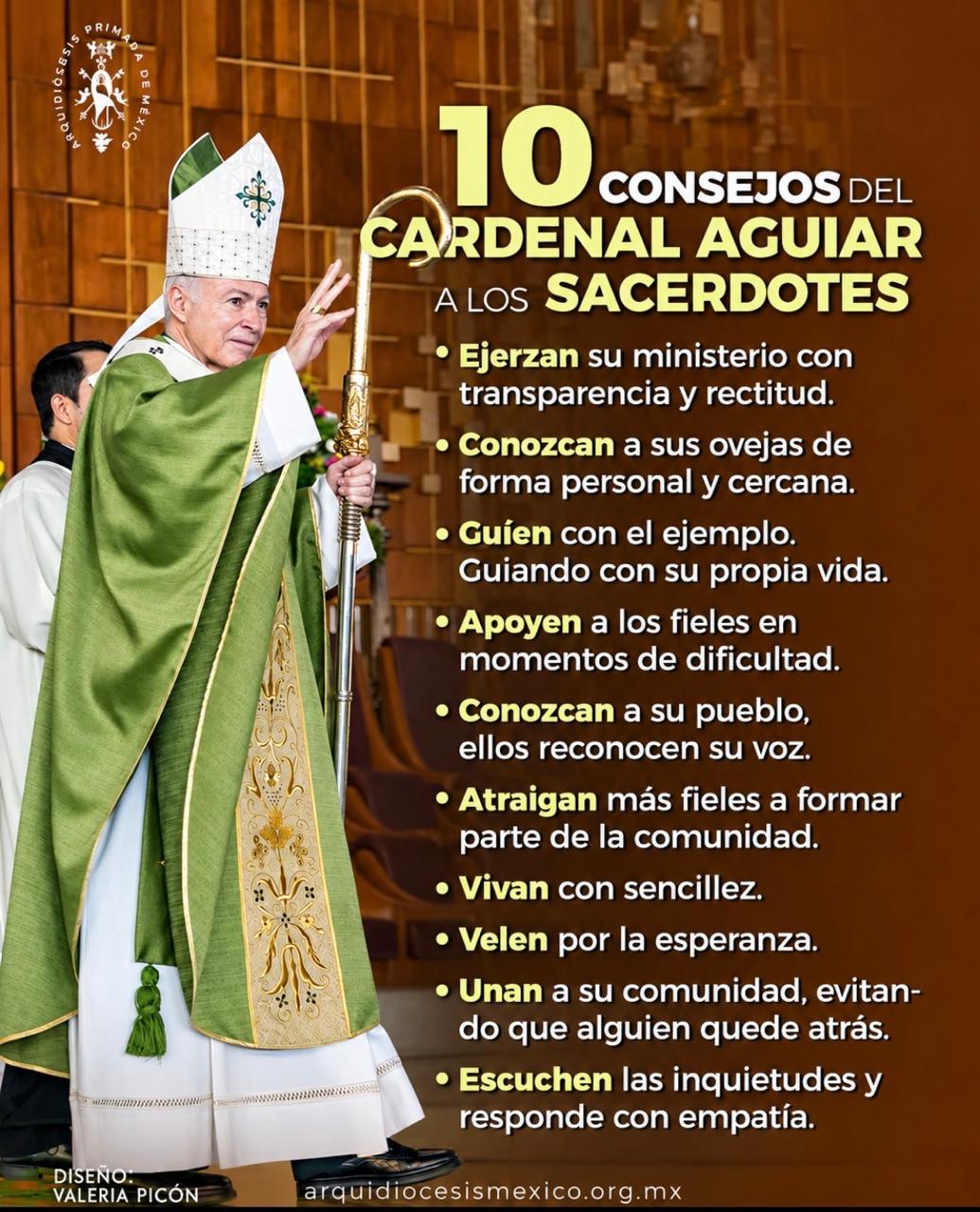
Credit to Whom It May Concern.- The weekly Desde la Fe recently published a decalogue in which Cardinal Carlos Aguiar offers ten pieces of advice to priests on how pastoral ministry should be exercised. The content of the decalogue is, in itself, irreproachable. Who could oppose transparency, closeness to the faithful, simplicity, listening, or hope?
Precisely therein lies the paradox. What provokes indignation are not the principles he proposes, but the profound contrast that priests and faithful perceive between that discourse and the way the primatial archdiocese of Mexico has been governed over the past eight years. Moral authority does not arise from words, but from example. A pastor may pontificate with his speeches, but he convinces only with his life.
Below are some considerations on that scandalous contrast.
1.- Transparency and integrity
The cardinal exhorts priests to live with honesty, integrity, and transparency.
It is an essential principle for every minister of Christ. However, transparency begins with the one who demands it. Throughout his career there have been public questions about the administration of resources and the lack of accountability. That perception has been aggravated by the absence of annual financial reports on the archdiocese’s finances or on the many assets of the archdiocesan patrimony that have been sold without the required consultations mandated by canon law. Where has the money from those sales gone? Why was the Holy See not informed? When the one who calls for transparency fails to generate trust in this area, the message lacks authority.
2.- Knowing the sheep
A pastor knows his people personally. He does not govern from a distance.
After eight years at the head of the archdiocese, numerous priests consider that the archbishop remains unknown to his faithful. Almost all parishes have not received his pastoral visit, patronal feasts do not count on his presence, confirmations are delegated, and direct contact with parish priests has been nonexistent. It is difficult to speak of closeness when a significant part of the people barely know personally the one who is their pastor.
3.- Leading by example
Example is always worth more than speeches.
The decalogue speaks of closeness, sensitivity, and dedication. However, many priests perceive a different reality: no presence among the poor, scant contact with young people, absence from hospitals and prisons, limited closeness to the presbyterate and a constant tendency to delegate day-to-day governance. Pastoral leadership is not exercised solely through decrees or administrative structures; it is exercised by walking with the people.
4.- Supporting in difficulty
Times of trial reveal the true face of the pastor.
Many priests have experienced loneliness in illness, old age, or difficult personal situations. That perception has fueled the idea of a distant authority, little attuned to the suffering of its own presbyterate. Pastoral closeness does not consist solely in issuing messages of solidarity, but in being present when it is most needed. Cardinal Aguiar never visits elderly or sick priests, does not attend the funerals of those who die, and, after eight years since his arrival, he does not personally know his presbyterate.
The treatment of Cardinal Emeritus Norberto Rivera was scandalous: he served the Archdiocese of Mexico for 22 years, fell gravely ill with COVID, and Aguiar Reyes refused to pay his hospitalization expenses.
5.- Knowing the people
Eight years represent sufficient time to travel through an archdiocese and learn its riches, its problems, and its challenges.
Many believe that knowledge was never consolidated. The dominant impression is of a government exercised from offices rather than from parishes, with scant presence in the daily life of communities. That distance inevitably ends up affecting pastoral decisions. The faithful of Mexico City, for the most part, have never personally seen their Pastor.
6.- Attracting more faithful
The mission requires going out, listening, inviting, and accompanying.
However, the presbytery of the archdiocese perceives a style of governance that privileges vertical decisions over pastoral accompaniment. Evangelization cannot be sustained solely through administrative plans; it needs a visible, close, and accessible pastor. Cardinal Aguiar has refused, unlike his predecessors, to make the annual pilgrimage with his faithful to the Basilica of Guadalupe, has canceled the massive Corpus Christi procession, canceled the living Rosary, and thus all the popular and faith manifestations that the Archdiocese of Mexico once had, now relegated to zero public presence.
7.- Living with simplicity
Simplicity does not consist solely in a sober lifestyle. It also means availability, closeness, and ease of dealing with others.
During these years, the image projected has been that of a markedly bureaucratic government, where direct contact with priests and faithful has been practically nonexistent and many responsibilities have been delegated almost entirely to the auxiliary bishops. The archbishop functions more as a bureaucrat than as the pastor and father he should be.
When he travels to Rome he flies first class, with a ticket costing over 100,000 pesos, and is transported in Rome by the official car of the Mexican Embassy to the Holy See—an act of corruption and a violation of the secular state.
8.- Safeguarding hope
Hope is born when the people experience that their pastor walks with them.
However, priests describe the current climate of the archdiocese as the most difficult in recent decades. Discouragement, distrust, and lack of communion cannot be attributed solely to cultural changes; they also call into question the way pastoral governance is exercised.
9.- Uniting the community
Instead of fostering communion, he has surrounded himself with a small group of unconditional supporters, characterized by flattery and lack of competence. He has promoted easily manipulated profiles, several of them with serious moral and personal problems that make them especially vulnerable to an authoritarian style of governance.
When many feel that their voices are not heard, ecclesial communion suffers and divisions deepen.
10.- Listening with empathy
Perhaps this is the most important point of all.
Listening requires time, patience, and humility. The presbyterate states that it has not found real spaces for dialogue with its archbishop. His style, beyond his refined manners and feigned smile, is totally authoritarian: Added to this is a constant demand for greater transparency in the administration of the archdiocese’s assets and for broader accountability to the presbyterate and the faithful. Authority in the Church is strengthened when it listens; it is weakened when it appears closed to dialogue.
As the culmination of this contradiction between words and deeds is the scandal of the Basilica of Guadalupe. This case has exposed a climate of corruption and opacity that has scandalized the people of God. Far from clarifying the facts, Cardinal Carlos Aguiar has covered for rector Efraín Hernández and has repeatedly ignored the warnings and complaints of the Chapter of Guadalupe. Once again he has preferred to impose his decisions arbitrarily rather than listen to those who, by their responsibility and direct knowledge of the situation, asked him for a transparent investigation and genuine accountability.
The ten pieces of advice from Carlos Aguiar published by Desde la Fe are valuable and deserve to be heard by every priest. The problem is not in the content of the decalogue, but in the credibility of the one who proposes it. In the Church, words only convince when accompanied by example. The faithful do not expect perfect pastors; they expect authentic, close, transparent pastors capable of listening. That has always been the teaching of the Gospel, and it will continue to be the criterion by which history judges the ministry of any bishop.
To Carlos Aguiar, Archbishop of Mexico, one can apply what Jesus said regarding the Pharisees: “do what they tell you, but do not imitate their works.”