


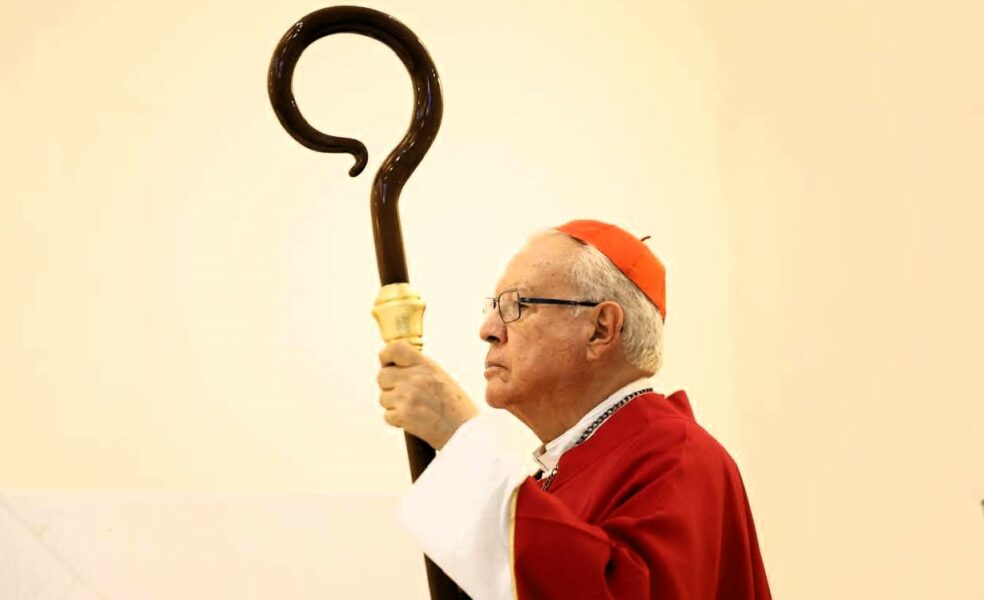
Pope Leo XIV has appointed Cardinal José Francisco Robles Ortega, metropolitan archbishop of Guadalajara, as papal envoy to preside over the beatification of Friar Augusto Rafael Ramírez Monasterio, a professed priest of the Order of Friars Minor who was murdered in Guatemala on November 7, 1983. The celebration is scheduled for Saturday, November 7, 2026, at Finca Florencia, in the department of Sacatepéquez, near Antigua Guatemala, where the future blessed served as parish priest and guardian. The date coincides, day by day, with the forty-third anniversary of his martyrdom.
This appointment, announced by the postulation of the cause and reported on October 6, places Robles Ortega in an uncommon line of Mexican cardinals called to act in the name of the Roman Pontiff outside their dioceses. In the beatification rite, the special envoy reads the apostolic letter, presides over the Eucharist, and proclaims the new blessed with the authority delegated by the Pope. In August, Friar Edwin Alvarado, vice-postulator of the cause, visited him in Guadalajara to present the work of the beatification and the ritual. Robles Ortega responded that it will be the first time he performs an office of this nature, said the appointment is an honor, and approved the liturgical scheme given to him.
This deserves a careful reading. Robles Ortega, archbishop of Guadalajara since December 7, 2011, has presided over the Mexican Episcopal Conference and has a solid ecclesiastical career, including notable participation in the last conclave. He does not lack offices. What he lacked, until now, was to be the Pope’s voice at an altar of martyrdom.
The appointment links him to other Mexican cardinals who have carried out pontifical representation, but the contrast is the key point. Historically, such missions often fell to the Primate Archbishop of Mexico or to cardinals of the Curia, not to the titular of Guadalajara. Ernesto Corripio Ahumada, Primate Archbishop of Mexico and cardinal since June 30, 1979, was special representative of John Paul II at the funeral of Óscar Arnulfo Romero, Archbishop of San Salvador, who was murdered on March 24, 1980, while celebrating the Eucharist.
The funeral was held on Palm Sunday, March 30, in the square in front of the Salvadoran cathedral. History recorded how what should have been a celebration of peace ended in tragedy. As he delivered the homily that recalled Romero’s teaching that violence cannot kill truth or justice, and that one cannot love by hating nor defend life by killing, an explosion and shots were heard that interrupted the Mass. The crowd, estimated in the tens or hundreds of thousands, surged forward; dozens died in the stampede, and the coffin had to be hastily buried inside the church. A later communiqué from the Salvadoran bishops accurately described the events the regime sought to distort with lies: “the confusion was total. The concelebrants had to suspend the Mass and sought refuge inside the cathedral, where some five thousand people also gathered. The catafalque containing the coffin with Monsignor Romero’s remains was brought into the church with great difficulty. The Mass could not be resumed, and later his remains were buried in a crypt in the main nave, as planned. Outside, in the square, the table holding the wine and hosts to be consecrated was overturned, and they were scattered on the ground. The flowers from the tomb were also scattered across the square. Numerous people—especially the elderly, women, and children—were gravely wounded or lay dead on the ground and on the cathedral steps, the very steps where, less than a year earlier, 23 students who had barricaded themselves inside the cathedral were killed by Security Forces,” they told the international community and the people of El Salvador.
Four years later, on January 25, 1984, John Paul II again appointed Corripio missus extraordinarius for the National Marian Congress of Bolivia, held in La Paz from January 29 to February 5, on the occasion of the four hundredth anniversary of the enthronement of the Virgin of Copacabana. The papal letter sent him precisely because he guarded, in the Archdiocese of Mexico, the shrine of Guadalupe.
Another precedent is that of Cardinal Javier Lozano Barragán, president of the Pontifical Council for the Pastoral Care of Health. At the end of January 2004, John Paul II appointed him special envoy to the XII World Day of the Sick, held in Lourdes from February 9 to 11 of that year, on the 150th anniversary of the dogma of the Immaculate Conception. On February 11 he was solemnly received as envoy and presided over the closing concelebration. In December 2004 the same Pope appointed him envoy to the XIII World Day, in Yaoundé, Cameroon, from February 9 to 11, 2005. There he presided over the Eucharist with the anointing of the sick at the Marian shrine of Mvolyé, in the presence of the President of the Republic, during a day marked by the papal message on AIDS in Africa.
Corripio represented the Pope as Primate and custodian of Guadalupe, at the funeral of a martyr and at a South American Marian congress. Lozano represented him as head of a Roman dicastery, in Lourdes and in Cameroon. Robles Ortega will represent him as Archbishop of Guadalajara, at the beatification of a Central American Franciscan. The see chosen by Leo XIV is not the Primatial See of Mexico, but that of the west, the same one that received the vice-postulator in August.
Who is the future blessed? Augusto Rafael Ramírez Monasterio was born in Guatemala on November 5, 1937, into a large and devout family. He was baptized on December 19 of that year and confirmed on April 8, 1945. He completed primary school in his country and secondary school at the Seraphic College of the Friars Minor in Diriamba, Nicaragua. On December 25, 1958, he began his novitiate in Jumilla, Spain; on December 26, 1959, he made his temporary profession. He completed his studies in philosophy and theology on the peninsula and was ordained a priest on June 18, 1967. He belonged to the Custody of the Most Holy Name of Jesus in Guatemala, then dependent on the Province of Cartagena, which explains his Spanish formation. Upon returning to Central America, he served as a formator in Diriamba until 1972. He returned to Spain for university studies in Salamanca, where he remained until 1977. In 1978 he assumed the guardianship and the parish of San Francisco el Grande in Antigua Guatemala.
The Order of Friars Minor summarizes his ministry thus: “he preached with an exemplary life, gave witness to the Gospel and the liberating power of faith, promoted truth and justice, stood in solidarity with the poor and the oppressed, and encouraged the faithful to follow Christ.” He stayed out of politics, but the pretext for eliminating him came in the confessional. In June 1983 he welcomed a peasant involved in the guerrilla who sought to avail himself of a government amnesty. That man was Fidel Coroy, a Kaqchikel Maya, catechist, linked to the Committee of Peasant Unity and the Guerrilla Army of the Poor.
On June 2, Friar Augusto was detained and held for about twelve hours at the military base in Chimaltenango. They tortured him to extract what he had heard in confession. They forced him to sign a statement that he had been well treated. They released him. Threats, police surveillance, and the suggestion— which he rejected—to leave the country followed.
On November 7, 1983, he was kidnapped for the second time. During the transfer in a vehicle of the special police, on the outskirts of the capital, he tried to escape. They caught up with him and shot him dead. His tortured and riddled body was identified the next day in the morgue by a relative. Medical-legal reports in the cause speak of nine gunshot wounds and death by hypovolemic shock. He was the thirteenth priest murdered in Guatemala since 1978. The Order emphasizes that the brutality was intended to extract the secret of confession and the accusation of sympathizing with the left. He died, in the wording of the decree, out of hatred for the faith.
The cause, promoted by the Franciscan Province of Our Lady of Guadalupe in Central America, was opened in 2008 at the curia in Guatemala City. On January 22, 2026, Leo XIV authorized, in an audience with Cardinal Marcello Semeraro, Prefect of the Dicastery for the Causes of Saints, the decree of martyrdom. Since it is a martyrdom, no miracle is required. November 7, 2026, will coincide with the anniversary of his death.
Robles Ortega will go to proclaim blessed a priest who died for keeping silent what the Church commands to be kept silent, in a civil war, 1960–1996, that pitted security forces, guerrillas, dissidents, and poor populations against one another and that cost the lives of numerous priests. That the Pope sends the Archbishop of Guadalajara, and not the Primate of Mexico or a prefect of a dicastery, for that proclamation, is the fact that distinguishes this representation, which joins those of the other two great Mexican cardinals, Corripio Ahumada in San Salvador and La Paz, and those of Lozano Barragán, who was Bishop of Zacatecas and auxiliary of the Archdiocese of Mexico, consecrated by none other than Archbishop Ernesto Corripio Ahumada and the emeritus archbishop, Miguel Darío Miranda, at the World Days of the Sick in Lourdes and Yaoundé. And this, in ecclesiastical protocol and in the Church in Mexico, says a great deal, especially when, among the active Mexican cardinals, Robles Ortega holds special weight in shaping the geography of the Church in Mexico. It is enough to observe the most recent episcopal appointments.