


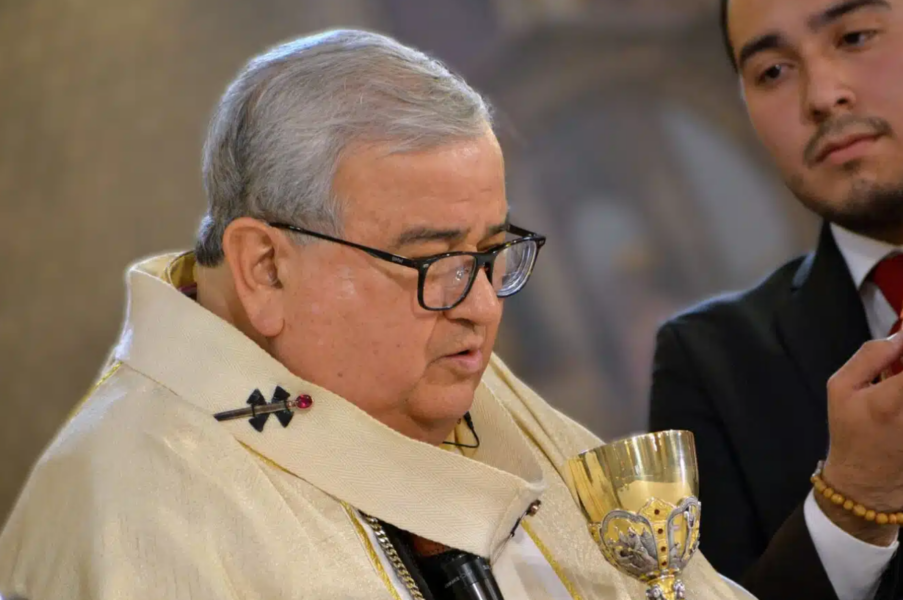
With hope placed in the Lord’s Resurrection, the Mexican Episcopal Conference announced on August 6, 2026 the death of Carlos Garfias Merlos, Archbishop Emeritus of Morelia. The announcement came precisely on the feast of the Transfiguration of the Lord and invited all the faithful to offer prayers for the eternal rest of the prelate, extending their condolences to family members, friends, the presbyterate, and the faithful of the Archdiocese of Morelia: “Grant him, O Lord, eternal rest. And let perpetual light shine upon him.” His death closes a trajectory of more than fifty years of priesthood and nearly three decades of episcopate marked by an intense vocation, a profound formation, and, above all, by a selfless and artisanal building of peace in some of the regions most affected by violence in Mexico.
Born on January 1, 1951, in Tuxpan, Michoacán, in the Archdiocese of Morelia, Carlos Garfias Merlos rooted there the dream of his priestly vocation from his youth. He studied Humanities, Philosophy, and Theology at the Seminary of Morelia and, at the same time, pursued studies at the Teacher Training Institute of Morelia, obtaining the title of Primary School Teacher. Later, he specialized with a master’s and doctorate in psychotherapy and spirituality at the Universidad Intercontinental in Mexico City.
This dual formation, theological and humanistic, spiritual and psychological, was not a mere academic complement, but the foundation of a way of exercising the priesthood centered on deep listening, integral accompaniment, and personal closeness. Psychotherapy and spirituality enabled him to understand the human person in their totality, so that his pastoral ministry was never limited to the liturgical or doctrinal, but opened itself to emotional wounds, crises of meaning, and the affective needs of persons.
Ordained a priest on November 23, 1975, in the cathedral of Morelia, he originally aspired to receive ordination on the feast of Saint John the Evangelist, December 27, a date he ultimately chose to celebrate his first Mass despite the group ordination of his companions in the context of post-conciliar reforms. Saint John, the beloved disciple, the intimate friend of Jesus, became the model of his priestly identity. Over the years, he would emphasize that to be a priest was, above all, to learn to be a friend, to be attentive to the needs of others, and to seek ways to help them.
The first twenty years of his priesthood were devoted almost entirely to the formation of future priests and the accompaniment of families. He served as a formator at the Minor Seminary of Morelia from 1975 to 1985. From 1985 to 1995, he directed the Introductory Course of the Major Seminary in Erongarícuaro, Michoacán, an experience he helped structure and initiate.
His greatest concern was closeness to each of his students; it was not merely about transmitting content, but about accompanying personal processes, discerning vocations, and sowing in young seminarians a spirituality of service and listening. At the same time, for a decade he was rector of the Church of the Three Marys in Morelia, where he implemented programs of formation and accompaniment for married couples and young people. He served as regional advisor for Marriage Encounters from 1989 to 1992, head of the Diocesan Family Ministry from 1993 to 1994, coordinator of the Archdiocesan Presbyteral Council, professor of Pastoral Theology and Sacraments at the Seminary, president of the Clergy Commission of Morelia from 1993 to 1996, and episcopal delegate for the ongoing formation of the presbyterate from 1995 to 1996.
In all these responsibilities, a deeply relational priestly vocation was revealed: the priest as formator, as elder brother, as one who walks alongside families and future pastors. His personality, marked by good humor, a capacity for dialogue, and an energy that did not easily fade, made people feel heard and valued.
On June 24, 1996, Saint John Paul II appointed him Bishop of Ciudad Altamirano; he received episcopal ordination on July 25 of the same year. On July 8, 2003, the same pontiff transferred him to the Diocese of Ciudad Nezahualcóyotl, of which he took possession on August 2, 2003. On June 7, 2010, Benedict XVI appointed him Archbishop of Acapulco. Finally, on November 5, 2016, Francis appointed him Archbishop of Morelia, taking possession of the archdiocese on January 17, 2017.
His episcopal motto summarized his entire life and gave continuity to his priestly vocation: “Christ is our Peace.” Already at his ordination, he had chosen as his theme the verse from Isaiah: “How beautiful upon the mountains are the feet of the messenger who announces peace.” The episcopate was not for him a rupture with the priesthood, but its prolongation in more complex and wounded territories.
From Ciudad Altamirano to Morelia, passing through Nezahualcóyotl and Acapulco, Garfias Merlos understood that peace is not decreed or imposed: it is built in an artisanal way, step by step, with the human materials available, amid structural violence, drug trafficking, and the fracture of the social fabric. He defined himself as “bishop, artisan, and builder of peace.” He did not seek magical solutions or grand media agreements, but concrete processes born of the same vocation of accompaniment he had cultivated in the seminary and in parishes. In each diocese, he promoted listening centers for victims of violence, safe spaces offering spiritual, psychological, and, when possible, legal assistance. He promoted the Houses of the Artisan, centers of care and rehabilitation for people with addictions, understanding that peace also passes through the recovery of the dignity of those who have fallen into cycles of self-destruction. He promoted municipal committees for peace and reconciliation, composed of civil authorities, religious leaders of different confessions, and members of civil society.
In Morelia, he presided over the Michoacán Council for the Construction of Peace and Reconciliation, an organization whose symbolic installation dates back to September 2019 and of which he was a central figure. Under his leadership, listening centers multiplied (more than thirty at different moments of his ministry), municipal committees were established in Morelia and other localities, programs of a culture of peace were promoted, workshops on forgiveness and reconciliation, and campaigns for the reconstruction of the social fabric.
He insisted time and again that peace begins in the family, the neighborhood, the school, and daily work, and that no one can delegate that task. His openness to dialogue even led him to propose, in an open and controversial manner, the possibility of conversations with actors of organized crime, inspired by the experiences of the Colombian Church. It was not about pacts of impunity, but about opening paths of conversion and reduction of violence, always with priority attention to victims.
That stance earned him internal and external criticism, but he never retracted: “Dialogue is the path of conversion for criminals,” he stated after the killing of “El Mencho.” His vision of peace was integral: education, solidarity economy, care for our common home, attention to addictions, and, above all, the rebuilding of trust. All of this flowed from his priestly identity: the priest as messenger of peace, as a friend who listens and accompanies, as an artisan who patiently works with broken human materials.
On November 23, 2024, in the cathedral of Morelia, Garfias Merlos opened the Jubilee Year for his fifty years of priestly life. In that celebration, concelebrated with the Bishop Emeritus of Chilpancingo-Chilapa, Salvador Rangel Mendoza, he read the decree of the jubilee year (from November 23, 2024, to November 23, 2025) and delivered a homily of profound gratitude. He recalled that he and his generation had been ordained in a previous jubilee year and asked those present to join in thanksgiving and in the renewal of their vocational response: “Here I am to do your will.” He spoke frankly of his moments on the brink of death: the COVID-19 infection that placed him in grave condition after celebrating his twenty-five years as a bishop, and another health crisis just two months before that Mass. “I have lived moments almost at the point of death and, thanks be to God, I have recovered my health… by the providence of God and his grace, in a miraculous way.”
Despite physical limitations, he affirmed that he felt full of mental, emotional, and spiritual energy. The jubilee was not merely a commemoration; it was a renewal of a priestly “yes” given half a century earlier, a “yes” that had been tested in illness and remained firm.
Months later, on December 27, 2025, he returned to his hometown of Tuxpan to celebrate fifty years of priesthood at the parish of Santiago Apóstol, the very place where he had rooted his vocational dream and where he had celebrated his first Mass. There he reiterated the two defining characteristics of his priesthood: friendship modeled on Saint John the Evangelist and the vocation of promoter and builder of peace. Shortly afterward, the book “Carlos Garfias Merlos: Bishop, Artisan, and Builder of Peace” was presented, conceived over years and published in the context of his fiftieth priestly anniversary. The work gathers his personal experience and his conviction that peace is an artisanal work that invites each reader to become, in their own way, a builder of reconciliation.
Throughout his episcopate, Mons. Garfias Merlos faced defamation, clashes with sectors of the political class, and tensions even within the Church itself. His openness to dialogue with criminal groups generated rejection among some bishops, Catholics, and politicians. Media reports about supposed benefits received from previous state administrations were answered by him with clarity: “I have nothing to hide; let those who make accusations prove them.” He never denied political friendships of different stripes, but rejected any interpretation that turned them into complicity. In the face of those storms, his response was always the same: transparency and availability. For years he held Sunday press conferences, almost always after Mass in the cathedral of Morelia. There he responded to journalists, explained initiatives, acknowledged limits, and reiterated the call not to delegate the building of peace. That permanent contact with the faithful and with Mexican society, through media, networks, and public presence, made him a recognizable voice, sometimes uncomfortable, but always accessible. He preferred the risk of the public word to defensive silence. That same media availability was, at its core, an expression of his priestly vocation: the priest does not hide, but makes himself present, listens, and responds.
The Mexican Episcopal Conference loses an undisputed leader who did not limit himself to denouncing violence, but founded a concrete process of peacebuilding that today is a reference in Mexico. The listening centers, the municipal committees, the Houses of the Artisan, the reconciliation workshops, and the insistence on circular dialogue among authorities, civil society, churches, and even conflicting actors constitute a pastoral and social heritage that transcends his person. His episcopal motto and his self-definition as an artisan of peace summarize a coherent life: peace is not an abstract concept, but a daily, patient work, sometimes misunderstood, but always necessary. And that work was born of a priestly vocation deeply rooted in friendship, in listening, in the formation of others, and in the proclamation of the Gospel as a message of peace.
On the feast of the Transfiguration, when the Church contemplates the glory announced in the midst of the cross, the news of his passing invited us to lift our gaze toward the hope of the Resurrection. The Archdiocese of Morelia, the presbyterate, the communities he accompanied in Guerrero, the State of Mexico, and Michoacán, and all those who joined his peace initiatives, keep the testimony of a pastor who believed that Christ is our Peace and that this peace is built, artisanally, with the hands of many. A priest who, from Tuxpan to the cathedrals of the dioceses he shepherded, responded time and again: “Here I am to do your will.”
May he rest in peace, Carlos Garfias Merlos.