


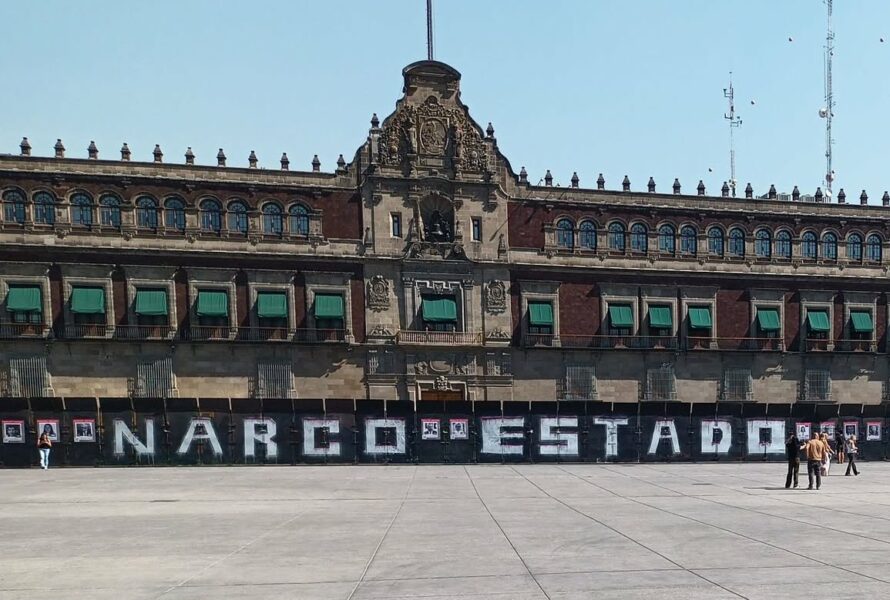
The Catholic Citizenship and Social Analysis Observatory presented on Monday, May 11, 2026, its report number 54, titled “The United States’ Strategy Against Narcoterrorism”. The document, prepared under the ethical criterion of the Compendium of the Social Doctrine of the Church (number 448), urges the International Community to overcome the “narrow market logic” and assume a duty of solidarity, social justice, and universal charity. However, the report focuses its attention on the growing tension between Mexico and the United States, openly questioning whether the current government defends national sovereignty or covers up alleged alliances with drug trafficking.
The report raises two central questions, without reaching submission: Is it valid to wrap oneself in the flag of Mexican sovereignty in the face of the demands of the United States to combat common enemies on national territory? And, what does the President of Mexico intend with her defiant attitude toward the United States in the face of the denunciation of the alliance between politicians and criminals? These questions are not rhetorical. The Observatory states that the government of Donald Trump has placed Mexico on the same list of enemies as China, Russia, Iran, and Venezuela, and has radically redefined the fight against organized crime.
According to the document, Donald Trump has abandoned the traditional view of cartels as mere criminal organizations. Now he categorizes them as “narcoterrorist groups.” Any person, organization, businessman, or government that provides them with cover, support, backing, or protection becomes a legitimate target for extraterritorial intervention by U.S. justice and armed forces. The report cites public statements by Donald Trump and his closest collaborators, including Secretary of State Marco Rubio, who have explicitly pointed to former President Andrés Manuel López Obrador as one of the priority targets due to alleged relations with criminal organizations.
The analysis of the facts asserts that the U.S. government has opened three simultaneous fronts against Mexico. On the legal front, the U.S. Department of Justice formally accused, on April 29, 2026, before the Federal Court of the Southern District of New York, the governor of Sinaloa, Rubén Rocha Moya, and Senator Enrique Inzunza Cázeres, among other individuals, of colluding with leaders of the Sinaloa Cartel to import narcotics in exchange for political support and bribes. Interim Prosecutor Todd Wallace Blanche announced that more accusations will come against Mexican “narcopoliticians” and that the goal is to dismantle the political protection networks of the cartels. The prosecutor himself stated that the Trump administration seeks to eliminate corruption within the current government.
On the military front, the Pentagon, now the Department of War, published on May 5, 2026, the 2026 National Drug Control Strategy and the United States’ Strategy Against Terrorism 2026. Both documents grant “combatant” status to narcoterrorists and their collaborators, including politicians and governments. Donald Trump has publicly declared that if the Mexican government “is not going to do the job, we will do it” through ground operations. The report recalls that the U.S. president has secretly ordered the Pentagon to use direct military force against certain Latin American cartels, with the possibility of acting on foreign soil.
The third front is diplomatic and commercial. The U.S. Ambassador to Mexico, Ronald Johnson—retired Army colonel and former Central Intelligence Agency agent for twenty years—has toughened his discourse against corruption and extortion, warning that these crimes directly affect U.S. companies and free trade under the free trade agreement. The Observatory highlights the weakness of Mexican diplomacy; the inexperience of the new Secretary of Foreign Affairs, Roberto Velasco Álvarez, “Lord Cacahuates,” and the ambassador in Washington, Roberto Lazzeri, contrasts with the professionalism and closeness of Ronald Johnson to President Donald Trump and Marco Rubio.
The report places these actions in the context of Donald Trump’s electoral urgency, who seeks to consolidate Republican majorities in the November 2026 midterm elections to avoid impeachment. At the same time, Trump promotes the “Donroe doctrine” (America for the Americans) and the “Shield of the Americas” project, a coalition of right-wing governments to combat left-wing populism linked, according to Washington, to the cartels and the interests of China and Russia in the region. Mexico was not invited to that summit precisely because of its alleged involvement.
In contrast, the President of Mexico participated in April in the “IV Summit in Defense of Democracy” in Barcelona, alongside Pedro Sánchez, Luiz Inácio Lula da Silva, Gustavo Petro, and Miguel Díaz-Canel, where she assumed a visible leadership of Latin American lefts and defended Cuba. The Observatory interprets this activism as an attempt to regenerate the regional leadership of the left, but warns that it occurs precisely when the United States is radicalizing its offensive.
The preliminary conclusions of the report are alarming. Mexico faces “the most difficult hours” of what remains of 2026. Virtually all the leaderships of the National Regeneration Movement party are threatened with facing U.S. justice. The discourse on the defense of sovereignty, according to the Observatory, “makes us think rather of desperate efforts for the defense of impunity”.
The document does not call for submission, but invites ethical discernment and realism; international cooperation, based on human dignity and the common good, cannot be confused with complicity. The regime is under the most serious international suspicion of having tolerated or protected alliances with drug trafficking. The question that the Catholic Citizenship and Social Analysis Observatory leaves hanging is whether Mexico will choose true sovereignty—which includes combating common enemies without qualms—or whether it will insist on a rhetoric that, in Washington’s eyes, only covers the protection of criminal interests.
The full report can be read here.
Catholic Citizenship and Social Analysis 54