


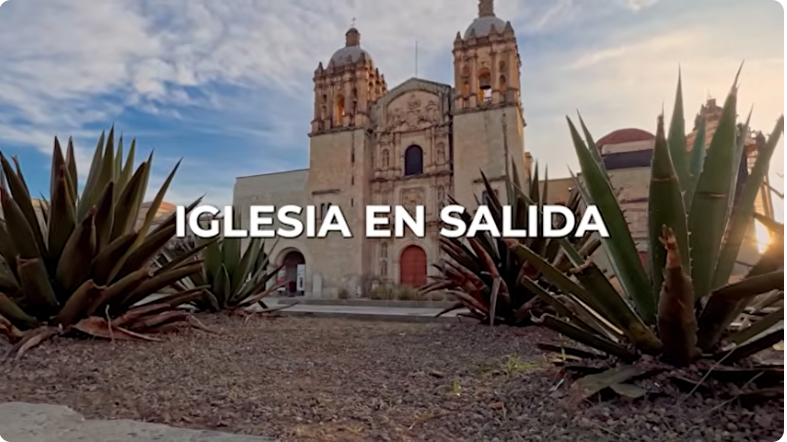
Ramón Castro Castro, bishop of Cuernavaca and president of the Mexican Episcopal Conference (CEM), presented this week catechesis 36 of the series “Thy Kingdom Come,” titled “Church on the Move”. In the message, he recalled that Jesus did not proclaim the Kingdom from comfort or from a distance, but by walking through towns and cities, approaching the poor, touching the sick, and looking at each person with compassion. “He taught us that the Church does not exist for itself, but to go out to encounter”.
The catechesis, distributed through the official channels and social networks of the CEM, takes up the well-known phrase of Pope Francis, “We prefer a Church bruised by going out to the street rather than a Church sick from being closed in”. In the context marked by violence, forced migration, poverty, and exclusion, this call acquires particular urgency. “We cannot stay on the sidelines of our people’s pain,” Castro Castro emphasized.
Being a Church on the move implies listening to the cries of reality, the violence in entire neighborhoods, the caravans of migrants fleeing hopelessness, the loneliness of the elderly, and the exclusion of young people without opportunities. It is not enough to analyze the problems; it is necessary to become incarnate in them with concrete gestures of closeness. The mission is not the task of a few. Every baptized person is a missionary disciple. In the family, at work, in the community, every Christian is called to announce with their life that the Kingdom of God is already among us, the message emphasizes.
The catechesis delves into an ecclesial style that dialogues, builds bridges, and works together with other social actors for the dignity of the person. It does not impose, it proposes; it does not condemn, it accompanies; it does not exclude, it integrates. Going out also implies pastoral conversion: reviewing styles, languages, and structures so that they truly serve the mission. Tradition is not a museum piece, but a living source that propels forward. The message culminates with an invocation to the Holy Spirit, “Let us ask for the audacity to go out without fear, trusting that God is already waiting for us on the peripheries,” the bishop stated.
This installment is part of a series that, next July, will mark one year of weekly broadcasts. Started in July 2025 to commemorate the centenary of the encyclical Quas Primas by Pius XI that instituted the solemnity of Christ the King, the initiative has offered to date 36 reflections on how to make Christ’s Reign present in Mexican reality. It is not a theoretical catechesis, but an integral pastoral project that unites prayer, formation, and social action.
The first chapters laid the foundations, the family as the heart of Mexico and the first sphere where the Kingdom must flourish, the need for a Mexico of justice and hope in the face of violence and marginalization, and the warning that the Kingdom is not for VIPs, but for all who welcome Christ with a humble heart. Later, topics such as the lay vocation, the Church as the seed of the Kingdom, peace that goes beyond the absence of wars, and the call to be a gift for others were explored.
In intermediate installments, holiness and grace, the search for truth amid disinformation, the common good and generosity, solidarity as social fabric, the family as domestic Church, and the workers of the Kingdom were addressed. The series has insisted on material detachment and the social mortgage of goods, and, recently, on active hope that does not resign itself to hopelessness.
Throughout these 35 chapters, Ramón Castro Castro has woven a mosaic that outlines the nature of the catecheses, Christ’s Reign is not a distant utopia, but a reality that is built here and now, in wounded families, in urban and rural peripheries, in inclusive economy, and in the fight against corruption and indifference. Each one has avoided abstract language to confront with courage the concrete faces of Mexican pain, searching mothers, migrants, indigenous people, young people without a future, vocation, and commitment.
Through the Blog Sursum Corda of InfoVaticana, it has accompanied punctually by publishing each installment and highlighting its relevance for evangelization in a wounded Mexico. From the first catechesis, which invited taking up the baton of the martyrs, to the current one, this space has documented how the series has become an instrument of formation in the centenary of the Cristero War and of the encyclical of Pope Pius XI
With catechesis 36, “Church on the Move,” the series enters the home stretch toward the first anniversary. Ramón Castro Castro not only reaffirms the doctrine, but launches a practical challenge, to go out, listen, accompany, integrate in a program of life and faith for the entire Mexican Church and for men and women of good will in this country where faith remains majority but secularization advances and social wounds bleed; these catecheses offer a compass: Christ the King does not reign from a distant throne, but in the heart of those who go out to meet their brother.