


We start the week and almost the month, a month of special Marian devotion that we don’t want to forget. It’s in all the media and it’s today’s top news, this Thursday we have an official visit from Marco Rubio. It’s the public closure of the latest, let’s say, frictions, between Pope Leo and Trump. Neither party is interested in this confrontation which, naturally, the usual suspects use to carry water to their own mill. It’s evident that all the fish is sold and let’s brush it off. We’ll have photos, smiles, hugs, and declarations of excellent relations. We assume Marco Rubio will bring first-hand information, the most first-hand possible, on Iran, Lebanon, Venezuela, Cuba, Ukraine …
Marco Rubio in the Vatican, the diocese of Rome, Catholic funds from the United States, the enigma of Leo XIV, strike at Padre Pío's hospital, the «Pope's Sunday», the invention of the Holy Cross.
In a 2012 article, Prevost stated that the Kingdom of God is a dynamic concept, not spatial. He argued that it is necessary to find ways to reach everyone, to welcome everyone, to engage in genuine dialogue with everyone. Later, Pope Francis expressed similar sentiments on several occasions. In a 2008 conference to his fellow monks, he said: «Our lives must be a sign of protest against the consumerist mentality of the society in which we live. People (…) expect from us a prophetic poverty, which by its very nature requires openness to the needs of others and perhaps also, in a special way, a defense of the social rights of the poor.» Prevost criticizes «neoliberalism, which has set itself up as the ‘savior of the people’ and has mercilessly marginalized the vast majority of humanity.» According to Vatican News, the publication date in Germany of the 560-page book has not yet been set.
One Year of Pontificate.
Almost a year has passed since the election of Leo XIII to the papacy and it’s not easy to summarize the beginning of his pontificate in a few sentences, especially since part of it was dedicated to the Jubilee agenda. Today’s article poses the balance in «line of continuity and discontinuity with Bergoglio.»
It is undeniable that, in terms of character, he shares more similarities with Benedict XVI than with Francis. Ratzinger had difficulty being interviewed, showing himself reserved, calm, and measured in his words, just like Prevost. The decision, although it did not receive the wide media coverage it deserved, to return to the Apostolic Palace and, formally, to use traditional vestments. From the «attic» of the Vatican, so to speak, chairs, thrones, mozzettas, and miters used when Ratzinger was Pope have been dusted off.
Leo has expressed his desire to seek unity, and he does so in a way that, it must be said, lacks Franciscan character. Even his apostolic visit to the Principality of Monaco, though very brief, does not fit the criteria of a Church open to the peripheries.
On the other hand, exquisitely Franciscan themes resonate, which he also tries to put into practice. In this sense, the initiative to convene the various presidents of the national episcopal conferences next October to jointly evaluate the reception of Amoris laetitia is interesting. It seems he does not want that synodality of Francis to remain a dead letter.
Pope Leo still needs to be put to the test; his ability to govern the Church and unite such diverse souls and sensitivities remains to be seen. Everything indicates that this balance will be maintained when making important decisions. Several heads of Vatican dicasteries who have reached seventy-five years must be appointed, new cardinals must be created, and bishops must be appointed for important dioceses in the near future, such as that of Milan in Italy. There we will see if for Leo substance is more important than form.
Strike at Father Pio’s Hospital.
The unions of Casa Sollievo della Sofferenza are not giving up and continue their hunger strike, started on May 2. «Lies don’t cure anyone. United we will win» is one of the slogans of the protest, which is taking place under the gazebo installed in front of the stairs of the Via Crucis in San Giovanni Rotondo. «We have received confirmation from the general management, from His Excellency Father Franco Moscone, that His Eminence Pietro Parolin will receive us on May 5 at 2:30 pm». Cardinal Pietro Parolin, Secretary of State of the Holy See, will preside over the celebrations of the seventieth anniversary of the inauguration of Casa Sollievo della Sofferenza. Unions and workers take to the streets to defend «Father Pio’s greatest miracle,» which is going through an unprecedented crisis. «An entire community and the economy, not just the local one, are in danger.» The dispute revolves around three pillars: contractual adjustments and delays, the elimination of the private health care contract, and the elimination of the 12-hour shift.
The «Pope’s Sunday» in Germany.
On May 8, Cardinal Robert Francis Prevost was elected successor to the late Pope Francis, taking the name Leo XIV. A few days before the first anniversary of that election, the Church in Germany annually celebrates a Sunday close to the election date as «Pope’s Sunday»: an occasion for prayer and thanksgiving for the ministry of the Successor of Peter. Marx, Archbishop of Munich and Freising, presided over a Eucharistic celebration in Munich Cathedral.
Marx highlighted the distinctive characteristic: «During the first year of his pontificate, I have always perceived Pope Leo XIV, even in personal encounters, as a person who seeks reconciliation and unity, who places his pontificate at the service of world peace, and who, with clear words, tirelessly reminds us of Christ’s universal message of love, non-violence, and mercy.» «Pope Leo has spoken out repeatedly, clearly and forcefully, against war and terror, and has raised his voice in defense of the poor and oppressed, who otherwise find very little protection. I am very grateful to him for this in these difficult times, when war is accepted by many powerful people or even knowingly employed.»
Marx wanted to combine gratitude toward Leo XIV with the memory of his predecessor: «With this celebration, we want to give thanks for the pontificate of Pope Leo XIV and invoke God’s blessing on his work. At the same time, we want to commemorate the late Pope Francis and his twelve-year pontificate, rich in blessings.» «Without being a copy of his predecessor, Pope Leo XIV positions himself in clear continuity with Pope Francis, who always directed the world’s attention to the marginalized and worked tirelessly for peace and reconciliation. This witness must not be forgotten!»
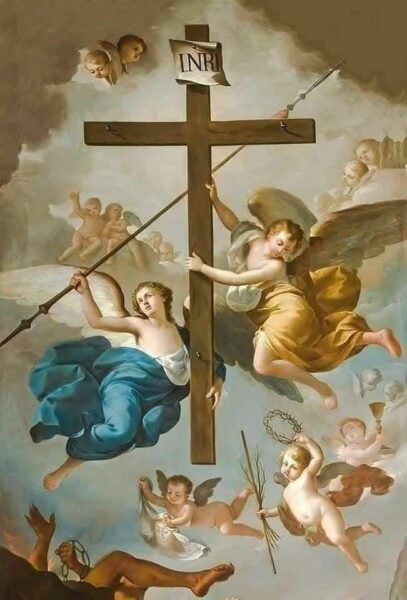
The Invention of the Holy Cross.
On May 3, in the Western Christian tradition, an ancient and deeply rooted commemoration is renewed: that of the finding of the Holy Cross, the central sign of Christ’s redemption. This anniversary, known as the Inventio Crucis , enjoyed great popularity despite no longer being included in the general Roman calendar reformed after the Second Vatican Council.
The so-called Legend of Judas Cyriacus recounts that the discovery of the Cross took place in Jerusalem in the 4th century on the initiative of Saint Helena, mother of Emperor Constantine. The story recounts that a Jew named Judas indicated the place where the three crosses of Golgotha were buried; the recognition of the True Cross was confirmed by a miraculous event, often described as the resurrection of a deceased person upon contact with it. The same tradition recounts the conversion and baptism of Judas, who took the name Cyriacus (from the Greek «dedicated to the Lord»).
A particularly significant moment was the consecration, on September 13, 335, of the Constantinian complex of the Holy Sepulcher in Jerusalem, which included the basilica of the Anastasis and the Martyrium. The celebrations associated with this event included the exhibition of the relic of the Cross the following day, which significantly contributed to the spread of its cult. In 614, during the Persian invasion led by the Sasanian ruler Khosrow II, Jerusalem was conquered and the relic of the Cross was stolen. The Byzantine Emperor Heraclius recovered it and, according to tradition, returned it to Jerusalem in 629 after his victory over the Persians.
«…and we will come to him and make our dwelling in him.»
Good reading.
Il Papa riceverà Marco Rubio in Vaticano il 7 maggio
Rubio a Roma per ricucire, vedrà il Papa e il governo
La Santa Croce di maggio: memoria liturgica, tradizione e devozione tra storia e interpretazione
«Un pontificato al servizio della pace»: il Cardinale Marx celebra il primo anno di Papa Leone XIV
Papa Leone XIV invita i vescovi a farsi ‘trovare’
Sesto comandamento, non sei più il primo
La questione liturgica al centro del prossimo concistoro straordinario
Leo Wants Wealthy American Catholics To Keep Donating, In Spite Of The Vatican’s Troubling History With The Papal Foundation
Lettera / A difesa di Leone
Papa Leone XIV: «Libertà di stampa spesso violata»
Un anno con Leone. Continuità e discontinuità con Francesco
Casa Sollievo “non si tocca”, primo segnale durante lo sciopero della fame: Parolin riceverà i sindacati.
¿Quién fue León XIV antes de ser elegido Papa? Un libro ofrece respuestas.