


Encyclical at the end of the month.
The text “On the Protection of the Human Person in the Age of Artificial Intelligence” was signed on May 15, the 135th anniversary of the Rerum Novarum encyclical of Leo XIII. The Magnifica Humanitas, the first encyclical of Pope Leo XIV, will be published on Monday, May 25: its central theme is the “protection of the human person in the age of artificial intelligence.”
The text will be presented in the Synod Hall in the presence (an unprecedented fact) of Leo XIV himself. The speakers invited to present the text are Cardinal Fernández, Czerny, Anna Rowlands, Professor of Political Theology, Christopher Olah, co-founder of Anthropic (USA) and director of research on the interpretability of artificial intelligence; and Leocadie Lushombo, Political Theology and Catholic Social Thought. We assume they are the amanuenses of the encyclical, since there is no reason to wait long.
The rapper Pope “Doot Doot”.
Obviously it is a most trivial matter, but it is in all the media: Pope Leo learning the 6-7 gesture together with a group of young people brought to the Vatican by Father Roberto Fiscer, one of those priests who has recently joined the circle of “influencer priests.” It is one of those contemporary memes that seem to arise from nowhere, devoid of real meaning, but which, precisely because of their ambiguity, manage to transform themselves into collective codes. The trend originated in the United States thanks to the song “Doot Doot (6 7)” by rapper Skrilla, and in the chorus, “six-seven” is repeated over the beat. No one really knows what “6-7” means and Skrilla himself has never attributed a precise meaning to the term.
The degradation of theology.
The Pontifical Academy of Theology promotes the creation of an Observatory on the contribution of digital technologies to the environment. A few days after the anniversary of Pope Francis’s encyclical Laudato si’ and the pastoral visit of Pope Leo XIV to Acerra (Naples), during which he will meet with the families of the victims of environmental pollution, the mayors and the faithful of the “Land of Fires.” “The Observatory is called to grow in the spirit of shared responsibility. The current digital world is closely linked to conflict: there can be no true peace without a technology that respects humanity, relationships and creation. At a time when digital technologies are transforming the life of the planet and of communities, we intend to offer a space for theological debate and reflection capable of raising awareness among companies and economic agents about a truly sustainable, ethically oriented use of technology that respects human dignity. Only in this way can innovation become an ally in the protection of creation and a promoter of peaceful, just and solidary coexistence.”
Poland with Saint John Paul II.
The President of the Republic of Poland, Karol Nawrocki, laid a wreath on the tomb of Saint John Paul II. May 18 is the anniversary of the birth of Karol Wojtyła, and the President of the Republic of Poland, Karol Nawrocki, together with his wife, Mrs. Marta Nawrocka, and the delegation, went to St. Peter’s Basilica in the Vatican, where they laid a wreath on the tomb of Saint John Paul II.
The first major crisis of Pope Leo XIV.
The potential Lefebvrian schism is the first major crisis that Pope Leo XIV has faced since his election. The Pontiff, whose mandate was to resolve conflicts in the Church, is now dealing with a group of extremely combative priests and bishops who, to preserve their aging hierarchy, have decided to ordain new bishops without papal mandate. This week, the situation has materialized, moving ever closer to schism. The Lefebvrians did the same in 1988, when they were excommunicated latae sententiae for ordaining four bishops without papal mandate. This situation remained unresolved for twenty years, until Pope Benedict XVI decided to lift the excommunication in the hope of laying the foundations for dialogue and renewed unity in the Church. The Society is making this decision at a time when the traditionalist movement within the Church appears to be particularly strong. The images of the recent pilgrimages from Paris to Chartres are evident to all, while the increase in adult baptisms (mostly traditionalists) in France has led the Archdiocese of Paris itself to examine the matter.
The Priestly Society of Saint Pius X finds itself in a different situation from 1988. Beyond various personal sympathies, the FSSPX lacks a charismatic figure like Archbishop Lefebvre, who enjoyed a reputation as a very capable missionary and could count on solid alliances even within the Holy See. Immediately after the schism, the Holy See established the Ecclesia Dei Commission, later suppressed by Pope Francis, as well as the Priestly Fraternity of Saint Peter, which represents the Holy See’s response to the traditionalist movement: it is possible to remain in the Church celebrating according to the ancient rite.
Leo XIV finds himself in a long period of transition. Five dicasteries will be replaced, others will leave their posts during the next year, but in other cases, Leo XIV will simply wait until retirement or the end of their mandate. This is a way to avoid internal crises.
In the next two or three years we will face a pontificate at several speeds. On the one hand, the Pope, with his personal decisions, his handwritten speeches and his eagerness to absorb the conflicts of the Church. On the other, the collaborators of the previous pontificate, who need to demonstrate to the world that they did not make a mistake before and who, in any case, fail to fully understand the new Pope. Now that the Pope faces the first great crisis of his pontificate, we will see if his confidence is well placed.
Sarah and the liturgy as entertainment.
Cardinal Robert Sarah warned that paganism has infiltrated the Catholic Church and that the liturgy has been reduced to mere “entertainment.” In an interview granted on May 4 to the French magazine La Nef he addressed the problems facing the Church today. “When faith is reduced to a sociological language, liturgy to mere entertainment, morality to constant negotiation and the Church to an institution that must adapt to the desires of the times, then something of paganism returns, not in ancient forms, but in the modern form of man placing himself at the center.”
This paganism is recognized by several signs: the blurring of the sense of sin, the discomfort with the assertion of revealed truth, the trivialization of the liturgy, the fascination with worldly categories and the forgetting of the supernatural purpose of the Church. When God ceases to be first, even within the Church, everything else is corrupted. This paganism is a “fluid ideology” that appears whenever “we turn away from the light of God to make a decision” and “worldly criteria of popularity take priority over the Beatitudes.” “Ambiguity is preferred to clarity, accompaniment without conversion to healing mercy, communication to contemplation and horizontality to worship.” “We end up believing that the Church will be better heard if it speaks like everyone else. However, the world does not expect the Church to repeat its words; it expects it to open the doors of Heaven to it.”
The Church “must free itself from the dogmas imposed by the media in order to preach with total freedom the Word of God transmitted by Christ. This reform is not institutional, but internal.” There are signs of hope: “I see it in the young people who do not seek a diluted religion, but a full faith; in the priests who want to be men of God again; in the families who are willing to go against the current; in the religious communities where the liturgy is truly oriented toward the Lord.” “I believe that the internal reform of the Church has begun. It has not been decreed from above, but is inspired by the Holy Spirit in the souls of the faithful.” “In Europe, we observe an increase in adult baptisms and in conversions to the faith,” noted the cardinal. “This is not a sociological triumph, but a spiritual sign. When cultural certainties collapse, some souls rediscover that only God remains. In France, for example, the Easter Vigil of 2025 had already confirmed an increase in adult baptisms, and this trend continued in 2026, according to numerous reports from local churches.”
The West and its Christian roots.
Declaration of Cardinal Müller in the Austrian newspaper Kath.net. The text addresses a question: Can the West understand itself apart from its Christian roots? The cardinal’s answer is clear from the first line—a resounding “no”—and from that denial unfolds a reasoning that intertwines theology, philosophy, law and political analysis. For Müller, Europe is not a simple geographical entity nor a market of nations, but a “cultural community” born of the synthesis of Christianity, Greek metaphysics and the Roman will to organization, founded on justice: giving to each what is due, according to the formula of Ulpiano, which in theological terms becomes the recognition of the inviolable dignity of every human being as the image of God. Deprived of this formative soul, the author warns, Europe runs the risk of being reduced to “a corpse,” a no-man’s land exposed to the most powerful of the moment.
Müller addresses this question by reviewing and updating the famous lecture of Benedict XVI in Regensburg in September 2006—which he attributes a “lasting merit”—and recalling, unexpectedly, Jürgen Habermas’s thesis on the only true subject of the West. In the second part, the argument is centered on the confrontation with Islam and the crucial question of violence disguised as religion. Müller carefully distinguishes pseudoreligious terrorism from authentic faith. The result is an essay with strong criticism of secularism, transhumanism and what the author calls the desired de-Christianization of Europe. A fundamental question that the Cardinal raises for the debate: if the decisive struggle of our time is not for raw materials nor for power, but “for the soul of man.”
In the worldview of post-Christian secularism in Europe and North America, there is the utopia of a “humanism without God,” according to Henri de Lubac. All the questions that religions have not been able to resolve would now be resolved by natural science and technology, in the spirit of reason and the Enlightenment. And then a world without violence and suffering would arise, a paradise of tolerance. The price of relativism, however, is very high. It inevitably leads to a dictatorship of thought. The consciousness of the inseparable unity between faith and reason, between the love of God and the love of neighbor, is the essence of the Christian contribution to intercultural dialogue and world peace. To remember this is the lasting merit of the lesson of Regensburg that Benedict XVI left us.
The sanctification of sodomy.
Regis Martin in Crisis Magazine highlights how the Final Report of Study Group 9 of the Synod of Bishops ( HERE ; HERE in MiL ) constitutes a striking attack against Scripture and against everything the Church has always taught about sodomy. Has sodomy ceased to be a sin? Should same-sex attraction among those prone to it no longer be considered a disorder? Will the sacrament of marriage soon be administered to homosexual couples? Has the Church changed its mind on sexual perversion, ceasing to insist that sodomites cease and desist from a practice that, until recently, it had unequivocally condemned? Certainly, one might think so, judging by the latest document issued by the General Secretariat of the Synod of Bishops, in which the traditional teaching of the Church is completely overturned on the grounds that it persists in maintaining a “paradigm” that is no longer applicable in today’s world. The fundamental point is that the Church is not, nor has it ever been, pastorally committed to the propagation of sin. Its task is to do everything possible to help us reach Heaven, which implies exhorting all of us to be holy. Yes, even sodomites. Provided, of course, that they, like all of us, renounce their sins.
The human body is not a machine.
Listening to certain popular science television programs, it is almost easy to think that the human being is simply a set of biological gears. They speak of the heart as a pump, the brain as a computer, the body as a sophisticated machine that can be repaired, updated and even artificially improved. This comparison, which is constantly repeated today, belongs to a materialist and nihilist vision of humanity. A vision that has lost the sense of the sacred, the sense of creation, the sense of God. We are not industrial products. We are not algorithms. We are not numbers within a digital system. We are creatures of God.
Our body is the temple of the Holy Spirit. Christ created us, He sustains us every day, He guides the history of the world, even when modern man believes he can replace God with technology, artificial intelligence and technological domination. Today, the world seems to be moving in a specific direction: transforming human beings into something controllable, manipulable and predictable. The total digitalization of life, smartphone addiction, nomophobia and the culturally imposed simplistic thinking are creating people who are increasingly spiritually isolated and more dependent on the system. Behind the word “progress” there often lies a much deeper project: building a man without a soul, without spiritual identity, without connection to God.
Transhumanism represents the supreme dream of this era: transcending the natural limitations of humanity, fusing man and machine, creating an artificially enhanced humanity. But when man seeks to become God, he inevitably ends up losing himself. Science is important when it remains at the service of the human person. But it becomes dangerous when it claims to decide what humanity is, what life is, what nature is. Without God, everything becomes permissible. Once God is eliminated, man is not liberated: he becomes more fragile, more manipulable, more alone. The man cannot live on matter alone, within every person there is a spiritual thirst that no artificial intelligence will ever be able to quench. The human body is not a machine that can be programmed, it is a gift of God.
Between Meloni and Berlusconi.
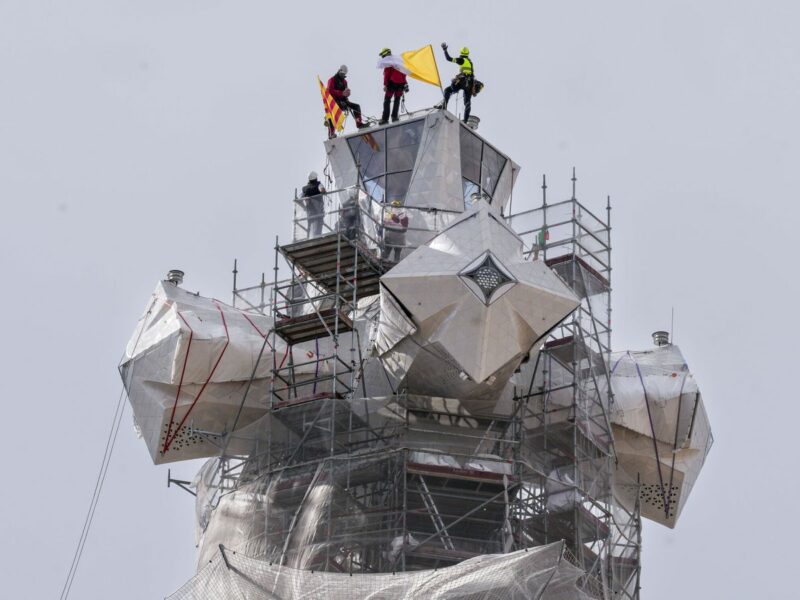
The cross of the Sagrada Familia.
The next trip of Leo XIV to Spain will focus on the blessing of the Tower of Jesus Christ of the Sagrada Familia, the extraordinary church in Barcelona designed by the brilliant 19th-century architect Gaudí, whose beatification is in progress. And this blessing is perhaps the one that best characterizes the first great European journey of the pontificate of Leo XIV. After the Sagrada Familia of Barcelona, Paris and Strasbourg are likely to complete the trio of apostolic visits to important places in Catholic Europe.
The Sagrada Familia of Barcelona, although it is not a cathedral, possesses its solemnity and its weight. From the laying of the first stone in 1882 until today, Gaudí’s design has remained intact. Just seeing the church from a distance, one perceives a strong sense of sacredness. That was Gaudí’s intention.
«This is eternal life: that they know You, the only true God, and Jesus Christ, whom You have sent.»
Good reading.