


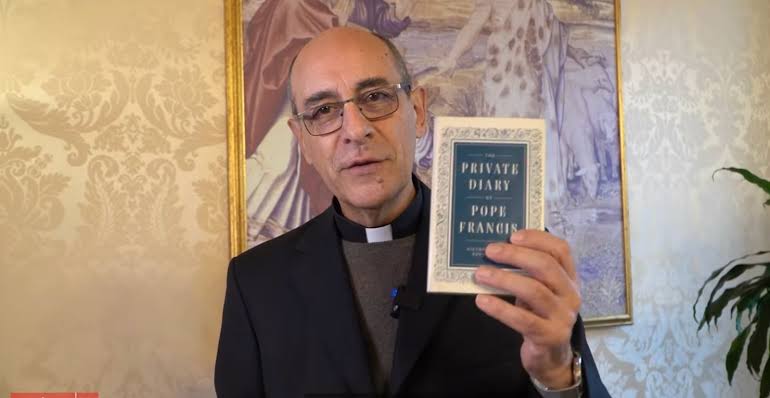
The book that Cardinal Víctor Manuel Fernández has published with the Librería Editora Vaticana is being read as the diary of the Pope who saw the devil. It is also the testimony of the man who headed the Dicastery for the Doctrine of the Faith in the last two years of Francis’s pontificate, and in that testimony there are phrases that, if signed by a critic of the pontificate, would have been read as an attack. Fernández recounts that Francis was becoming very deaf and that, when speaking with him, there was no certainty that he understood well; that, when he did not understand everything, intuition saved him; that sometimes he affirmed one thing and in other contexts seemed to say another; and that in his final years he delegated without demanding many explanations. It is written by the prefect who signed Fiducia supplicans.
«Intuition saves me»
The anecdote opens the book. In a private audience, Fernández dared to tell Francis that he was becoming very deaf and that, when speaking with him, there was no certainty that he understood well. He asked how he managed when asked for a response without having understood everything. «Intuition saves me», the Pope replied. Fernández does not date the conversation and presents it as praise: the «wonderful power» of his intuition was a gift that often rescued him from difficult moments.
On the same page he explains that this pastoral intuition is the reason why Francis «sometimes affirmed one thing and in other contexts seemed to say another». The two statements complemented each other, he maintains, but anyone who wanted to analyze his entire thought «was left disoriented». He did not like prefabricated messages and sought in his heart what was fitting to communicate at each moment.
During the pontificate, pointing out those contradictions was one of the usual reproaches of his critics. Now it is his prefect of Doctrine who describes them, attributes them to a method, and admits that they disoriented anyone who tried to reconstruct his complete thought. The question the book does not ask remains. The documents of the dicastery are approved by the Pope in audiences granted to the prefect. Fiducia supplicans bears the formula of approval from the audience of December 18, 2023. Fernández does not say when the deafness began or in which audiences the Pope answered guided by intuition.
Delegating without demanding many explanations
The second confidence appears at the end of the account of the 2021 and 2022 crisis, the two years in which, according to the diary, Francis struggled against a temptation to power and against a distrust toward others that he attributed to the devil. To avoid falling back into it, Fernández writes, in his final years the Pope strove to trust his collaborators fully, to avoid suspicions, and to «delegate without demanding many explanations». And he adds a phrase that can be read in two ways: «Those of us who worked with Francis in different positions will have to answer before God for the honesty we showed in the face of that trust».
Fernández arrived at the dicastery in September 2023. With the approval of that Pope who delegated, Fiducia supplicans, Dignitas infinita, the May 2024 norms on alleged supernatural phenomena, and the note on Medjugorje are his. Of Dignitas infinita the book gives a workshop detail: in an audience on the draft, Francis was interested in it being a powerful confession of the infinite dignity of every human being and in showing the attacks on that dignity in different social dramas. «Following that guideline the entire document was revised».
There is one more document the book does not mention and that Fernández has referred to in his interview with Vatican News. The afternoon when Francis showed him the diary, they were speaking privately about preparing a text that would establish what to do if the Pope lost consciousness irreversibly. It did not go forward. To La Nación he has placed that conversation at the end of 2024 or the beginning of 2025, in the last months of Francis’s life. In December 2022, the Pope himself had revealed in an interview with ABC that at the beginning of the pontificate he signed a letter of resignation in case of medical impediment.
«The greatest change in the Church’s teaching»
Fernández devotes a section to human dignity as an «unbreakable» conviction of Francis and draws its doctrinal consequence. That conviction, he writes, led the Pope to produce «the greatest change in the Church’s teaching during his pontificate: the condemnation of the death penalty».
The phrase is not innocent in the mouth of a prefect of Doctrine. When the Congregation for the Doctrine of the Faith presented in 2018 the new wording of number 2267 of the Catechism, the letter to the bishops signed by Cardinal Luis Ladaria insisted that the text was in continuity with previous magisterium and that it expressed an authentic development of doctrine, not in contradiction with preceding teachings. That letter attempted to close the debate on whether it was a development or a change. His successor, in a book from the Holy See’s publishing house, calls it a change, and the greatest of the pontificate.
Popular piety, without purifying
The third part of the book reviews the underlinings of the texts that Bergoglio wanted to have in Rome: Evangelii nuntiandi, the document from Puebla, and the one from Aparecida. In Puebla he used colors, with a legend on the first page: red for «inspiring syntheses», blue for «great guiding lines». Fernández draws attention to what Bergoglio did not underline. He marked the passage on the revaluation of popular religiosity, which expresses the religious identity of a people, but left unmarked the clause that qualified it with an allusion to deviations and ambiguities. He underlined that popular piety offers a privileged place for evangelization and omitted the condition, in the same passage, that it be purified of its deformations. According to Fernández, he was tired of the criticisms of popular piety coming from traditionalist and progressive sectors.
The cardinal adds a first-hand detail. During the Aparecida conference, in 2007, Bergoglio, who chaired the drafting commission, asked him to write «a highly positive description of popular piety, avoiding speaking of deviations or of purification», and exhorted him to prefer the language of growth and maturation. Fernández was part of the drafting team. The same approach, he notes, later passed to Evangelii gaudium. Evangelii nuntiandi, the first of the texts Bergoglio kept underlined, devotes its number 48 to popular religiosity and warns of its limits and of the deformations of religion, even superstitions, to which it is exposed. Fernández does not say whether that number is underlined.
A quote no one can find
The principle that «time is greater than space» is one of the four formulated by Evangelii gaudium, and Francis invoked it throughout the pontificate to explain his way of governing: to initiate processes rather than occupy spaces. Fernández explains its origin. It matured in the light of Saint Peter Faber, the companion of Saint Ignatius, from whom Francis had framed the formula of religious profession next to the holy water font. In number 171 of Evangelii gaudium, Francis attributed to Faber the phrase, «time is the messenger of God». And here the prefect makes a concession: «Until now the phrase has not been found literally in the writings of the saint». It expresses, he adds, a reflection typical of Faber.
The book has come out exactly thirteen years after the date of Evangelii gaudium, November 24, 2013. The prefect of the Doctrine of the Faith recognizes in it that one of the authoritative quotations of the programmatic exhortation of the pontificate has no located source.
The praises and the «irreproachable man»
To illustrate Francis’s respect for the dignity of each person, Fernández assures that the Pope spoke well of his collaborators in the Curia even when someone tried to extract a criticism from him. And he transcribes what he heard him say. Of Parolin: «an excellent diplomat, the cardinal who best understands international politics». Of Sarah: a believer «of the finest spiritual sensitivity». Of Tagle: «a saint who has the best of the Easterners: the incarnation of kindness». Of Müller: «he seems aggressive, but he is a good man, but good, good». Francis did not renew Müller at the head of the Dicastery for the Doctrine of the Faith in 2017 and accepted Sarah’s resignation as prefect of Divine Worship in February 2021. The book does not say when those praises were pronounced.
Of Robert Prevost, Francis said that he had always been «a great pastor, a generous missionary, and an irreproachable man». The qualifier appears printed in a book that Leo XIV himself endorsed and in which he requested cuts. His handling of abuse complaints in the diocese of Chiclayo, when he was bishop, has been the subject of controversy. According to what Fernández has told La Nación, the Pope has not yet read the definitive version.
The book also contains the reverse of those praises: the Curia collaborator who spoke ill of Francis in public and whom, according to what the Pope recounted in 2023 before Fernández and a bishop, he did not dismiss so as not to become a puppeteer. The book does not give his name.
How the book was made
The only authorization the book invokes is a phrase. One afternoon in Santa Marta, Francis showed Fernández the place where he kept some books and the old agenda and said: «Of this, you will see». To La Nación, the cardinal has clarified that it was not an order or a commission, but an expression of trust, and that the phrase was accompanied by a word, «edification», which he interpreted as that which might do good to people. Francis’s will, of June 2022, does not mention his papers.
The closest precedent bears the seal of the same publishing house. John Paul II asked in his will that his personal notes be burned and that his secretary watch over it. Cardinal Dziwisz did not do so, and in 2014 the notes were published; the Italian edition was by the Librería Editora Vaticana. Then there was an express order that was disobeyed. Now there is no order of any kind, and Francis’s will is reconstructed from the memory of his editor.
After the election of Leo XIV, Fernández spoke to him about the texts, the Pope found the box and sent it to him. The cardinal has told La Nación that he does not know whether Leo XIV read them before sending them, that the Pope was concerned upon learning that there were phrases with confusing things about living persons and that, after reading the first draft of the book, he asked to remove those paragraphs and some surnames, leaving only first names or ellipses. To Vatican News he has explained that the Pope agreed with everything and that the comment was considered important, because publishing only the texts could confuse readers who did not know Francis in depth.
The result has three layers of silence that the reader cannot distinguish. The passages Bergoglio wrote in code, which Fernández has described as phrases that begin in Spanish, continue with signs resembling hieroglyphs and return to Spanish; the book says that «we cannot and must not decipher» those signs. The cuts requested by Leo XIV. And the ellipses of the editor himself. In the Italian edition, the quotations alternate brackets with ellipses without explaining what each sign marks. Added to that is the translation: Bergoglio wrote in Spanish and the editions in other languages render expressions such as «me caí del catre», which the Italian edition has to explain in a note. Fernández assures, nevertheless, that the book hides nothing.
The seams
A 160-page book prepared by the prefect of the Doctrine of the Faith and published by the publishing house of the Holy See should withstand the checking of dates. It does not always do so.
The two phrases that Fernández links to the visit to Fátima on the occasion of World Youth Day, «I looked and asked» and «I looked at her and she spoke to me», appear dated October 5 and 6, 2023. Francis was in Fátima on August 5. The book places Bergoglio’s vocational call in San José de Flores on September 21, 1953, the feast of Saint Matthew, but cites as written «precisely 50 years later» a note dated September 14, 2003. When speaking of the years Francis called «fugitive», Fernández adds to Córdoba «the four years lived» earlier by Bergoglio in Europe, «especially in Frankfurt»; according to the official biography, Bergoglio moved to Germany in March 1986 to prepare his thesis and his superiors later assigned him to the Colegio del Salvador in Buenos Aires and to Córdoba. And in the list of names that, according to the editor, show Francis’s attention to each person, appears the note of January 13, 2008: Father Duarte «turns ninety today». The priest with whom Bergoglio went to confession in 1953, whose death the diary itself recalls, died the following year. Fernández does not clarify whether it is a commemoration or another person.
An argument with a signature
Fernández does not present the book as a critical edition. He presents it as a response. Knowing these pages, he writes, is fundamental for those who speak of Francis without respect and for those who claim that he was «an empty man, without faith or without deep convictions». In the final chapter he orders by levels those who speak of the Pope and places at the most superficial level those who hate him and construct «the figure of a monster», a vision «often impregnated with a strong ideology». In another he laments the culture of cancellation of a society he calls woke. To Vatican News he has confessed that he was slow to speak of Francis out of cowardice before those who rejoiced at burying him.
The editor also does not absent himself from his book. He recounts that Bergoglio commissioned him in Aparecida with the text on popular piety, that the guiding lines of Evangelii nuntiandi on the participation of the laity were the same ones Francis gave him when the dicastery was studying that question, and that the first draft of Dilexi te was Francis’s before Leo XIV completed it. He recalls that, when congratulating him on something, the Pope told him: «Humble yourself! Because God wants to use you for important things». And that the second time he asked him by telephone to accept the prefecture, when he finally said yes, he replied in a firm voice: «I hope you come as soon as possible. Humble yourself and trust». The first time, Fernández had said no.
There is, finally, an incongruity of tone. The norms that Fernández’s dicastery approved in May 2024 established that, as a rule, the Church no longer pronounces on the supernatural origin of the phenomena it examines. Those norms refer to public phenomena, not to the interior life of a person. But the book is an official edition of the Holy See, and the chapter that collects Francis’s encounters with the devil, the entrance to hell, and the Virgin who «spoke» is titled «Visions and signs from heaven».
The volume ends with the phrase with which Francis introduced himself on the telephone to people of trust: «I am Bergoglio». Fernández writes that he has tried to reach that core. The Bergoglio who signs these pages is the one the editor has wanted to show. The one who wrote in code remains untranslated.
Read also
- Fernández resists correcting the legal ambiguities of the excommunication decree against the FSSPX
- The secret votes on Medjugorje: almost two thirds rejected its supernatural origin
- Bishop of Malawi asks forgiveness from the faithful who have felt «offended» and «scandalized» upon seeing the Pope’s signature on Fiducia supplicans