


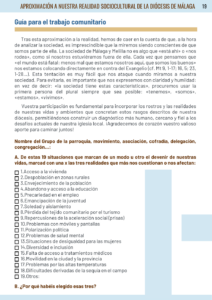
The Diocese of Málaga has begun preparing its Diocesan Pastoral Plan 2028-2033 with a 26-page document, “Approaching our sociocultural reality of the Diocese of Málaga,” which has been proposed for group work by parishes, confraternities, congregations, and movements. The text, accessed by InfoVaticana, asks each group to mark the three realities that “most challenge or affect us” among eighteen proposals, plus an “other” checkbox, and to send testimonies about them. The list begins with access to housing and ends with drought in the countryside. None of the eighteen refer to faith, the sacraments, or religious practice. After Bishop José Antonio Satué’s introductory letter, the words God, Christ, and Jesus do not appear again in the following 23 pages.
Satué’s letter presents the process as a work that “will be written by many hands,” based on the proposal launched at the Diocesan Assembly on June 20. This academic year, he explains, the diocese wants to look at its reality from three perspectives: sociocultural, ecclesial, and theological; for the second, it proposes taking a “selfie” as a Diocese. The diocesan calendar leaves the drafting of the plan, which will govern the next five years, for the 2027-2028 academic year. This first text is defined as an “x-ray” of our environment, and the groups’ testimonies “will be integrated into the final document that will give light to the Synodal Diocesan Pastoral Plan.”
The x-ray occupies fifteen pages. It discusses rental prices in the capital, which rose 97% between 2015 and 2023, evictions, chained contracts, private vocational training, waiting lists, tourist apartments, traffic jams on the A-7, heat-related deaths, and drought in the Axarquía. It dedicates sections to young people, the elderly, migrants, and women, and others to haste, loneliness, screens, and polarization. In the analysis, the religious dimension appears three times, always as data on coexistence or tradition: the coexistence in Melilla of Muslim and Christian communities with Hebrew and Hindu minorities; the “harmonious coexistence of multiple religious confessions,” listed alongside the diversity of the LGTBIQ+ community; and Holy Week, which appears alongside the feasts of the Virgin of Carmen and Saint John, the fair, and the verdiales as part of a “valuable identity legacy” that “provides cohesion.” The word marriage does not appear anywhere in the document. Abortion does not either, although the text notes that in 2025, 14,506 people died in the province and 11,603 were born, and, citing the FOESSA Report, attributes young people’s “frustrated fertility” to the forced delay of their emancipation.
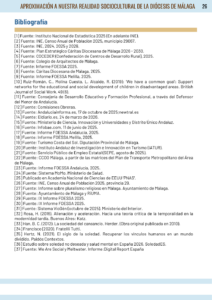
The 37 bibliographic notes show where the diagnosis comes from. Seven refer to reports from the FOESSA Foundation, promoted by Cáritas, and two to Diocesan Cáritas; four to the INE, and two to Comisiones Obreras, from which come the figure of applicants without a public vocational training place and the data that 85% of interurban travel is done by private car. eldiario.es, Newtral, and Infobae also appear, and for the cultural part, German sociologist Hartmut Rosa, philosopher Byung-Chul Han, and economist Noreena Hertz. The only pontifical document on the list is Fratelli tutti. In the fifteen pages of the x-ray there is not a single citation from Scripture, the Catechism, or the Council.
The guide for group work warns against a temptation. Every time we think that “the world is terrible: thank goodness we are here, that we are the good ones,” it warns, “we are placing ourselves directly against the Gospel,” and refers, among other passages, to chapter 23 of Saint Matthew, the one with the woes against the scribes and Pharisees. To avoid it, it asks to use, “whenever possible,” the first-person plural. The questions it proposes for collecting testimonies follow the pattern of the diagnosis: what meals at home are like when there are mobile phones on the table, what gender inequalities have been witnessed “while walking down the street,” what discrimination people with disabilities, migrants, or the LGTBIQ+ community have suffered, what “bad faces” are seen among neighbors with different political ideas. Responses reach the Vicariate of Pastoral Care through an online form that marks the name, surnames, and ID number of the person filling it out as mandatory.
On November 5, Satué himself presented the diocesan report for 2025: 3,844 baptisms, 5,386 confirmations, 3,623 first communions, and 817 weddings, fewer in all four cases than the previous year. None of these figures are in the x-ray, which does measure hotel overnight stays in August, apartment prices in La Malagueta, and the daily hours Spaniards spend in front of a screen. Nor is there a single piece of data on Sunday Mass, vocations, or catechesis.
The diocese’s predictable response is that faith will have its turn. The process calendar reserves for this same academic year an ecclesial diagnosis, with the clergy, consecrated life, and the laity, and a theological deepening on the Church as communion and mission. But the sociocultural document delimits its own object, and according to its introduction it wants to focus on “those customs and ways of living that are transforming the way we live and relate to each other daily.” That in one year the diocese has celebrated fewer baptisms, confirmations, first communions, and weddings falls squarely within that definition, and it is a change for which the diocese has its own figures, presented by its bishop this same month. It was left out.
A parishioner who participates in one of the groups, and who has sent the material to this editorial office, complains that, with so many spiritual shortcomings, the parish dedicates its meetings to climate change and housing. The document closes with a prayer asking the Lord for a diocesan Church that “does not want to place itself alien or withdrawn from the society of which it is a part.” In its pages of analysis it achieves this to the point that the Malaga City Council, cited twice in the bibliography, could sign them without changing hardly a comma.
Document. Working on the sociocultural reality of the Diocese of Málaga
Read also