


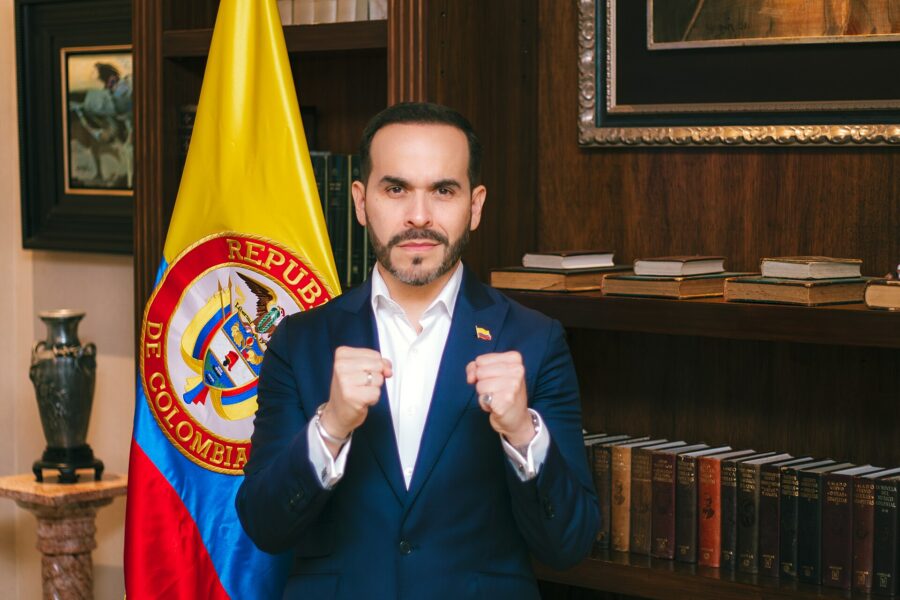
The Fifth Section of the Council of State of Colombia has denied the tutela filed against President Abelardo de la Espriella and has concluded that he did not violate the secular character or religious neutrality of the State when he crowned an image of the Virgin of Fatima at the “Gran Velatón por Colombia” nor when he shouted “¡Viva Cristo Rey!”. The ruling, adopted on 13 November, responds to the claim of a citizen, Román Camilo Díaz Fernández, also directed against the Minister of Cultures, Paola Holguín, and the then Minister of the Interior, Rodrigo Lara.
The coronation took place on 28 August in Bogotá’s Plaza de Bolívar, at the end of a day of prayer and candles convened by the Government in memory of the victims of the earthquake on 10 August, as published by InfoVaticana. The claimant maintained that that act, together with other actions by the president, amounted to preferential treatment toward one religious confession.
A day with sufficient “secular justification”
According to the Fifth Section, the coronation does not in itself disregard the principles of neutrality and secularism, because it formed part of a day with an important, verifiable, consistent and sufficient secular justification: humanitarian support for the victims of the earthquake. The court also ruled out any violation arising from the use of cultural resources in the organization of the event, which the claimant had questioned in relation to the Ministry of Cultures.
The judgment also examined other actions by the head of state and likewise considered them compatible with secularism, including the wearing of a kippah in the context of bilateral relations with Israel and his visit to a synagogue in Barranquilla. In this way, the ruling stresses that the presence of religious gestures in official acts does not, by itself, imply that the State identifies with a particular belief.
“Viva Cristo Rey”: the president’s freedom of conscience
Regarding the expression “¡Viva Cristo Rey!”, the Fifth Section held that uttering it, whether at the inauguration or in speeches, does not violate neutrality or secularism. The court recalled that the president, like any citizen, retains his rights to freedom of conscience, worship and expression, and that the exercise of those rights is not annulled by the office he holds.
De la Espriella reacted by stating that the Council of State has established that he did not violate the rights to equality or to freedom of worship and conscience, and that his faith “is part” of his personal convictions. The president has also reaffirmed that Colombia is a secular state in which religious freedom and freedom of conscience must be guaranteed for all.
Another ruling on the same day orders him to rectify
On the same 13 November, the Fifth Section ruled on another tutela, filed by a citizen who declares himself an atheist, and in that case it did side with the claimant. The court considered that certain words spoken by the president on 15 October at the Ministry of Cultures, in which he referred to “atheist social-communism,” stigmatized those who profess no religion.
Consequently, it ordered De la Espriella to issue, within five days, a public statement recognizing that non-religious convictions are protected by the Constitution, to remove the videos of the speech from his channels within 48 hours, and to refrain henceforth from stigmatizing people for their beliefs or for not having any. Thus, the resolution concerning the coronation of the Virgin remains separate from this second one, which refers to a specific expression about atheism and not to any act of worship.