


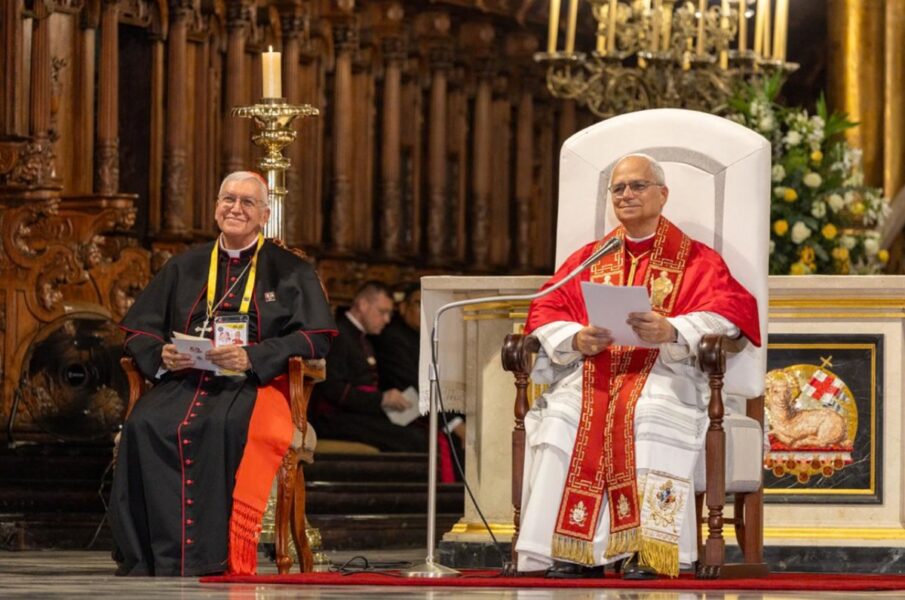
Cardinal Carlos Castillo, Archbishop of Lima, used the prayer vigil of Leo XIV with young people at the National Stadium to bestow the title of martyrs on the two protesters who died in November 2020 during the demonstrations against the government of Manuel Merino. “And there are two martyrs of the young people, Bryan and Inti,” he said on Thursday, November 12, before the Pope and some 52,000 people, after recalling that in the mobilizations of recent years, “in some cases, several of them were shot.” Leo XIV then took the floor, limiting himself to thanking the cardinal’s intervention in a generic way and mentioning neither the deceased nor the term. The word martyr does not appear in the speech published by the Holy See.
Jordan Inti Sotelo Camargo, 24, and Jack Bryan Pintado Sánchez, 22, died on November 14, 2020, in downtown Lima during the second national march against Merino, struck by pellets. Merino resigned the following day and Francisco Sagasti assumed the presidency. Since then, the two names have become the symbol of those mobilizations and the cause of human rights organizations, which attribute the deaths to police repression. Six years later, no court has established who fired the shots.
The judicial process explains why the cardinal’s words are not innocuous. The then Prosecutor of the Nation, Zoraida Ávalos, filed a constitutional complaint against Merino, his President of the Council of Ministers, Ántero Flores-Aráoz, and his Minister of the Interior, Gastón Rodríguez, as alleged perpetrators by omission of the homicides. Congress archived the complaint in 2022: the Subcommittee on Constitutional Accusations approved in June the report of Congressman Alejandro Cavero, which held that there was no evidence that the Police had used lead pellets, and the Permanent Commission ratified the archive on July 1. The Prosecutor’s Office then turned against the police chain of command. Prosecutor Jhousy Aburto has requested up to 35 years in prison for several officers as indirect perpetrators, arguing that the deployed agents carried 12-gauge shotguns compatible with the pellets found in the bodies. No ballistic expertise, according to the documentation handled by the Lima newspaper Expreso, has linked a specific projectile to a weapon or a specific agent.
Expreso published on Saturday an extensive report accusing the cardinal of failing to tell the truth. The newspaper includes the testimony of jurist Mario Amoretti, former dean of the Lima Bar Association, according to whom the Police did not use lead ammunition, there are videos with homemade weapons in the hands of protesters, and the Prosecutor’s Office, which clung from the beginning to the thesis of police responsibility, “refused to investigate them.” The newspaper also mentions the discovery of 352 rubber pellet cartridges, which would reinforce the defense of the agents. The thesis of the infiltrators, however, has not been proven either. The December 2020 expert report on Sotelo’s body described a lead pellet from a shotgun cartridge with no signs of artisanal manufacture, a fact that does not prove police authorship but also does not support the homemade weapons hypothesis. The case remains open in all directions.
Expreso also provides documents on the two deceased. According to the reproduced sentence, Pintado was convicted in 2018, through early termination of the process, as the perpetrator of an aggravated theft against a 16-year-old adolescent from whom he had taken the mobile phone, with a suspended two-year prison sentence. In Sotelo’s case, the newspaper does not present a conviction, but a police report from August 2018 from the Caja de Agua police station in San Juan de Lurigancho, which describes him as having been intervened with drugs that, according to the document, he declared he sold retail to pay for his studies. When the report was released in 2020, the family maintained that it was an error that had been overcome. Merino told Bethel Noticias that the deceased were not martyrs of any repression and that their death was used politically, and has lamented that a space of faith is used to politicize the tragedy, although he says he wishes justice for the families.
None of this resolves the question raised by the cardinal, and it is worth stating it precisely. A criminal past does not prevent martyrdom: the Church venerates converted sinners and the Gospel promises paradise to the good thief on the very day of his death. What makes a martyr is the cause, not the suffering or the biography, according to the old Augustinian formula: martyrem non facit poena, sed causa. The Catechism defines martyrdom as “the supreme witness to the truth of the faith” (n. 2473), a testimony of Christ dead and risen sustained until death. Francis opened in 2017, with the motu proprio Maiorem hac dilectionem, a different path for those who offer their lives for others, but conditioned it to a free and voluntary offering, moved by charity, in the face of certain and short-term death, and to the exercise of Christian virtues. Dying from a gunshot in a demonstration against a government does not fall into either of the two categories, whoever fired it.
The setting aggravates the use of the term. Castillo did not speak at a rally but at a prayer event presided over by the Successor of Peter, before tens of thousands of young Catholics. In the mouth of a cardinal and in that place, the word martyr does not function as a civic metaphor. It functions as an ecclesial judgment. It is not the first time that the archbishop has introduced these names into the liturgy. In the Te Deum on July 28, he asked in the prayer of the faithful for Inti, for Bryan, and for Eduardo Ruiz, “Trvko,” the rapper killed in October 2025 by the shot of a police sub-officer dressed as a civilian, as then recognized by the Commander General of the Police, Óscar Arriola. Praying for the deceased is a work of mercy. Proclaiming them martyrs before the Pope is another matter.
Leo XIV spoke that night of the cross, the instrument of death that through Christ’s self-giving became “the place where his love was manifested.” It was the only death he spoke of.
Read also