


It happened during the television coverage of the Pope’s farewell at the shrine of Argentina’s patroness. Among the live connections broadcast by El Nueve, a group of young people wearing yellow vests—who said they were serving the Church that day—spoke to the camera about the harmony, family, and unity the visit had left them. One of them took the microphone to address the Pontiff: “We also wanted to make a request to the Holy Father […], but especially we want to ask that the traditional Mass be freed.”
The young woman described the traditional liturgy as “an ancient rite of many centuries of our Church,” celebrated by “the great saints” and through which the Church “has always been sanctified.” She explained the reason for the plea: “We do not have it available now; it is not free; it cannot be celebrated, and many young people are encouraged and want to continue that rite.” The request, she clarified, was not limited to her country: “Not only in Argentina, but throughout the rest of the world, we want to have the possibility in our parishes of attending Mass celebrated in the Tridentine rite.”
There is no record that the request was repeated in an organized way among the crowd gathered in Luján or that it reached the Pope. It was, however, captured live on the morning when Leo XIV concluded his stop in Argentina before traveling to Peru. In his homily, the Pontiff stated that “the various sensibilities present in the Church, the strong convictions that animate each person, are a richness,” although he made no explicit reference to the liturgical question.
The situation the young woman described originates from Traditionis custodes, the motu proprio with which Francis revoked in July 2021 the regime of Summorum Pontificum (2007) established by Benedict XVI. Since then, celebration with the 1962 Missal depends on the authorization of the diocesan bishop, who must designate places of worship other than parish churches. That is what the young woman was referring to when she asked to be able to attend that Mass in “our parishes.”
Young people in Buenos Aires too
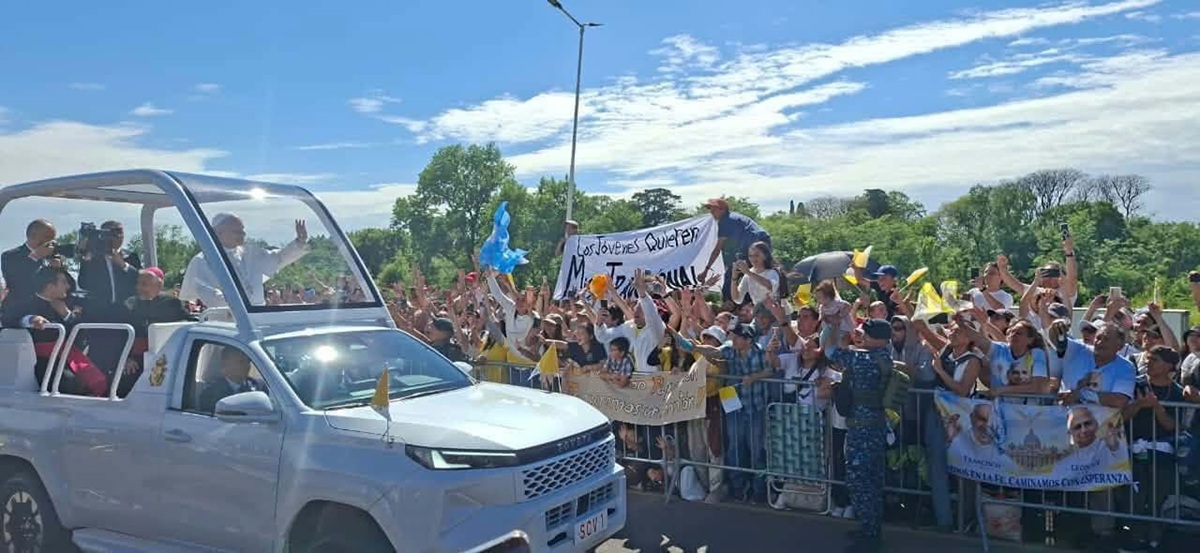
Luján was not the first stop on the trip where this request appeared. On Monday, November 9, during the first day of the visit, a group of young people unfurled a banner reading “Young people want the traditional Mass” as the popemobile passed through Buenos Aires, as reported by InfoVaticana. The images show the Pope waving from the vehicle.
That same day, the archbishop emeritus of La Plata, Héctor Aguer, asked in statements to AdVaticanum to “repeal Traditionis custodes” and described the restrictions imposed during the previous pontificate as “draconian.” Days earlier, Cardinal Oswald Gracias had told the same outlet that “he would not be in favor of prohibiting its spread”, provided that did not imply rejecting the Second Vatican Council.
Luján, destination of Our Lady of Christendom
For Argentine faithful attached to the traditional liturgy, Luján holds particular significance. It is the destination of the pilgrimage of Our Lady of Christendom, inspired by the Paris-to-Chartres march organized by Notre-Dame de Chrétienté since 1983. The Argentine initiative began in 2010 with four friends who that year reached the shrine with eighteen people.
Today it covers about one hundred kilometers on foot over three days, from the Church of the Immaculate Conception in Rawson to the basilica. The pilgrims attend Mass each day in the traditional form of the Roman rite, at field altars, and have priests available for confession. The seventeenth edition, held from August 15 to 17 under the motto “Behold your mother,” gathered more than 2,300 pilgrims, a record figure. “We always grow. Slowly and gradually, but we grow,” summarized one of its founders, Nicolás Stier.
That pilgrimage, however, ends at the doors of the shrine. The closing Mass cannot be celebrated inside the basilica because the prohibition issued by the bishop of Mercedes-Luján after Traditionis custodes remains in force, and the pilgrims celebrate it outdoors before the final stretch. That is why the request to free the Traditional Mass, heard precisely in Luján during the Pope’s farewell, carries special resonance.