


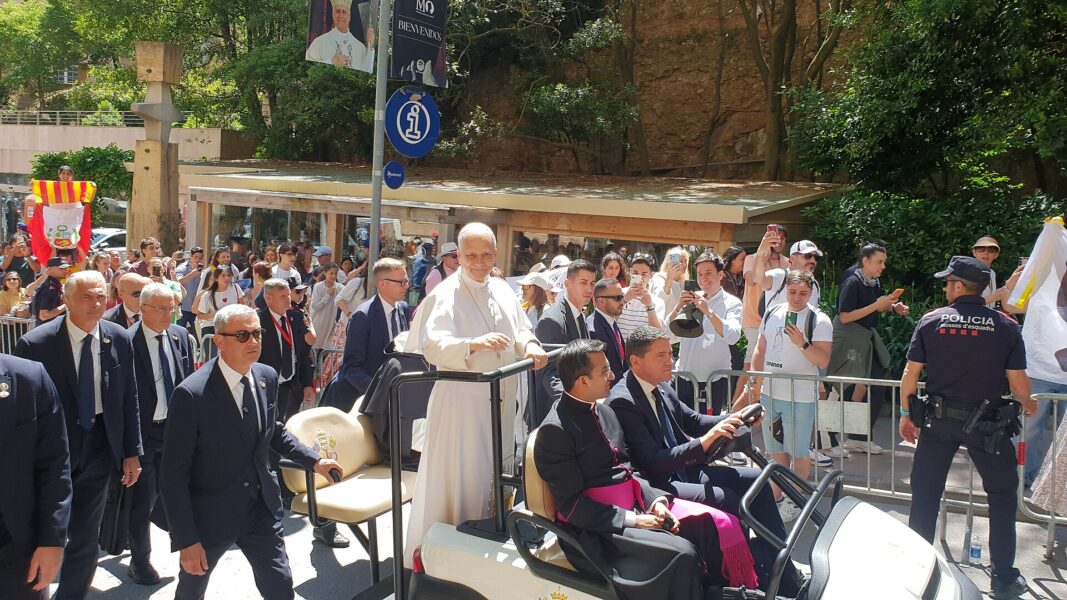
Pope Leo XIV delivered a speech on November 9 at the Catholic University of Argentina in Buenos Aires before workers, business leaders, union representatives, and spokespeople from social organizations, in which he recalled the principles of the Church’s social doctrine. According to the text published by the Holy See, the Pope stated that the entrepreneurial vocation is a noble calling when guided by the social function of property and capital, but that if economic profit becomes the sole criterion of success, the company becomes dehumanized and turns into “a structure of sin that generates exclusion.”
The dignity of the worker above profit
The Pontiff placed the dignity of the person as the starting principle and affirmed that depriving someone of work is not only denying them an income, but also “gravely wounding their dignity,” nullifying their capacity to contribute to society and casting them into exclusion. From this he concluded that access to employment must remain a priority objective of public policies and a criterion for evaluating any development model.
In the same speech, Pope Leo XIV recalled that the Church recognizes and defends the right to private property, but that it must always be subject to a social obligation, since the earth and its fruits have been given by God to sustain all humanity. “We are not absolute owners, but custodians of a legacy that must be shared with justice,” he said. He also warned against greed, which he described as a disease of the heart, and called for the success of a company to be measured also by its contribution to the common good.
Unions, artificial intelligence and the example of Enrique Shaw
He entrusted unions with defending those who have no voice, resisting the commodification of work, and reaching out to the existential peripheries—that is, precarious, informal, and excluded workers. He also referred to waste-pickers, peasants, and artisans, and recalled the “three T’s”: land, housing, and work.
Regarding technology, the Pope noted that the challenges of artificial intelligence and unregulated automation “can put so many jobs at risk and become a real threat to proper integral human development.” In his view, technology must always be subordinated to ethics, and the algorithm cannot replace human discernment.
As a model for the business world, he proposed the Venerable Enrique Shaw, a Catholic entrepreneur who discovered the Gospel through the Church’s social doctrine, was one of the founders of the Catholic University of Argentina itself, and defended the idea that “it is necessary to form Christian entrepreneurs.” The speech closed with an invitation to build “social friendship” in Argentina and to construct, through daily work, “the civilization of love.”
An intervention that follows the one at Palacio Libertad
The UCA remarks came one day after Pope Leo XIV, before President Javier Milei, stated that the economy must be at the service of the person. The address to the world of work is part of the Pope’s apostolic journey to Uruguay, Argentina, and Peru, and reiterates that same approach with more technical language on business, property, and employment.