


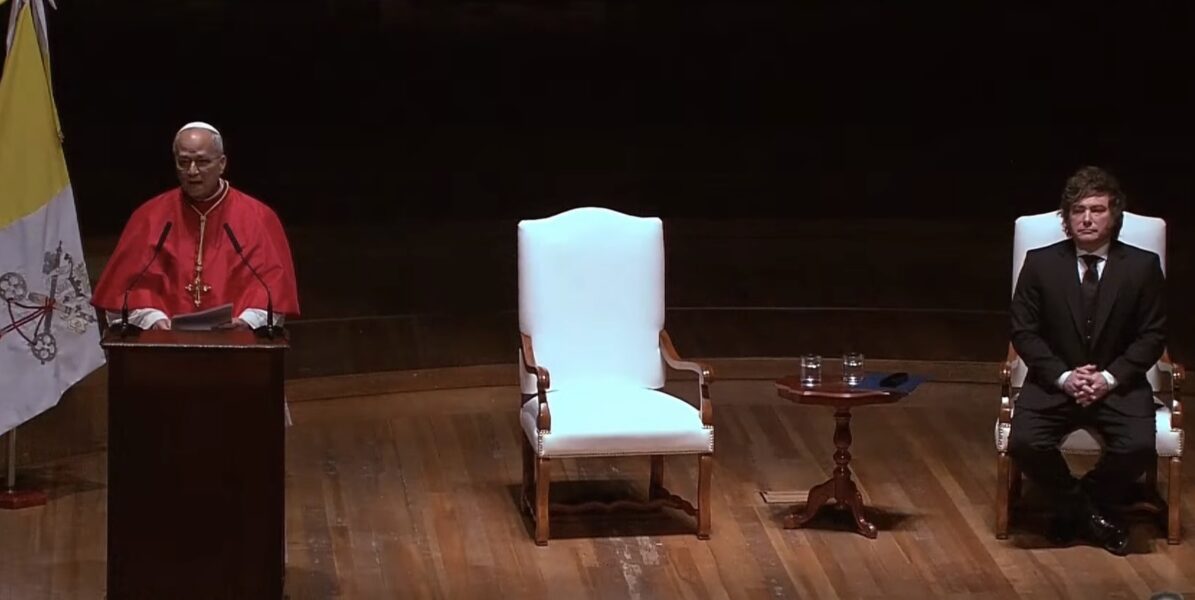
Pope Leo XIV delivered the most anticipated speech of his trip to Argentina on Sunday, November 8, at the Palacio Libertad, the former Kirchner Cultural Center in Buenos Aires. For nearly twenty-five minutes, with President Javier Milei at his side and in the presence of Vice President Victoria Villarruel, governors, officials, the diplomatic corps, and representatives of civil society, the Pontiff painted a demanding portrait of the country: he praised its cultural and democratic heritage, defended the life of the unborn, and clearly warned about the human cost of an economy that forgets the most vulnerable.
The day had begun shortly after four-thirty in the afternoon, when the papal plane, arriving from Montevideo, landed at Aeroparque Jorge Newbery, where Milei awaited him at the foot of the gangway. In Plaza de Mayo, the head of the Buenos Aires city government, Jorge Macri, handed him the keys to the city. After a private meeting at Casa Rosada, Leo XIV addressed Argentina’s entire political leadership.
A shepherd in the homeland of Francis
The Pope presented himself as the successor of the apostle Peter and, therefore, as a shepherd. With an emotional nod, he recalled that he was traveling the reverse path of his predecessor and arriving in the land where Francis had begun his story. From there, he built a reflection on national identity as a received legacy: no generation, he said, starts the homeland from scratch. Among the signs of that heritage, he evoked Martín Fierro, Borges, tango, and shared mate, that everyday gesture that turns a pause into conversation.
Democracy, power, and adversaries
In a country marked by harsh polarization, Leo XIV called for safeguarding democracy as part of that heritage and recognizing in those who think differently a compatriot with whom destiny is shared. He also issued a warning to those in power: authority reaches its highest meaning when exercised as service and when it accepts the limits of power. He upheld the family as the basic cell of society and, in the final stretch, invited everyone to keep alive the purpose of national unity proclaimed in the preamble of the Argentine Constitution.
“The economy must serve the person”
The economic passage was the most commented on of the afternoon. The Pope maintained that one of the most elementary conditions of a dignified life is being able to live from one’s own work, and he called for favoring everything that opens opportunities and stimulates private initiative, provided that growth also reaches those who face the greatest difficulties. The central phrase resonated in the hall with the force of an inalienable principle of social doctrine: “The economy must be at the service of the person, and not the person at the service of the economy.”
Leo XIV had concrete words for families bearing the weight of uncertainty, for those seeking employment, for the elderly who built the country over decades, and for those who, even while working, cannot meet their household needs. He added an uncomfortable question for any government: a nation must seriously ask itself what has failed when its young people must leave their land to fulfill their dreams. For that reason, he called for strengthening education, vocational training, universities, and research, and for trusting in the initiative and creativity of the new generations.
Life, from the first instant to its natural end
On moral grounds, the Pontiff posed a direct question to legislators: what place do those who have not yet been born occupy in their decisions? He called for welcoming life from its first moments and safeguarding it until its natural end, a defense that aligns with Milei’s position against abortion. He completed the idea with a deliberate nuance: that same dignity requires special attention to illness, dependency, and disability, a sector severely affected by cuts and for which the Argentine Church had already interceded with the Government.
Creation, technology, and ethics
Leo XIV recalled that God has blessed Argentina with extraordinary natural wealth—fields, water, energy, minerals, and ecosystems of enormous diversity—and, in the wake of Benedict XVI’s Caritas in veritate, defended an authentically human ecology that unites care for creation with care for persons and ensures that the use of those resources benefits the communities living in those territories.
Regarding artificial intelligence and technical advances in medicine, education, production, and research, he warned that their application requires measuring consequences and assuming responsibilities. Technological development, he stated, needs an ethical awareness equal to its reach, in a reference to Francis’s exhortation Laudate Deum.
Corruption, crime, and dialogue among nations
The Pope identified organized crime, human trafficking networks, arms and drug trafficking, and corruption as serious threats that damage coexistence, fuel violence, and divert resources needed for the common good. On corruption he was especially severe: it erodes citizens’ trust in their institutions. On the international level, he defended that the legitimate interests of each nation be protected through dialogue and called for strengthening cooperation among countries in the face of challenges that none can confront alone.
Gardel, Francis, and the final blessing
In closing, Leo XIV recalled that there are goods a society needs that no public policy can produce on its own. He cited Carlos Gardel to underscore that life is short but good endures, evoked Francis’s well-known wish that the Lord make Argentines grow as a people, and concluded with a blessing for Argentina and all its inhabitants.
A contained Milei
The president, who had asked to know the content of the first papal speech in advance, notably lowered his usual tone and celebrated the presence of leaders from across the political spectrum. The passages on the economy, retirees, and disability were met with especially enthusiastic applause from the opposition benches, and Buenos Aires governor Axel Kicillof urged the leadership to “take note” of the message.
Leo XIV’s visit to Argentina will continue until Wednesday, November 11, with stops in Córdoba, a meeting with inmates at the Buenos Aires federal penitentiary complex, and a Mass at the Luján shrine, where authorities expect around one and a half million faithful.