


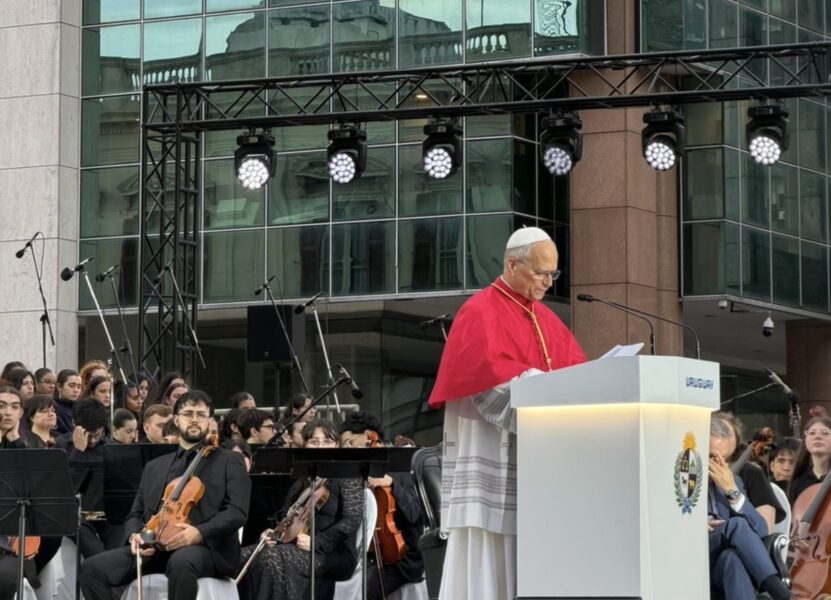
Pope Leo XIV defended the dignity of the unborn this Friday in the first speech of his apostolic journey to Uruguay, delivered in Montevideo’s Plaza de la Independencia before the authorities, civil society and the diplomatic corps, following the welcome remarks by President Yamandú Orsi. According to the official text published by the Holy See, the Pope stated that the one who has not yet been born “already belongs to the human family and to the future of his people,” and that his absolute dependence on the mother “does not diminish the dignity that belongs to him nor the protection he deserves.”
The pontiff added that welcoming a new life requires parents to assume their responsibility alongside mothers, that the family offer its support, and that social conditions exist that allow both parents to raise their children. He concluded the passage with an affirmation linking the two realities: the protection of the unborn and the support of those who welcome them are, he said, “inseparable.” In the same passage he cited John Paul II, for whom the future of humanity “is forged in the family.”
A bas-relief as a starting point
The Pope began with the monument to Artigas that presides over the square and its bronze frieze depicting the 1811 exodus of the Eastern people. He recalled the phrase attributed to the national hero, “my authority emanates from you,” to explain that authority is received from a community and before it one is accountable. He then described some figures in the relief, such as a woman holding a child, children walking alongside adults, and an elderly woman with a cane, to emphasize that a person’s value does not depend on what they produce or on their strength.
From that idea he moved to the care of the most vulnerable. Pope Leo XIV warned that loneliness, anguish and the loss of hope can lead someone to stop finding reasons to live, alluding to suicides in the country, and asked that no one feel like a stranger among their own. According to the ANSA agency, Uruguay has the highest suicide rate in Latin America, with 19.16 deaths per 100,000 inhabitants, according to data from the Ministry of Public Health in 2025.
Healthcare for all and a secular state
The Pontiff also referred to his recent illness and thanked the care he received. He recalled that many people lack the means for a timely diagnosis or for the treatments they need, and maintained that guaranteeing healthcare for everyone, regardless of their resources, is a responsibility of the entire society. Illness or frailty, he added, does not reduce anyone’s full belonging to the community.
Regarding secularism, a characteristic of the Uruguayan State, the Pope affirmed that it must guarantee a space in which believers and non-believers can coexist with freedom and respect, and that this neutrality does not oblige one to confine the religious dimension to the private sphere. Religious communities, he indicated, can contribute to the common good while respecting the autonomy of civil institutions.
First stage of a twelve-day journey
Montevideo is the first stop of a journey that will also take Pope Leo XIV to Argentina and Peru until November 17, as InfoVaticana reported when the plane took off from Rome. In Uruguay, he is scheduled to speak on Saturday in the Aula Magna of the Catholic University before the educational community, before the youth vigil at the Centenario stadium.