


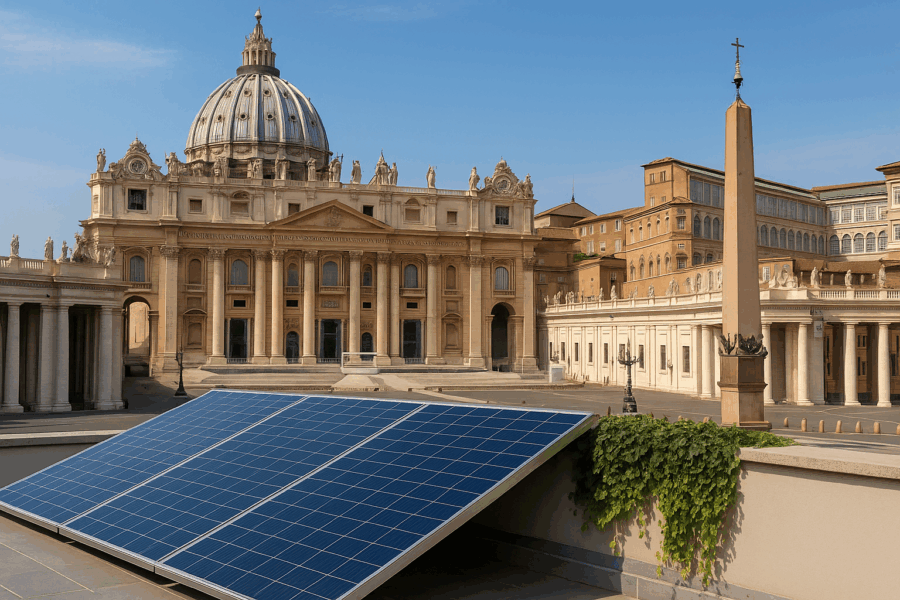
The Dicastery for the Service of Integral Human Development presented this Wednesday, November 4, in the Holy See Press Office, the fifth annual report of the Laudato si’ Action Platform and the launch of a digital atlas that allows users to consult the ecological initiatives of Catholic institutions worldwide. The press conference included the prefect of the dicastery, Sr. Alessandra Smerilli, and the director of the Platform’s program, Alonso de Llanes, among other speakers, ten years after the publication of Pope Francis’s encyclical.
According to De Llanes, the atlas links the activity of participating Catholic institutions with geographic and climate data. The tool gathers three types of information: the location of the institutions, the activities of their communities, and the environmental data of the places where they operate. Users can select a country or diocese, identify participating institutions, and, always with their consent, consult their environmental plans and reflections. “The knowledge we need already exists in many places,” De Llanes stated, adding: “We have discovered that it is possible to build a platform.”
More than 13,000 profiles in five years
The annual report puts the number of registered profiles on the Platform at more than 13,000 after five years of operation, of which 6,200 correspond to institutions and 7,400 to families and individuals. The document highlights the growing participation, the initiatives driven by religious congregations and Catholic communities around the world, and the new tools to strengthen the Church’s commitment to integral ecology.
Sister Roxanne Schares, executive secretary of the International Union of Superiors General (UISG), noted that the organization, which represents 600,000 religious sisters on five continents, estimates that more than 50% of the world’s congregations participate in the Platform. “Religious men and women around the world have taken on the commitment to creation,” she declared. For his part, Bishop Allwyn D’Silva, former auxiliary bishop of Bombay (India), recalled that in his experience “we promoted what we call a carbon fast.”
Smerilli: “These are not just environmental projects”
The prefect of the dicastery emphasized that care for creation and care for the human person constitute one and the same task. “These are not just environmental projects,” Smerilli stated, also acknowledging that “we have learned that an invitation is not enough.” Regarding the encyclical, she maintained that “this is not a text to be simply read or quoted.” According to the prefect, over five years communities have been guided toward the Platform, and now it is hoped that the Platform itself will help them find one another.
Lorna Gold, executive director of the Laudato Si’ Movement, assured that “in the last five years, we have shown that the Church is willing to respond.” The Platform is a digital space where communities and institutions create a profile, develop their integral ecology plan, and communicate the actions they have taken.
The Vatican’s ecological agenda has had other recent milestones. In September, the International Theological Commission proposed speaking of “sin against creation and against the Creator” in a document on care for our common home.