


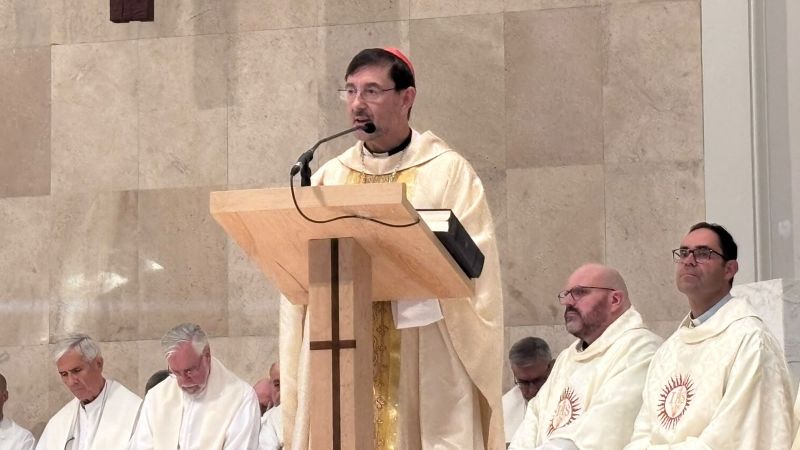
Cardinal José Cobo, Archbishop of Madrid, has published the pastoral letter Somos vidas en camino, dedicated to the movements, communities, methods and new ecclesial realities present in the archdiocese. The text, released on 4 November by Archimadrid, states that “it is about walking alongside” these realities and sets out a procedure for new initiatives, evangelisation methods and events to develop in Madrid.
Request to the archbishop and at least two years “ad experimentum”
The most concrete part of the letter appears in its annex. According to the document, any new reality must be submitted “to the attention of the archbishop”, after which the territorial vicar will begin an ecclesial discernment process with an ad hoc commission. If the assessment is positive, the initiative will proceed “ad experimentum”, with diocesan accompaniment, “for at least two years”, before any possible definitive approval.
The letter adds that before any action in the archdiocese, “the approval of its archbishop” must be obtained, a requirement that also applies to initiatives originating outside the diocese. The text also calls for stronger coordination with the deaneries, vicariates and diocesan delegations in order to move towards a unified pastoral approach.
Against emotionalism and the use of the parish “to dominate it”
Regarding the first proclamation, Cobo draws on the doctrinal note Cor ad cor loquitur, which emphasises that “emotions and feelings carry significant weight” in it, and echoes its warning against an emotionalist reductionism: “Feelings cannot be detached from either truth or goodness”. In this regard, the letter urges that the religious experience not become a succession of emotional impacts without continuity in Christian formation.
As for the parish, the archbishop describes it as a “community of communities” and a “family of families”, and as the ordinary place of Christian initiation. He asks that new realities be integrated into it, but “not to exploit it unilaterally or to dominate it”. Participation in the Parish Pastoral Council and discernment at the deanery level are the paths he indicates for this integration.
Formation in the faith “in its integrity”
The document calls for “each charismatic reality” to be a place of formation in the faith “in its integrity” and establishes that the itineraries of the movements “cannot be an alternative to catechesis”. The text does not mention specific movements and refers in general terms to “movements and associations”. It also does not specifically address the celebration of Mass, although it defines the parish as a “eucharistic community”.
Archimadrid accompanied the release of the letter with a phrase from the cardinal himself: “It is about walking alongside the movements, communities, methods and new ecclesial realities”. The letter acknowledges that some of these realities gather faithful from different parts of the archdiocese, which poses difficulties for coordination with territorial structures, and proposes overcoming an exclusionary approach in favour of a unity that is not uniformity.