


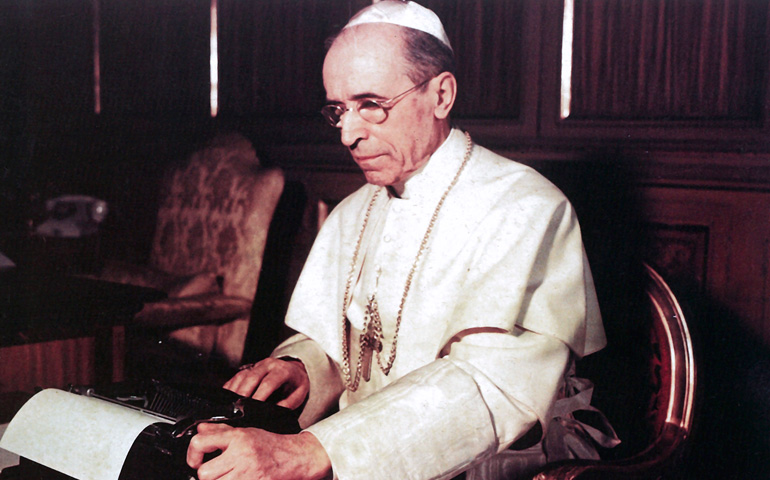
On November 5, 1956, Pope Pius XII published the encyclical Datis nuperrime, in which he condemned the violent repression of the Hungarian revolution and the Soviet military intervention that had begun the previous day. Seventy years later, that document remains one of the most significant pronouncements of the Holy See against communist repression in Eastern Europe.
The encyclical was promulgated when Soviet troops had once again occupied Budapest and other Hungarian towns to crush the uprising that began on October 23, 1956.
The hope for freedom that ended under Soviet tanks
During the first days of the revolution, thousands of Hungarians mobilized against the communist regime and demanded political change, national independence, and an end to Soviet domination.
The events awakened hopes in various European countries and also in the Holy See.
On November 1, Pius XII had published the encyclical Laetamur admodum, in which he expressed his satisfaction at the news of a possible improvement in the situation in Hungary and Poland.
However, just three days later, Soviet forces launched a new large-scale military intervention against Hungary.
The repression left thousands of victims and put an end to the revolutionary experience.
“A bloodied people has once again been reduced to slavery”
In response to these events, Pius XII published the encyclical Datis nuperrime on November 5.
The Pontiff denounced that the blood of citizens was once again flowing through Hungarian cities and towns and lamented that the recently restored national institutions had been destroyed by force.
He also condemned the imposition of a new servitude by foreign arms.
Pius XII maintained that the legitimate freedom of peoples could not be extinguished by the shedding of blood and recalled that an authentic peace must be founded on justice, freedom, and charity.
The pontifical condemnation came at a time when Soviet authorities were attempting to forcibly reestablish control over Hungary.
Cardinal Mindszenty and the persecution of the Church
The Hungarian revolution was closely linked to the situation of the Catholic Church in the country.
One of the symbols of resistance to the communist regime was Cardinal József Mindszenty, Archbishop of Esztergom and Primate of Hungary, who had been arrested in 1948 and sentenced in 1949 after a trial promoted by the communist authorities.
During the days of the revolution, he was released from captivity.
However, when Soviet troops regained control of Budapest, Mindszenty had to take refuge in the United States embassy.
He remained there for fifteen years, until his departure from the country in 1971.
His story became one of the best-known testimonies of ecclesial resistance to communist persecution in Eastern Europe.
The pontifical denunciation of the repression
In Datis nuperrime, Pius XII recalled the biblical account of Cain and Abel to denounce the shedding of innocent blood and call for an end to the violence.
The Pope also invited Catholics to pray for the victims and for the restoration of a peace founded on justice.
The encyclical today constitutes a historical document of special interest for understanding the position of the Holy See regarding the Soviet repression of 1956 and the defense of the freedom of peoples subjected to communist regimes.