


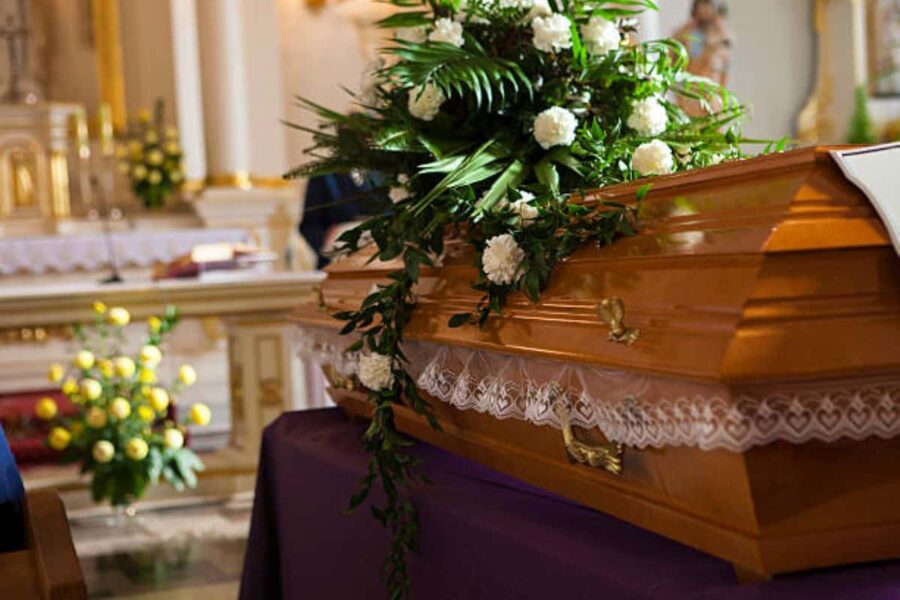
39% of Spaniards would choose a civil funeral for their own farewell, compared to 38% who would prefer a religious ceremony, according to a study conducted by Sigma Dos for the Observatory of Funeral Services (OSF). The results, presented on September 22 in Madrid, reflect a shift in the preferences of the Spanish population in an area traditionally linked to religious celebrations.
The report, based on 1,628 interviews, was presented during the V Meeting of the Observatory of Funeral Services, held at the Ateneo de Madrid. The difference between the two options is barely one percentage point, so the results show a practically balanced situation between those who would opt for a civil ceremony and those who maintain their preference for a religious funeral.
These are preferences declared by the respondents and not a record of the ceremonies that are actually held in Spain. Therefore, the data do not allow us to conclude that civil funerals are already the majority in practice.
The president of the OSF, María Dolores Asensi, linked this evolution to the religious changes experienced by Spanish society, which is increasingly less tied to traditional beliefs and practices.
Cremation prevails among respondents’ preferences
The study also reveals a majority inclination toward cremation. 59% of Spaniards say they would choose to be cremated, while 19% would prefer burial.
Another change noted in the report is the growing interest in personalized farewells. 47% of respondents are in favor of incorporating elements that reflect the personality, tastes, or life trajectory of the deceased, a trend especially widespread among young people aged 18 to 29.
Among the most valued options are music chosen by the deceased, mentioned by 34.6%; organizing a meal or gathering afterward, at 30.5%; and projecting a tribute video, at 23.7%.
These preferences point toward ceremonies increasingly centered on the personal memory of the deceased, although the report does not establish that such elements are incompatible with holding a religious funeral.
The majority considers it important to leave instructions for their funeral
The results also show a difference between the importance Spaniards place on planning their farewell and the conversations they have about the matter.
81% consider it important to leave prior instructions on how they want their funeral to be organized. However, only 47% acknowledge having discussed it with their family members.
Regarding the most valued aspects of funeral services, humane treatment ranks first, cited by 63% of participants.
This is followed by the professionalism of the staff, at 43%; speed in processing, at 38%; and price, mentioned by 33%.
The report thus reflects that, beyond the type of ceremony chosen, families place special importance on the support received in the moments following the death.
84% consider the 21% VAT applied to funerals unfair
The study also addresses the cost of funeral services and their social perception.
83% of respondents understand that these services are essential, while 84% consider the 21% VAT currently applied in Spain to be unfair.
During the presentation, María Dolores Asensi linked this issue to the need to ensure equitable access to funeral services, especially in rural areas.
The president of the Observatory also defended the importance of maintaining adequate coverage throughout the territory, preventing depopulation from hindering access to these services.
Despite criticism of taxation, 76% of participants say they have a good or very good image of funeral companies and their professionals.
New technologies and environmental concerns
The transformation of funeral services is also reflected in the incorporation of digital tools.
55.6% of respondents believe that technology can facilitate greater participation in farewells, for example, through the live streaming of ceremonies via videoconference for relatives who cannot attend.
Among the most requested digital services are the deletion of the deceased person’s digital footprint, at 39%, and the management of their digital legacy, at 38%.
On environmental matters, 84.9% argue that cemeteries should combine respect for tradition with care for the environment.
Likewise, 60.5% consider it advisable to expand ecological funeral options, and 63% would be willing to hire a sustainable service if it had the same price as a conventional one.
A new indicator of religious changes in Spain
The preferences collected by the Observatory of Funeral Services add to other studies showing the transformation of the Spanish religious landscape.
The September barometer of the Sociological Research Center (CIS) showed that 17.1% of Spaniards declared themselves atheists, compared to 15.9% who identified as practicing Catholics.
Although both studies analyze different issues, their results allow us to observe how the evolution of religious beliefs is also manifested in preferences related to death and funeral rites.
For the Catholic Church, funeral rites are not merely an act of farewell or a tribute to the deceased. The funeral liturgy expresses faith in the resurrection of Jesus Christ, prayer for the soul of the deceased, and hope in eternal life.
The Catechism of the Catholic Church recalls that Christian funerals are a liturgical celebration in which the ecclesial community expresses its communion with the deceased and proclaims the hope of the resurrection.
In this context, the OSF data show that the choice between a religious ceremony and a civil one has become another area where the transformation of customs and religious identity in Spanish society is reflected.