


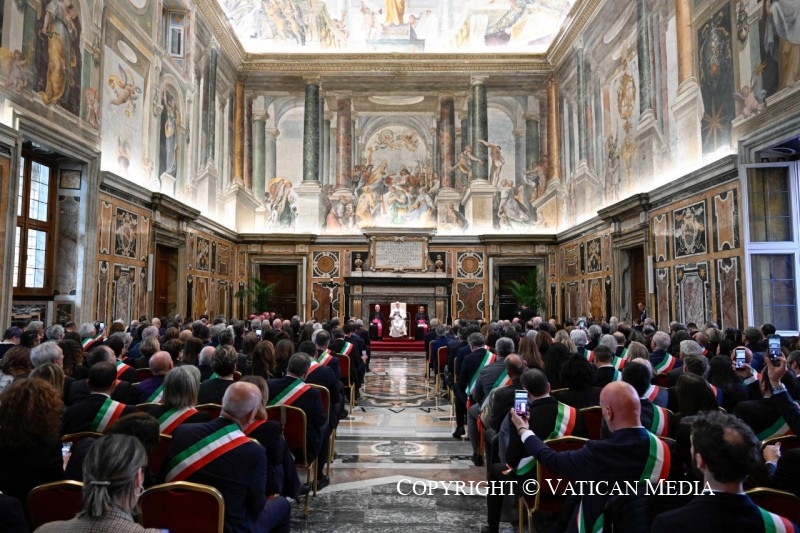
Pope Leo XIV received this Saturday, October 31, in the Vatican Apostolic Palace, a delegation of representatives from the municipalities of central Italy affected by the 2016 earthquakes. On the tenth anniversary of that tragedy, which left hundreds of victims and severe material damage, the Pontiff recalled that reconstruction cannot be limited to erecting buildings, but must also recover the spiritual and communal foundations of the affected populations.
In his address, Leo XIV drew on the biblical examples of Nehemiah and Haggai, as well as the figures of Saint Rita of Cascia, Saint Nicholas of Tolentino, Saint Benedict, and Saint Francis of Assisi, to highlight the importance of shared responsibility and a hope translated into concrete actions. The Holy Father called for material reconstruction to proceed with speed, safety, and transparency, but especially insisted on the need to «start again from the center, start again from God, from people, from the common good, from relationships».
Below, we offer the full address of Pope Leo XIV, translated into English:
Address of Leo XIV to the representatives of the municipalities affected by the earthquakes in central Italy
Vatican Apostolic Palace, Saturday, October 31, 2026
In the name of the Father, and of the Son, and of the Holy Spirit.
Peace be with you.
Your Excellencies, brothers and sisters, good morning to all of you. Welcome!
Ten years have passed since the tragic sequence of earthquakes that struck your regions. These were events that caused hundreds of victims, enormous destruction, and deep pain in entire communities, which still bear their wounds today.
In the face of this reality, I would first like to join you in listening to the Word of God, beginning with a text that plays an important role in the encyclical Magnifica humanitas (cf. n. 8). It is the Book of Nehemiah, which recounts the return of the people to a Jerusalem still in ruins after the devastation wrought by the Babylonians. Nehemiah teaches us a twofold approach. First, the communal one: the city, in fact, is reborn not by the work of a single person, but through the shared responsibility of the entire people. Nehemiah also suggests to us that to rebuild, one must have a vision. In such dramatic cases, it is not enough to nurture good intentions or to rely on disordered voluntarism. To rebuild, it is necessary to acquire eyes capable of discovering in a ruin the project of a house and a city. It is the gift of a prophetic gaze that knows how to perceive, beyond the rubble, something that no one yet sees; a gaze that knows how to discern, amid the present evil, the good that is possible and necessary to accomplish.
I therefore encourage you to resume the journey with this twofold perspective: on the one hand, the synodal approach to building together; on the other, the prophetic vision, which, starting from present needs, knows how to look ahead and recognize what common good must be effectively pursued.
This is how the saints acted. Your land has been blessed by the presence of women and men of God who knew how to live these two dimensions and historically transform evil into good. I think, for example, of Saint Rita of Cascia or Saint Nicholas of Tolentino, who through prayer and the proclamation of the Gospel brought peace to families and communities devastated by hatred and violence. Moved by that same vision of the future, Saint Benedict had already known how to reform and rebuild the Church and society through prayer and work, laying the foundations of what would become present-day Europe. Finally, eight hundred years after his passing, we remember Saint Francis of Assisi. Before the crucifix, he heard the voice of the Lord saying to him: “Go and repair my house, which, as you see, is all in ruins” (Second Life by Thomas of Celano: FF 593). Then he began to restore materially several small churches in the area, later understanding that the “house” of which the Lord spoke was the Church itself, which at that time was undergoing a profound spiritual crisis.
The example of the saints reminds us that hope, in order not to remain a mere desire, needs above all tangible and urgent responses. For this reason, ten years after the earthquake, it is necessary to devote all energies so that material reconstruction is carried out in the shortest possible time, with safety and transparency. Moreover, hope, in order to be lasting, requires perspective: it must identify points of reference that guide the way.
In this regard, I would like to point out to you the example of another biblical figure involved in the reconstruction of Jerusalem: the prophet Haggai. He lived shortly before the governor Nehemiah and also invited the people to rebuild. Like Nehemiah, he addressed the religious and civil authorities and the people of the city, so that all might feel responsible for the common rebirth. His message, however, is very specific: Haggai invites the people, concerned with their own houses and individual needs, not to forget that center which represented the heart of the Holy City, namely the temple. Indeed, one cannot start again without first rebuilding what gives meaning and foundation to a community. Otherwise, everything remains disconnected and collapses. It is therefore a matter of starting again from the center, of starting again from God, from people, from the common good, from relationships. Then our hope will be founded on rock. Thank you.
Dear brothers and sisters, I encourage you to this work of reconstruction with the words of the same prophet Haggai: “Take courage, all you people of the land—oracle of the Lord—and work, for I am with you!” (Hg 2:4).
I thank you for your visit and, invoking the intercession of the Blessed Virgin Mary and your patron saints, I bless you all from my heart, together with your communities.