


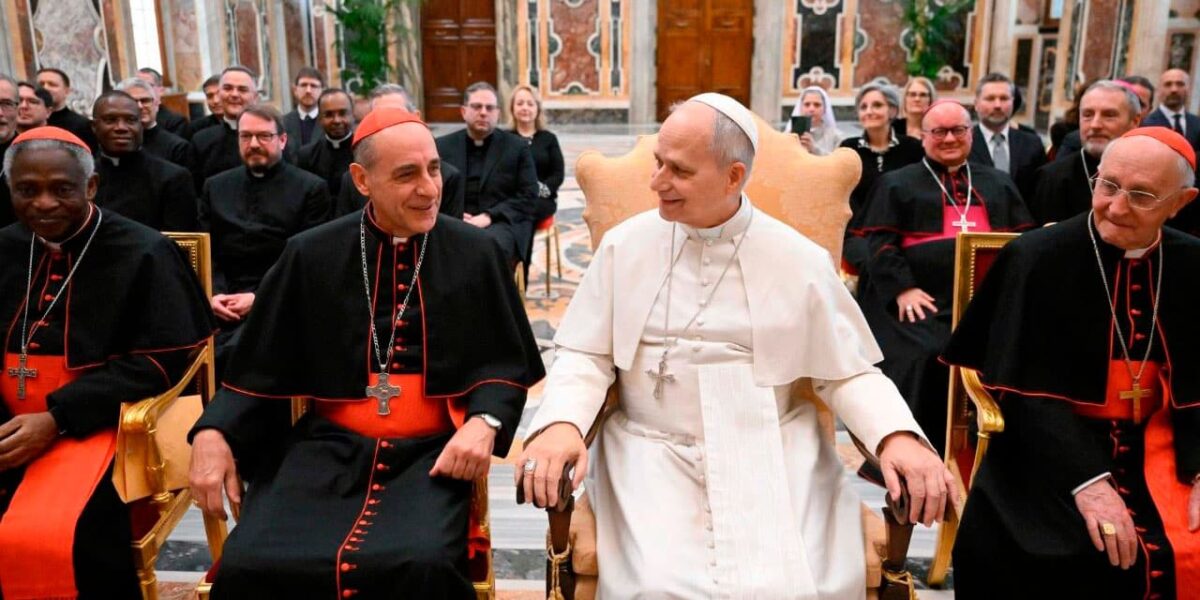
Cardinal Víctor Manuel Fernández, prefecto of the Dicastery for the Doctrine of the Faith, will not be part of the entourage accompanying Leo XIV on his first apostolic journey to Latin America. He himself confirmed this in an interview given to Vida Nueva, in which he also dispels any doubts about the Pontiff’s health and previews the content of the book he will publish on November 24 with Francis’s private writings.
Absent in Bergoglio’s homeland
The Argentine prelate explains that he asked the Pope to remain in Rome during the tour, which the Holy See has already confirmed and which will take Leo XIV to Uruguay, Argentina, and Peru between November 6 and 17. He cites the length of the trip and several pending matters at the dicastery that, he says, are coming to fruition right now. He adds that he will travel to Argentina shortly afterward for a commitment made some time ago.
Fernández justifies his decision with a curious confession about his working method: he claims he does not like to be away for more than five consecutive days and that even his vacations are taken in small segments spread throughout the year. He downplays his absence by insisting that the only protagonist of the journey is the Pope with the People of God, and that in Argentina the focus should not be on Francis either, but on Leo XIV.
The absence is striking. We are talking about the closest collaborator of the late Argentine Pontiff, whose figure will inevitably hover over every stage of the visit to his native country.
“The Pope is splendid”
Asked about the health of Leo XIV, from whom the lower lobe of the right lung was removed on October 13 at the Gemelli after a tumor was detected, the prefect is categorical. “The Pope is splendid,” he states, and recounts that he had an audience with him that very morning and took the opportunity to resolve all his doubts about his condition, leaving the meeting completely reassured. He goes further and asserts that he is certain the Church can count on a long pontificate.
The cardinal denies that the operation has marked a before and after in the Pope’s pace. In his view, when people speak of “reorganizing” the schedule, they simply mean it is advisable not to overwhelm him in the days following the procedure with everything that accumulated during his absence—something that, he recalls, also happens after any apostolic journey.
To illustrate this, he draws on his own experience: he reveals that a few weeks ago he underwent surgery for a benign sebaceous cyst and that the healing required an extra effort, although he acknowledges that the Pope’s recovery has been easier than his own. As proof of vigor, he recounts that the day before Leo XIV called, on his own initiative, a meeting on an issue a working group had been handling—a sign that he has not only regained his normal rhythm but has intensified it. Fernández considers the matter closed.
The prefect’s words coincide with the latest Vatican bulletin, according to which the disease was localized and the Pontiff does not require additional oncological treatment.
Francis’s intimate diary
The bulk of the conversation revolves around “The Personal Diary of Pope Francis”, the volume that the Vatican Publishing House will release on November 24, barely a week after the Pope’s return from Latin America, simultaneously in 94 countries. It gathers private notes by Jorge Mario Bergoglio dated between 1992 and 2024, selected and commented on by Fernández himself.
The cardinal maintains that the book gives priority to Francis’s voice, although he believes his own commentary—described as discreet—proves very helpful for precisely understanding certain phrases and their context. He admits that the content surprised him: he had had the material in his hands but had not read it until preparing the edition. After doing so, he describes it as essential for knowing the soul and intimacy of the Argentine Pope, with aspects absent from everything published until now and which, in his opinion, complete the portrait of his identity.
It remains to be seen whether this intimate portrait, filtered and annotated by the collaborator who drafted many of the most controversial documents of the previous pontificate, will clarify Francis’s legacy or will instead serve to establish an official reading of it.