


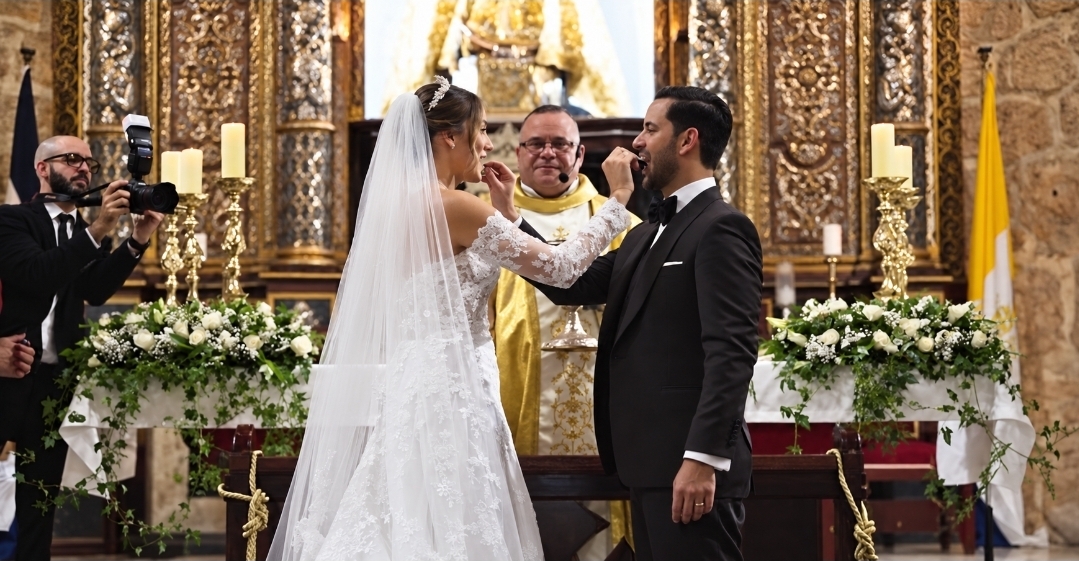
The wedding of content creators Carlos Durán and Zoe Roberta, held last October 10 at the Church of Our Lady of Mercy in the Colonial City of Santo Domingo, was officiated by priest Frankely Rodríguez, according to Dominican press reports. A ceremony with social media coverage that featured a gesture deserving attention for its liturgical significance: the spouses giving each other communion in the presence of the celebrant.
The photograph of the moment shows both bringing the host to each other’s mouth, with the priest positioned between them.
A prohibition that specifically mentions weddings
The instruction Redemptionis Sacramentum, published in 2004 by the Congregation for Divine Worship and the Discipline of the Sacraments, addresses precisely this scenario. Its number 94 states:
«The abuse whereby spouses, in the nuptial Mass, administer Holy Communion to each other must be eliminated».
The provision identifies the practice as an abuse and orders its elimination. It is the celebrant’s responsibility to ensure that the distribution of communion respects this norm. Precisely at a wedding, where many attendees may have an occasional relationship with religious practice, the clarity of the signs acquires special importance.
A pedagogy that blurs the presence of Christ
The problem has an evident catechetical dimension. Giving each other communion can present the Eucharist as an extension of the exchange of rings or as another gesture of affection between the newlyweds. Attention shifts toward the couple and the sacrament becomes exposed to being interpreted as an expressive resource of their sentimental history.
Catholic faith confesses that in the Eucharist Christ is entirely present, with his Body, Blood, soul and divinity. The Catechism, in number 1374, teaches that this presence is true, real and substantial. This reality requires that the gestures of the celebration help recognize who is being received.
From this perspective, reciprocal communion constitutes a disastrous pedagogy: it introduces confusion precisely at the moment that should express eucharistic faith with greater clarity.
The love of spouses finds in the Eucharist nourishment for their married life. Celebrating this relationship requires keeping the center of the liturgy on Christ and teaching, also through gestures, the reverence due to his presence.