


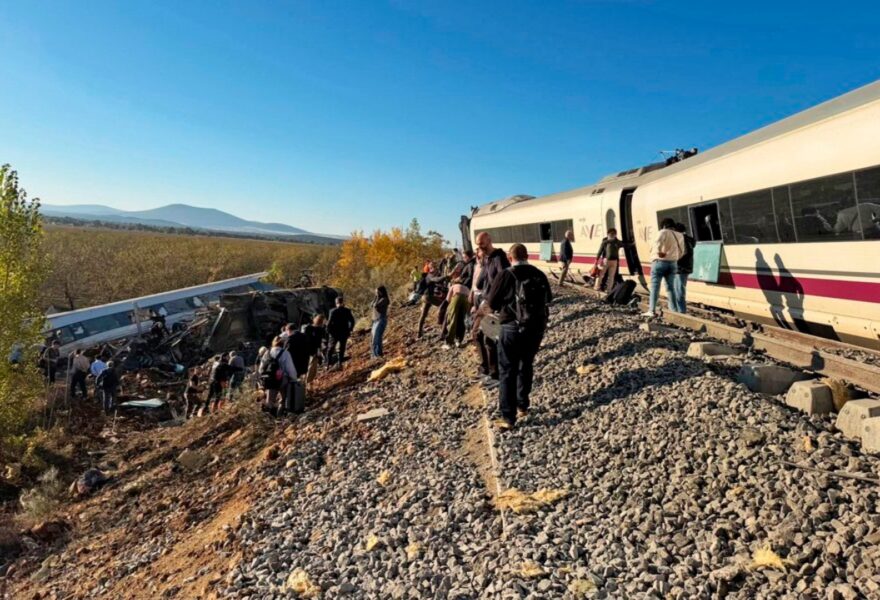
Before the ambulances and before the rescue teams, sacramental forgiveness from God reached the tracks in Urda (Toledo). Fernando Fernández de Bobadilla, parish priest of Los Yébenes, was among the first to arrive at the scene of the collision between the Iryo and the AVE trains on this black Wednesday. His first act was to impart collective absolution to all those lying among the wreckage. With at least 68 dead, Spain’s worst high-speed rail accident has also left a simple and resounding lesson of faith.
Absolution, first
The priest did what was required of him at the moment it was most needed. Faced with dozens of injured and dying passengers scattered among the carriages and the embankment, hearing confessions one by one or administering the anointing to each gravely wounded person was impossible. He himself explained it to ABC: “I gave collective absolution. In these cases, that is what the Vatican recommends.”
He was right. Canon 961 of the Code of Canon Law permits this extraordinary form of the sacrament when imminent danger of death threatens and there is no time to hear each penitent individually. The absolution thus reached all who could still receive it, including those lying motionless whose survival was still unknown. The Church requires the penitent’s repentance and, if they survive, the intention to confess their grave sins later. It is an exception designed precisely for tragedies such as this.
Only then did he begin to assist the medical personnel. He held IV bags while the wounded were triaged with colored wristbands—black for the dead, red for the critically injured, and yellow for the lightly wounded. He told the radio that the bodies being removed were “a multitude.” He does not even remember when the first medical teams arrived, because in those hours he stopped measuring time.
“Father, I’m alive”
The parish priest of Urda, José Miguel Fernández, learned of the tragedy through a call from the Archbishop of Toledo, Francisco Cerro, and immediately went to the tracks. He was among the first to arrive and helped extract passengers from the trains. One of them, still dazed, threw himself into his arms with a phrase the priest has carried with him ever since: “Father, I’m alive! Give me a hug!” The man attributed his survival to God.
Later came the pavilion in Urda, where the lightly injured were being treated, and the school pavilion, where families arriving from Madrid waited. There a woman took his hand and did not let go for hours, asking about her daughter-in-law. The priest stayed by her side until her son called to confirm the death.
His assessment of the day is simple and eloquent. Dressed as a priest, no one rejected his presence, neither beside the trains nor in the pavilions. Many thanked him and spontaneously spoke to him of their faith in God. “God always helps,” he summarizes.
José Manuel, a priest from Consuegra, also came. He assisted in the care of the victims while bodies and injured were being pulled from the wreckage.
The archbishop on the scene
Francisco Cerro left the Toledo see and went to Urda and Los Yébenes with the injured and their families. He described the scene as Dantean and explained that what the Church could offer in those hours was listening and companionship. The archdiocese opened the parishes of Urda, Los Yébenes, and Consuegra and placed Cáritas at the service of those affected.
Toledo tolls for the dead
This Thursday at noon, the bells of all the churches in the Archdiocese of Toledo will toll for the dead. It is the slow, solemn peal with which the villages of Castile have always announced the death of a neighbor. This time it will ring simultaneously in hundreds of belfries, from the primatial cathedral to the smallest parish. It has been requested by the archbishop, who calls the faithful to pray the Angelus at that same moment for the eternal rest of the deceased. He also asks that the injured and their families, and all those caring for them in hospitals and pavilions, be entrusted to God’s mercy.
The call closes a response that the diocese gave from the first minute with its own priests. The Vicar of La Mancha, the archpriest, and the parish priests of Urda, Los Yébenes, and Consuegra were on the tracks or in the pavilions from the early hours, together with many other priests and faithful. The parishes opened their doors to those affected and Diocesan Cáritas made itself available to the families. In the Basilica of the Most Holy Christ of Urda, Wednesday’s midday Mass was already offered for the victims, as were the afternoon Masses.
This Thursday at six in the evening, the parish of Urda will expose the Blessed Sacrament to pray for the eternal rest of the victims and the recovery of the injured. The parish priest hopes the entire town will attend, a town that holds a centuries-old devotion to the Most Holy Christ of Urda and welcomes pilgrims from across half of Spain. It is the way a diocese sustains the pain of a people. First came the sacrament on the tracks, and now prayer and shared mourning arrive in all the churches.