


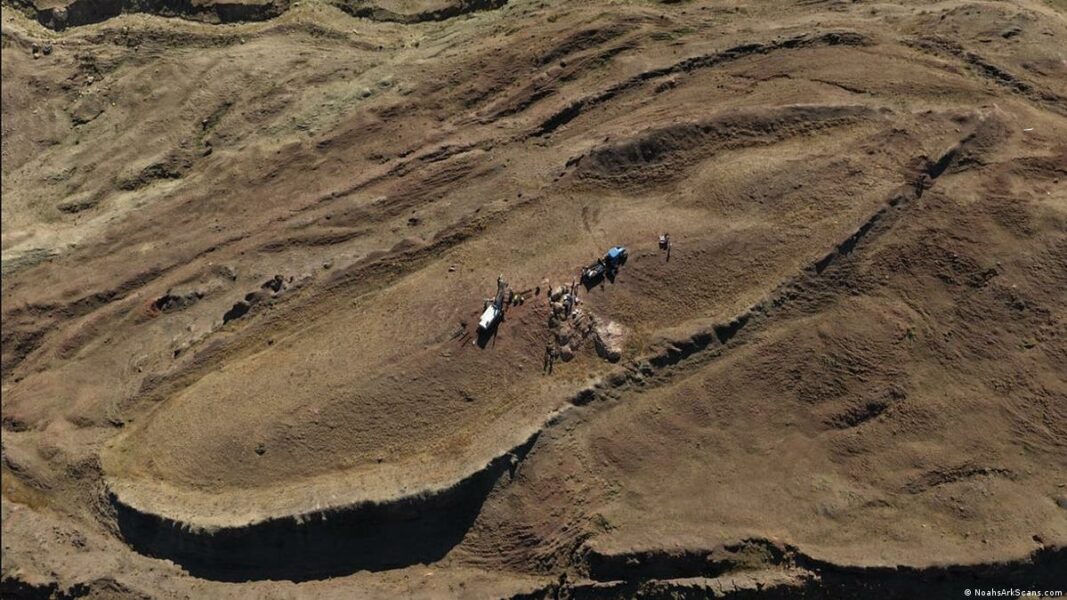
A team of researchers studying a boat-shaped rock formation in eastern Turkey has obtained more than 400 soil samples through drilling carried out at various depths. The group, called Noah’s Ark Scans, maintains that the analyses could provide new evidence about the origin of the structure, which some researchers identify as the remains of Noah’s Ark.
The campaign is taking place at the Durupınar formation, located in the Ararat Mountains region. In an interview with LifeSiteNews, Lauren Witzke, the project’s communications and fundraising officer, explained that the samples are being examined by Cumhuriyet University in Sivas and other laboratories.
The final results have not yet been published.
Drilling and new subsurface explorations
The team claims to have carried out drilling nearly 18 meters deep, after identifying various anomalies beneath the surface using geophysical techniques.
According to Witzke, the explorations conducted with a technology called BaktharRadar reportedly detected structures that the researchers interpret as possible chambers, corridors, and organized levels.
The system was used by Khrosrow Bakthar, a rock mechanics specialist who collaborates with the project.
The formation under study is approximately 157 meters long and has a silhouette reminiscent of a boat. The research promoters believe its dimensions could correspond to those described in the Book of Genesis.
Witzke stated that the drilling has allowed the recovery of materials from different sectors of the formation, including deep zones that had not previously been examined with these procedures.
Among the objectives of the analyses is determining whether there are organic remains compatible with ancient wood. The team also aims to study the possible presence of animal DNA.
«They will have to rewrite the textbooks»
The spokesperson expressed confidence that the work will ultimately confirm that the structure corresponds to Noah’s Ark.
In the interview, she stated that a potential discovery would have consequences for scientific explanations about the history of humanity and living beings.
«They will have to rewrite the textbooks and biology books,» Witzke declared, linking her interpretation of the site to a literal reading of the biblical account of the universal flood.
These statements express the conviction of the project’s promoters. For the time being, no laboratory results or independent scientific studies have been presented to demonstrate that the formation is a man-made vessel.
Geological objections and next steps
The identification of Durupınar with Noah’s Ark has been the subject of controversy for decades.
In 1996, geologist Lorence Collins and researcher David Fasold published a study interpreting the formation as a natural geological structure, created by processes of deformation and erosion.
The current research leaders question those conclusions and believe that the new exploration techniques will allow examination of subsurface areas that had not been studied in sufficient depth.
Witzke announced that Bakthar’s technical report could be published in November, while analyses of the collected samples continue.
She also revealed that Turkish archaeologist Cenker Atila, linked to the project, is expected to present new information about the research, and that the team hopes to begin excavations in 2027, provided the corresponding permits are obtained.
Until the results of the analyses are known and can be independently evaluated, the identification of the Durupınar formation with Noah’s Ark remains an unproven hypothesis.