


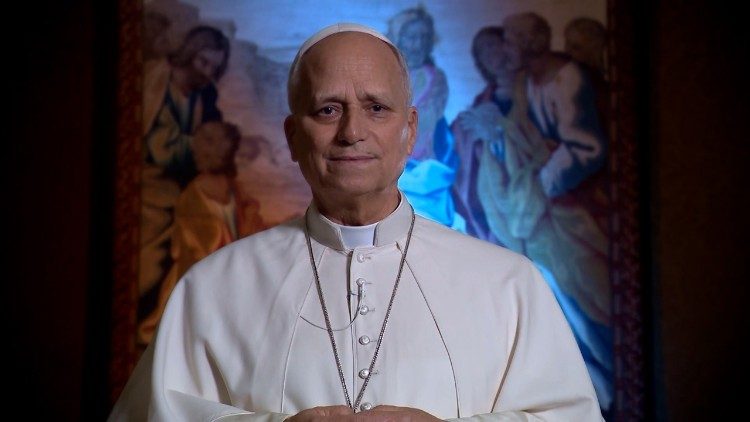
Pope Leo XIV sent a video message this Tuesday, October 27, to participants in the international meeting “Unarmed and Disarming Peace,” held in Assisi on the occasion of the 40th anniversary of the historic Day of Prayer for Peace convened by Saint John Paul II in 1986. The Pontiff, who was unable to attend in person on medical advice following his recent lung surgery, called for renewed dialogue and prayer in the face of armed conflicts. “There is no such thing as a holy war: only peace is holy!” he declared.
As announced last Friday, October 23, doctors advised against the planned helicopter transfer to Assisi as a precaution, given the short time since the surgical procedure on October 13. The decision was made despite a follow-up X-ray confirming his good post-operative recovery.
In his message, Leo XIV expressed regret at not being able to participate in the meeting: “I would have liked to be with you, beside the tomb of Saint Francis, on this important anniversary.” The Pope thanked the Dicastery for Interreligious Dialogue and the Community of Sant’Egidio, while warning of the “worrying rehabilitation of war as an instrument of international politics.”
Forty Years of the Assisi Meeting
The video message was sent to participants in the meeting held from October 25 to 27 in the city of Saint Francis, where representatives of various religions gathered to commemorate the day convened by John Paul II on October 27, 1986.
Leo XIV expressed his desire to have participated personally in the anniversary and greeted the patriarchs, religious leaders, Franciscan families, and representatives of the Community of Sant’Egidio present in Assisi.
The Pope recalled that John Paul II sought to highlight the relationship between an authentic religious attitude and the commitment to peace. He also expressed gratitude for the continuity of the prayer and dialogue meetings held over the past four decades.
Referring to the international situation, the Pontiff cited his encyclical Magnifica humanitas to note that globalization has not guaranteed the stability some expected after the end of the Cold War.
“Almost blind trust was placed in the markets’ ability to produce well-being, democracy, and stability, whereas in reality globalization has not automatically generated unity and peace,” he recalled.
Prayer in the Face of Violence
Leo XIV defended the value of prayer against those who consider it ineffective in the face of international conflicts.
“Prayer may seem weak before the powers of the world, but it is the humble strength of believers,” he affirmed.
The Pontiff called for prayer that God might touch the hearts of those who promote war and terrorism, and recalled that “prayer is never in vain.”
He also presented the example of Saint Francis of Assisi, whose eighth centenary of death is being commemorated this year, as an invitation to cultivate dialogue with God, with others, and with all creation.
The message concluded with a prayer for peace in all countries and with the Gospel beatitude: “Blessed are the peacemakers, for they will be called children of God” (Mt 5:9).
Video Message of the Holy Father Leo XIV to the Participants in the International Meeting “Unarmed and Disarming Peace”
Dear brothers and sisters:
You are gathered in Assisi forty years after the Day of Prayer for Peace on October 27, 1986. That event was an initiative of Saint John Paul II which, on that occasion, highlighted the intrinsic bond uniting an authentic religious attitude with a living sensitivity for peace.
I extend my warmest greetings to the Patriarchs and Religious Leaders, many of whom over the years have actively participated in the various days of prayer and dialogue that followed. I greet with affection Bishop Felice Accrocca, Pastor of the Church in Assisi, the Franciscan families, and all those gathered there. I would have liked to be with you, beside the tomb of Saint Francis, on this important anniversary, to see your faces and together give a beautiful testimony: living as brothers and sisters is already possible!
I thank the Dicastery for Interreligious Dialogue and the Community of Sant’Egidio for having continued with effort this path laid out by my Predecessors. I am comforted by the long and faithful journey carried out over these years, which has been very fruitful. Pope Francis, regarding that unforgettable Day of October 1986, said: “It was not meant to and could not remain an isolated event. You have continued that path and have increased its momentum.” [1]
John Paul II, after that first historic meeting, invited us “to continue living the spirit of Assisi.” [2] It was then the time of the “Cold War,” a very different scenario from the present one. After 1989, not a few maintained that globalization would ensure stable peace for the world. Unfortunately, as I wrote in Magnifica humanitas, “almost blind trust was placed in the markets’ ability to produce well-being, democracy, and stability, whereas in reality globalization has not automatically generated unity and peace, but has provoked fundamentalist, identitarian, and nationalist reactions” (n. 201).
In this context, there is taking place “a worrying rehabilitation of war as an instrument of international politics” (ibid., 190). Thus betraying the memory of the twentieth century and the useless slaughter of millions of human lives, once again—as we read in the Catechism of the Catholic Church—“the accumulation of arms, as a paradoxical way of preventing possible adversaries from waging war, is for many a way of ensuring peace among nations” (n. 2315). Precisely in these times of a culture of power, it is necessary to foster the spirit of Assisi, which is the rejection of the religious legitimization of war, a spirit of mediation and dialogue, a contemplative experience and creative action for a future of peace. Yes, because peace must once again become the common ideal of peoples, the star guiding all our decisions, the criterion that unmasks injustice, the common horizon of all persons.
We must rebuild peace everywhere, not prepare more wars! War can never be waged in the name of God! For us believers, “to fight in the name of religion means, in reality, to strike at religion itself” (Magnifica humanitas, 223). There is no such thing as a holy war: only peace is holy!
Therefore, the path begun in Assisi in the common search for peace is, above all, the path of prayer. Prayer may seem weak before the powers of the world, but it is the humble strength of believers. We turn to God, the giver of peace: may He reach the hearts of those who desire war and terrorism. And let us not forget: prayer is never in vain!
Prayer is a school of dialogue with God, with persons, and with all creatures. Let us think of Saint Francis, whose eighth centenary of death we have celebrated. The world needs dialogue. The path of Assisi commits religious leaders to fostering a climate of dialogue among the faithful and in society, so that the language of arrogance may be replaced by that of peace, negotiation, and understanding. This can “gradually distance humanity from the spiral of violence” (ibid., 221).
Brothers and sisters, may our prayers obtain from God the long-desired peace for all the countries of the world! May He make us unarmed instruments of His peace. “Blessed are the peacemakers, for they will be called children of God” (Mt 5:9).
_________________________________
[1] Francis, Address to Participants in the International Meeting for Peace, September 30, 2013.
[2] Cf. St. John Paul II, Address to a Group of Representatives of Non-Christian Religions, October 29, 1986.