


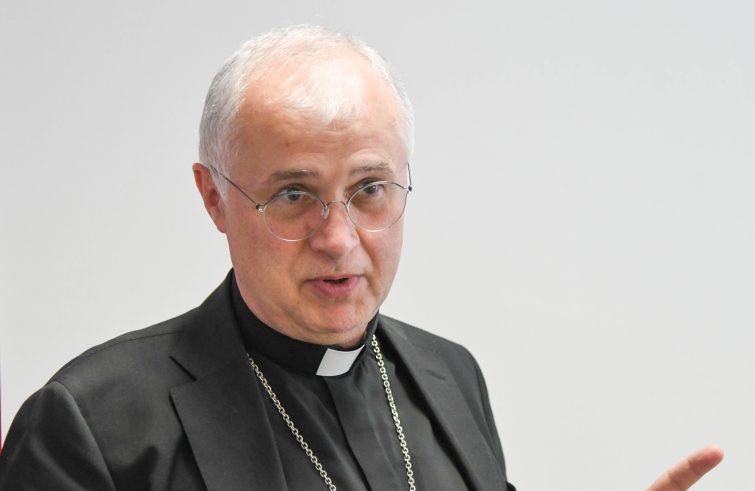
Bishop Claudio Giuliodori, president of the International Scientific Institute Paul VI Foundation, has warned of the moral implications of in vitro fertilization during an international congress held in Rome from October 16 to 18. The meeting, which included the participation of Cardinals Pietro Parolin and Matteo Zuppi, addressed infertility from Catholic doctrine and presented proposals focused on prevention, diagnosis, and treatment of its causes.
Under the title “The Splendor of the Human: Safeguarding Fertility, Healing Infertility,” the congress took place at the Roman headquarters of the Catholic University of the Sacred Heart and commemorated the 25th anniversary of the International Scientific Institute Paul VI and the 50th anniversary of the Center for the Natural Regulation of Fertility.
Cardinal Pietro Parolin, Secretary of State of the Holy See, inaugurated the academic sessions with a lecture dedicated to “the dignity and beauty of procreation in the Church’s magisterium.”
Giuliodori warns about the ethical consequences of in vitro fertilization
During his intervention, Monsignor Claudio Giuliodori questioned artificial reproduction techniques that separate the generation of new life from the conjugal act.
As he explained, in vitro fertilization “removes the generative act from the responsibility of the spouses” and transfers it to the intervention of physicians and laboratory technicians.
The bishop recalled the teaching of the instruction Donum vitae, published in 1987 by the Congregation for the Doctrine of the Faith, which establishes that “what is technically possible is not thereby morally admissible.”
Giuliodori pointed out that assisted reproduction techniques raise questions that go beyond the possibility of achieving a pregnancy. Among them, he mentioned the obtaining of germ cells, the selection of gametes through artificial intelligence, and the production and freezing of human embryos, as well as their possible use in scientific research.
The president of the ISI Foundation maintained that the public debate on artificial reproduction usually focuses on the desire of adults to have children, while paying less attention to the rights of the child and the circumstances of their conception.
He also referred to cryopreserved embryos in Italy. According to his estimates, there could be between 30,000 and 100,000, although he acknowledged that precise figures do not exist.
The Church teaches that human procreation must respect the dignity of the spouses and of the child from the first moment of his or her existence. Donum vitae rejects techniques that replace the conjugal act with artificial fertilization procedures and recalls that the child cannot be considered an object to which one has a right.
The prevention and treatment of the causes of infertility
The congress dedicated several sessions to the reproductive health of married couples, knowledge of natural fertility, and the prevention of causes that hinder conception.
Dr. Paola Pellicanò, physician at the Center for the Natural Regulation of Fertility and president of Donum Vitae, advocated for care for couples that is not limited to offering assisted reproduction procedures.
Pellicanò highlighted the importance of education on fertility, healthy habits, and early diagnosis of problems that may affect the ability to conceive.
The Center for the Natural Regulation of Fertility, created in 1976 from a project promoted by Dr. Anna Cappella with the support of the Holy See and the Italian Episcopal Conference, has accompanied more than 8,000 couples over these decades.
According to the specialist, more than a thousand instructors of the Billings ovulation method, based on the recognition of the woman’s natural signs of fertility, work in Italy.
For his part, Giuliodori presented the results of the programs developed by the International Scientific Institute Paul VI, which currently operates within the Fondazione Policlinico Universitario Agostino Gemelli.
The bishop stated that the pregnancy rates obtained through their programs exceed those reported by some assisted reproduction centers, although he did not provide methodological data in that comparison to allow equivalence between the different treatments and patient groups.
Participants advocated for comprehensive care for couples with difficulties conceiving, combining medical knowledge with respect for the dignity of the person and the moral teaching of the Church.
Parolin and Zuppi defend the dignity of human life
Cardinal Matteo Zuppi, Archbishop of Bologna and president of the Italian Episcopal Conference, presided over the inaugural Mass of the meeting.
During his intervention, according to Vatican News reported, he defended human life “from conception to death” and denounced that “the right to life is trampled with such arrogance.”
The cardinal also stated that “humanity does not flourish with limitations, but through them,” in a reflection on the dignity of the person and the need to accompany situations of suffering and fragility.
Parolin’s inaugural lecture placed the meeting within the framework of the Church’s magisterium on the transmission of human life, while the scientific sessions addressed issues such as preconception health, prevention of infertility, and the challenges posed by the development of new reproductive technologies.
The program also included a reflection on the so-called “throwaway culture” and the risks of reducing human procreation to an exclusively technical process.
Leo XIV was scheduled to receive the participants during the first day, but the audience was canceled due to his hospitalization following surgery on October 13.
Zuppi expressed during the meeting the affection and closeness of the participants to the Pontiff, for whom he requested prayers while he continued his recovery.