


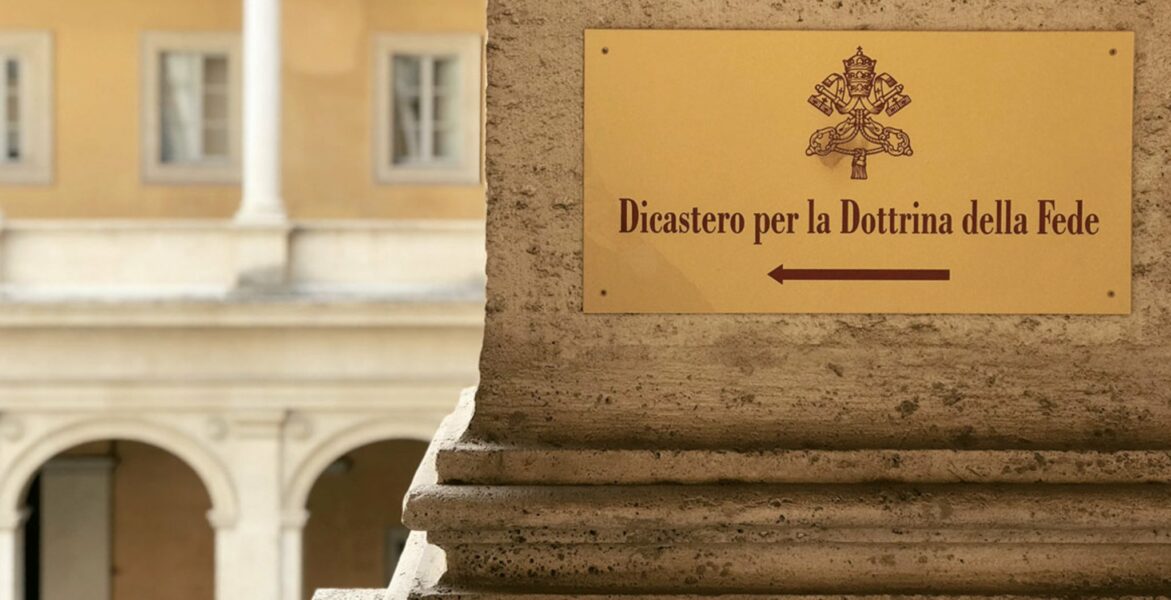
The Dicastery for the Doctrine of the Faith has published this Thursday, October 22, Venite ad me (“Come to me”), a new document on the transmission of the faith that recognizes the importance of the liturgy, the beauty of worship, and the different sensibilities present in the Catholic tradition. The text, conceived under the pontificate of Francis, signed by Cardinal Víctor Manuel Fernández Saraz, and approved by Leo XIV, addresses the Church’s difficulties in transmitting Christianity to new generations amid contemporary cultural transformations.
Under the title Considerations on the Transmission of the Faith in an Age of Change, the document devotes several sections to the family, evangelization, new technologies, and Christian formation. Among its proposals, it highlights the need to restore the centrality of the proclamation of Jesus Christ and to recognize the role of the liturgy as one of the principal means of transmitting the faith.
The Dicastery calls for showing the richness of the liturgical tradition
In number 94, the document states that special attention must be given so that the faithful of all dioceses, including those who approach or return to the Church, may come to know the different liturgical sensibilities present in the Catholic tradition.
“With due respect for the currently valid liturgical norms, pastors are called to highlight the richness of the Catholic liturgical heritage,” the text affirms, citing as an example the variety of musical styles that form part of that heritage.
The Dicastery considers that the liturgical celebration must preserve the symbolic richness of the Church and, at the same time, be comprehensible to the faithful. In this regard, it speaks of maintaining a tension between fidelity to tradition and understanding of the message being celebrated.
This reflection appears in a section that presents the liturgy as an essential element for the transmission of the faith, especially in an age marked by the loss of religious references and the weakening of Christian practice.
The liturgy cannot be reduced to an external ceremony
The document insists that the liturgy should not be understood as a mere ritual framework of ecclesial life, but as a privileged place of encounter with Christ.
According to the Dicastery, through gestures, words, silences, and symbols, the faithful participate in the mystery being celebrated and receive a faith that has been lived and transmitted by previous generations.
The text recovers the traditional principle lex orandi, lex credendi, which expresses the relationship between the Church’s prayer and its faith, and underscores the importance of forming believers to understand liturgical language.
It also cites Saint Augustine, who recalled the deep impression made on him by the hymns and chants of the Church, and the theologian Romano Guardini, who described his experience before the solemn celebrations in the cathedral of Monreale, in Sicily.
Through this latter testimony, the document acknowledges that there are different forms of prayerful participation, including silent contemplation of the rites. Guardini highlighted the capacity of the faithful to welcome the sacred through sight and contemplation, even during prolonged celebrations.
The transmission of the faith has been interrupted in numerous families
Beyond the liturgical question, Venite ad me addresses the crisis of faith transmission between generations. The Dicastery echoes the concern expressed by Leo XIV upon noting that, in some regions of the world, this transmission “has been almost completely interrupted.”
The text recalls that the family has historically been the first setting where children received the Christian faith. Domestic prayer, participation in Sunday Mass, Marian devotions, and religious celebrations were part of a daily life that allowed Christianity to be passed from parents to children.
However, it acknowledges that this continuity has weakened in numerous countries, especially in the West. For this reason, it raises the need to recover the first proclamation of the Gospel, directed both to those who have never known Christ and to those who have drifted away from the Church.
Fernández acknowledges that the document does not intend to close the debate
In its introduction, the Dicastery clarifies that Venite ad me has the character of “Considerations” and not of a doctrinal note.
Its purpose is to stimulate ecclesial reflection and pastoral commitment, examining different perspectives on the transmission of the faith without intending to close a question that, according to the text itself, remains open to new analyses.
The document expressly acknowledges that these considerations are not characterized by terminological precision or by a systematic treatment like that of other doctrinal texts of the Dicastery, but rather adopt a more discursive style.
The drafting began during the pontificate of Francis, who had requested a reflection on this issue. Subsequently, the work continued under Leo XIV, with contributions from numerous episcopal conferences.
The text was deliberated by the Dicastery on June 24, 2026, and approved by the Pope on August 21. It is signed by the prefect, Cardinal Víctor Manuel Fernández, and by the secretary of the Doctrinal Section, Monsignor Armando Matteo.
Popular piety, art, and beauty as paths of evangelization
The document also affirms the value of popular piety and traditional expressions of the Catholic faith. The Dicastery recalls that these practices have made it possible to preserve and transmit Christianity even in adverse cultural contexts.
Alongside them, it highlights the role of art, beauty, sacred music, and personal witness as means capable of drawing people closer to the Gospel.
The reflection extends to the challenges of digital technologies and artificial intelligence. Although it recognizes the new possibilities for evangelization offered by these means, it warns of the risk of constructing a faith adapted to individual preferences and disconnected from the Church’s teaching.
Venite ad me concludes with an invitation to recover the proclamation of Jesus Christ as the center of Christian life, evoking the image of the light of the Paschal candle that is passed from one candle to another during the Easter Vigil, a symbol of the faith received and communicated from generation to generation.