


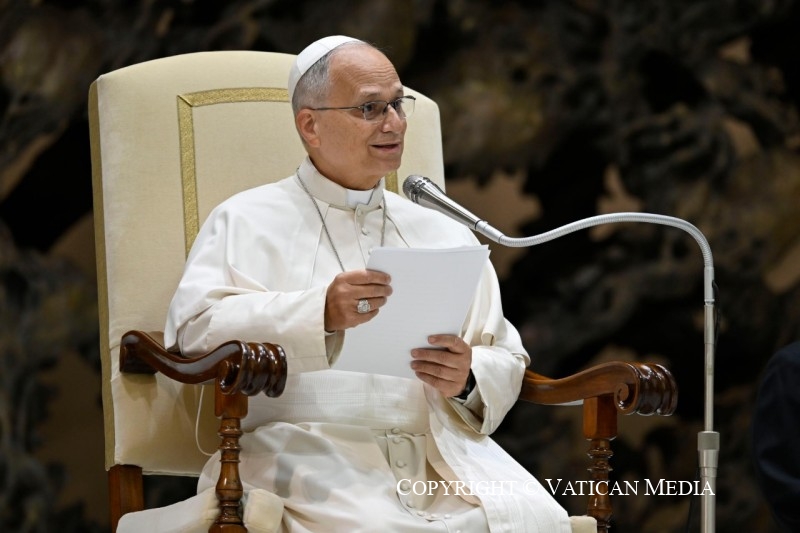
Pope Leo XIV received participants in the International Congress on School and University Pastoral Care this Thursday, October 22, in the Paul VI Hall. The Congress is being held in Rome on October 22 and 23. During his address, the Pontiff warned about the difficulties faced by many young people, marked by loneliness, uncertainty about the future, and a culture of performance that subjects them to constant comparisons.
The Holy Father called for Catholic schools and universities to be places of welcome, where students feel accompanied and can discover the truth through the encounter between faith and reason. He also stressed the need to educate the heart, cultivate trust, and protect young people from a mindset that considers human thought useless. “A misunderstood meritocracy ends up failing to respect people,” he stated.
Address of Leo XIV to the Participants in the Congress on School and University Pastoral Care
Let us begin with the sign of the cross with which we have all been baptized.
In the name of the Father, and of the Son, and of the Holy Spirit.
Peace be with you.
Your Eminence,
Your Excellencies,
dear brothers and sisters:
I greet you with joy at the beginning of this Congress on school and university pastoral care. I thank the Prefect of the Dicastery for Culture and Education, the secretaries and the officials, as well as those who will have the task of promoting reflection and deepening; and I joyfully welcome all of you who have come from so many parts of the world. I congratulate you on the work you carry out in educational and academic institutions for the proclamation of the Gospel and the dignity of the person.
It is essential that school and university pastoral care know how to respond to the desire that each person carries within and to walk together a human and Christian path. The recipients of your ministry are distinguished by the enthusiasm, generosity, and spirit of service so characteristic of young people. Yet, how many students also live in situations of existential distress! Wounded families, digital loneliness, feelings of inadequacy or fear of a future that seems uncertain. Many walk the corridors of our schools and universities and perhaps feel anonymous. How important it is that Catholic schools and universities be, above all, a “home,” a family place where each person is awaited! The first proclamation often passes through a style of welcome: someone who looks you in the eyes, who remembers your name, who notices your absence, who rejoices at your return.
In a welcoming environment, the student can express his or her deep desire to understand, to give meaning to reality. Here lies the proper vocation of schools and universities: the common search for truth. I therefore encourage you to stimulate the intelligence of young people, to value their questions. May your passion—especially that of those who work in Catholic institutions—be to help young people experience the beauty of the encounter with Christ, the fruitfulness of the synergy between faith and reason, between the knowledge of faith and the various fields of knowledge.
School and university pastoral care is called to accompany the slow germination of thought, to teach discernment and to seek with perseverance. Educational processes “need times of maturation, of confrontation with reality beyond appearances, and of a patient journey.” We must “protect our young people […] from that subtle seduction that makes human thought seem useless precisely when it is most needed” (Encyclical Letter Magnifica humanitas, n. 140).
Not a few young people today are as if paralyzed by the fear of making mistakes, of not measuring up, of being misunderstood, of not meeting expectations. We live in a culture of performance that continually compares and classifies, sometimes mercilessly. A misunderstood meritocracy ends up failing to respect people. That is why many end up giving up even before trying.
Help the young people you meet to be protagonists of a new way of inhabiting the world, builders of fraternity, of a more just society. Courage is born of a covenant of trust: of the experience of someone who believes in you before you believe in yourself. Jesus did not choose the Twelve because they were brave; he called them and, with his trust, made them capable. To our young people we must be able to repeat the words that the disciples addressed to the blind Bartimaeus: “Take heart, get up, he is calling you!” (Mk 10:49).
Beneath the armor that so many adolescents build to avoid suffering lies the desire to love and be loved. School and university pastoral care will be all the more fruitful the more it focuses on educating the heart. Educating the heart in compassion, in gratitude, in the capacity to be moved by the suffering of others; educating it in praise and in the desire for God. Service to the poor, volunteering, and care for creation are not accessory activities, but places where the heart learns to expand. Let us not forget: charity and prayer are inseparable.
Dear brothers and sisters, false teachers and deceptive messages promise to quickly answer the questions of young people. You, on the other hand, have chosen to do something greater: to walk with them along the way, until they discover the gifts that God has already placed within them. Like the Risen One with the disciples of Emmaus, who draws near, walks with them, listens, explains, sets their hearts on fire, and finally allows himself to be recognized in the breaking of the bread (cf. Lk 24:13-35).
May his Holy Spirit always enlighten and sustain your service. May the Blessed Virgin Mary, Seat of Wisdom, accompany you, together with my blessing. Thank you.