


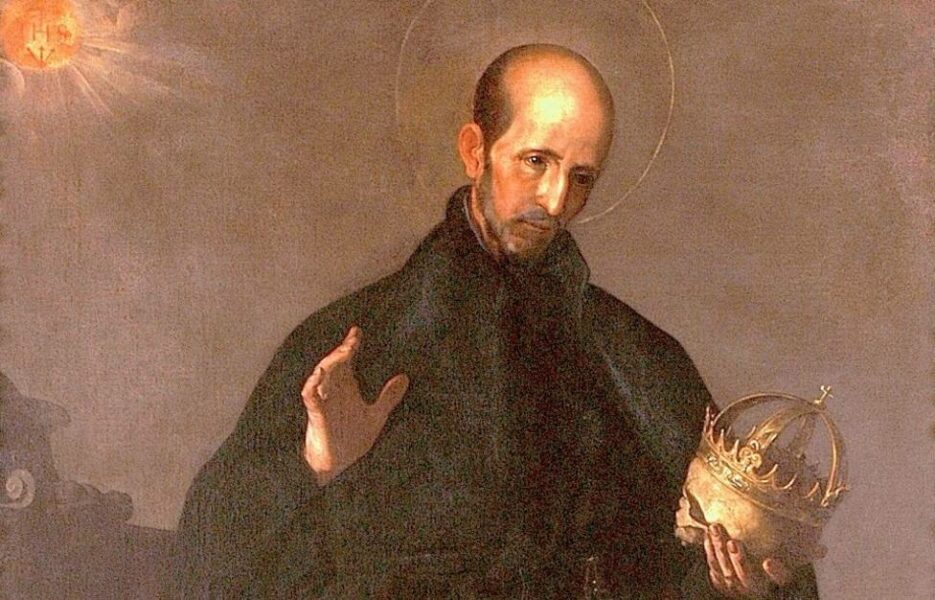
On October 10, the date on which the traditional Roman calendar commemorates Saint Francis Borgia, the Church contemplates the life of a man who knew from within the power, wealth, and honors of imperial Europe before renouncing them to follow Christ in the Society of Jesus. Duke of Gandía, viceroy of Catalonia, and trusted confidant of Charles V, he ultimately became a priest and the third superior general of the Jesuits. His trajectory stands as one of the most eloquent testimonies of the sixteenth century on the fragility of human glory and the value of eternal goods.
Francis was born in 1510 into one of Spain’s most powerful families. Through his lineage he was related to Pope Alexander VI and to Ferdinand the Catholic, and from a very young age he received an education intended to prepare him for court life. His marriage to Leonor de Castro, lady-in-waiting to Empress Isabel of Portugal, consolidated his position in the circle of Charles V. Everything seemed to indicate that his future would be tied to affairs of state and the administration of the imperial domains.
The death of an empress and the fragility of glory
An episode that occurred in 1539 has remained especially linked to the memory of Saint Francis Borgia. After the death of Empress Isabel, the nobleman took part in the transfer of her remains to Granada. Biographical tradition recalls the profound impression it made on him to witness the corruption of a body that shortly before had been admired for its beauty and dignity.
That encounter with the reality of death contributed to an interior transformation that had been maturing in his soul. Francis began to understand more clearly the distance between the honors the world can bestow and the eternity for which man has been created. The celebrated resolution traditionally attributed to him—not to serve any longer a lord who could die—summarizes the spiritual meaning of that experience, though it should be understood as an expression of his conversion rather than a documentary transcription of his words.
His life did not change immediately. He continued to fulfill important public responsibilities and was appointed viceroy of Catalonia, where he carried out tasks of government and administration. In 1543 he inherited the dukedom of Gandía. Yet amid those obligations his dedication to prayer, penance, and works of charity continued to grow.
From the imperial court to the Society of Jesus
The death of his wife in 1546 opened a new chapter. Francis had eight children and had to attend to the family obligations proper to his state, but he had matured in his decision to dedicate the rest of his life to God. After making the necessary arrangements for his children and settling the affairs of his household, he entered the Society of Jesus, founded only a few years earlier by Saint Ignatius of Loyola.
The contrast between his former position and his new religious life was extraordinary. The man who had been treated as one of the great lords of Spain now accepted the obedience proper to a religious and prepared to exercise the priesthood. His renunciation did not spring from contempt for the responsibilities he had held, but from the conviction that God was calling him to a more complete self-giving.
The biography published by the Society of Jesus recalls that Borgia had personally known some of the first Jesuits and that his administrative experience later proved very valuable to the young order. Saint Ignatius appointed him commissary general for Spain and Portugal in 1554, entrusting him with responsibilities that contributed to the growth of the Society.
A duke turned superior general
In 1565, Francis Borgia was elected third superior general of the Jesuits, after Saint Ignatius of Loyola and Diego Laínez. During the following seven years he led an order that was in full expansion and that would play a decisive role in the Catholic renewal following the Council of Trent.
His governance favored the consolidation of religious formation, the internal organization of the Society, and the development of its colleges and missions. The knowledge he had acquired at court and in civil administration was placed at the service of a task very different from the one for which he had been prepared in his youth.
The life of Borgia shows that holiness does not necessarily require having always lived far from temporal affairs. For years he was a husband, father, ruler, and nobleman, and in those circumstances he began to respond to God’s grace. His later entry into religious life was the culmination of a conversion that had been transforming his priorities.
In 1571, Saint Pius V entrusted him with a diplomatic mission related to efforts to unite the Christian powers against the Ottoman threat. His health deteriorated during that journey, and he died in Rome on September 30, 1572. He was canonized by Clement X in 1670.
The glory that does not pass
The Church preserves in Saint Francis Borgia the example of a man who learned to judge the goods of this world in the light of eternity. He had known the prestige of a great family, the favor of the emperor, and the responsibilities of government, but he understood that none of those realities could constitute the ultimate end of his existence.
Catholic spiritual tradition has always insisted that the problem does not lie in the legitimate possession of goods or in the exercise of authority, but in making them the object on which the heart depends. Honors, wealth, and power can be placed at the service of the good, but they cannot overcome death or grant eternal life by themselves.
Saint Francis Borgia arrived at this conviction through a particularly intense experience of human transience. His response was to seek Christ with greater radicality, first in his duties as husband and ruler, and later in religious and priestly life.
His memory continues to remind Catholics of a truth that runs through all Christian spirituality: the glory of the world passes, while the life given to God finds in Him a good that cannot be lost.